Ditch the Cables: A chest and bicep workout for beginners
I spent my first three years of lifting chasing a 'pump' that disappeared the second I stepped into the locker room. I’d stand in line for the cable crossover machine at a big-box gym, paying $60 a month just to do flyes that felt like they were doing more for my ego than my actual muscle fibers. If you are tired of the gym crowd and the over-complicated routines you see on TikTok, I have good news: you can build a massive upper body in your garage with a single pair of dumbbells. This chest and bicep workout for beginners is designed to cut through the noise and focus on the heavy basics that actually build foundational size.
Quick Takeaways
- Focus on mechanical tension over chasing a temporary muscle pump.
- The floor press is a safer, more effective alternative to the bench press for beginners.
- Pairing chest (pushing) with biceps (pulling) keeps your muscles fresh for every set.
- Progressive overload is the only way to ensure long-term growth.
Why Beginners Ruin Their First Upper Body Days
Most new lifters fall into the 'variety trap.' They think that because a pro bodybuilder does six different types of chest flyes, they should too. The reality? Those pros have a decade of foundational strength that you don't have yet. When you're starting out, your nervous system and your muscle fibers need heavy, basic movements to grow. If you spend your time on endless cable crossovers or concentration curls with 5-pound weights, you’re missing the boat on actual hypertrophy. You need to focus on movements that allow you to move the most weight through a safe range of motion.
I see it all the time in home gyms—guys buying every attachment under the sun before they can even do twenty perfect push-ups. Chasing a pump feels good, but it's often a distraction from the hard work of building real strength. You should be looking for an effective chest workout guide for strength that prioritizes the 'big' lifts. If you aren't adding weight or reps to your lifts every two weeks, you aren't training; you're just exercising. There is a massive difference between the two.
The Anatomy of a Good beginner workout for arms and chest
Why are we pairing chest and biceps? In the world of old-school bodybuilding, this is a classic 'non-competing' split. When you perform a chest exercise, like a press or a push-up, you are using your pectorals, your anterior deltoids (front shoulders), and your triceps. Your biceps are essentially resting during these movements. By the time you finish your chest work and move to your biceps, those muscles are completely fresh and ready to handle maximum intensity.
This synergy is the secret to a great beginner workout for arms and chest. If you paired chest with triceps, your triceps would be so fatigued from the pressing that you wouldn't be able to use enough weight to actually grow them. By separating the 'push' of the chest from the 'pull' of the biceps, you maximize your output on both. It’s an efficient way to train that doesn’t leave you feeling like your joints are made of glass by the end of the session. You get to hit the big muscles hard, then move to the smaller 'mirror muscles' with full energy.
The Routine: A No-BS chest and arm workout for beginners
This routine is simple, but don't mistake 'simple' for 'easy.' We are going to focus on three primary movements. You’ll perform 3 sets of each, aiming for a rep range of 8 to 12. If you can do more than 12 reps with perfect form, the weight is too light. If you can’t hit 8, it’s too heavy. Rest for 90 to 120 seconds between sets—this isn't a cardio class; you need your strength back before the next set. Also, I should mention that this isn't just for the guys; I highly recommend a real arm and chest workout for women who want to build upper body stability and tone without needing a rack full of machines.
Movement 1: The Dumbbell Floor Press
The standard bench press is great, but for a beginner training at home, it can be a shoulder-wrecker. The floor press is my favorite alternative. By lying flat on the floor, the ground acts as a physical stop for your elbows. This prevents you from overstretching your rotator cuff at the bottom of the movement, which is where most bench press injuries happen. It forces you to use your chest and triceps to 'explode' the weight up from a dead stop.
To do this right, tuck your shoulder blades together and keep your feet flat on the floor. Lower the dumbbells until your upper arms gently touch the ground, pause for a split second to kill the momentum, and then drive them back up. Because you don't have the 'bounce' of a bench, your chest has to do all the work. It’s a pure strength builder that builds a thick mid-chest without the risk of a 200-lb bar pinning you to a bench in an empty garage.
Movement 2: The Classic Deficit Push-Up
Standard push-ups are fine, but we want more. By using your dumbbells as handles, you can lower your chest past the level of your hands. This 'deficit' creates a massive stretch in the pectorals, mimicking the effect of a cable flye or a chest press machine but using your own body weight. It’s one of the most underrated movements for building that 'shelf' look on the upper chest.
Keep your core tight—don't let your hips sag toward the floor. If you can easily knock out 15 of these, slow down the tempo. Take three seconds to lower yourself and one second to explode up. That increased time under tension will do more for your muscle growth than doing 50 sloppy reps. This is the ultimate 'no-equipment' chest builder that scales with you as you get stronger.
Movement 3: Heavy Alternating Hammer Curls
If you want arms that actually look big in a t-shirt, you need to focus on the brachialis and the forearm, not just the 'peak' of the bicep. Hammer curls, where your palms face each other in a neutral grip, are the fastest way to get there. This grip allows you to lift significantly heavier than a standard palm-up curl, which translates to more mechanical tension and more growth.
Keep your elbows pinned to your ribs. Do not swing the weights. If you have to lean back to get the weight up, you’re using your lower back, not your arms. I like to do these alternating—left arm, then right arm—to ensure I'm not using momentum to cheat the reps. This movement builds the thickness that makes your arms look wide from the front, filling out that space between your elbow and shoulder.
How to Set Up Your Space Without a Fancy Gym
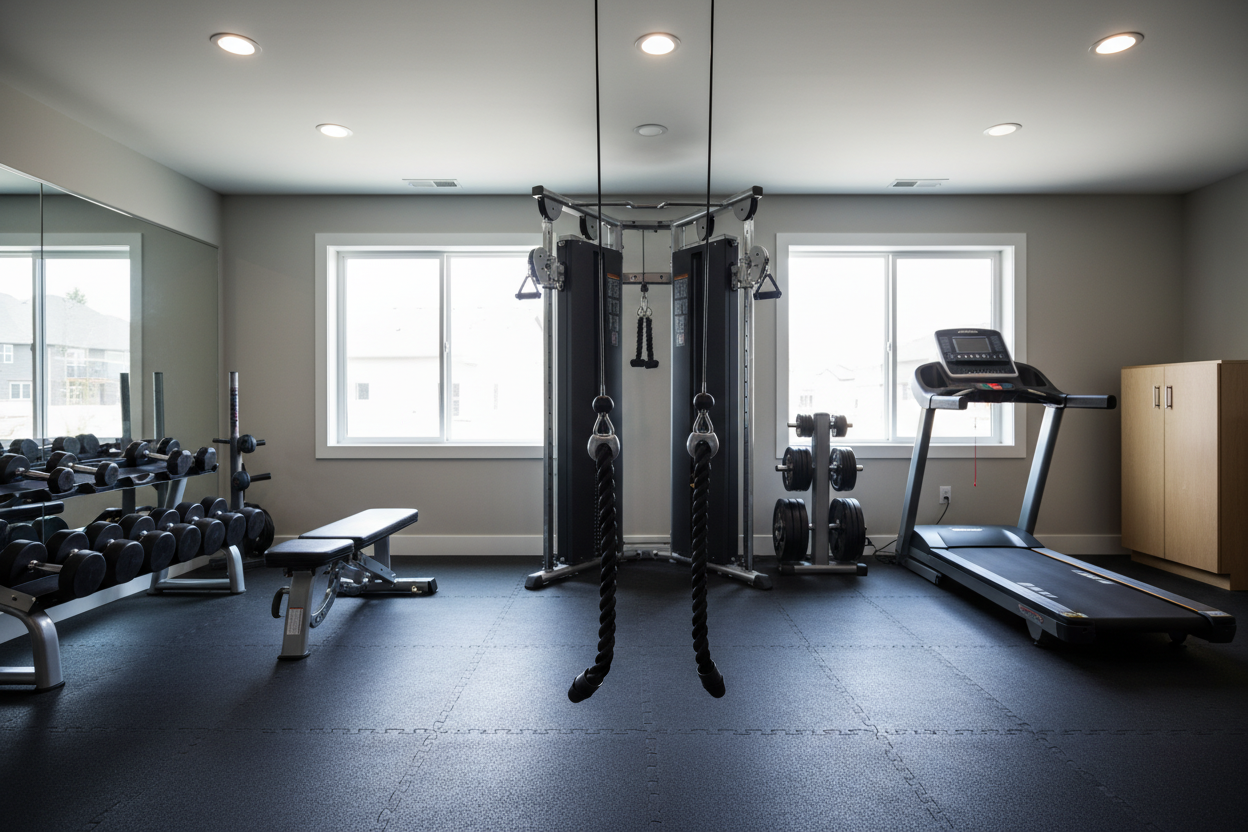
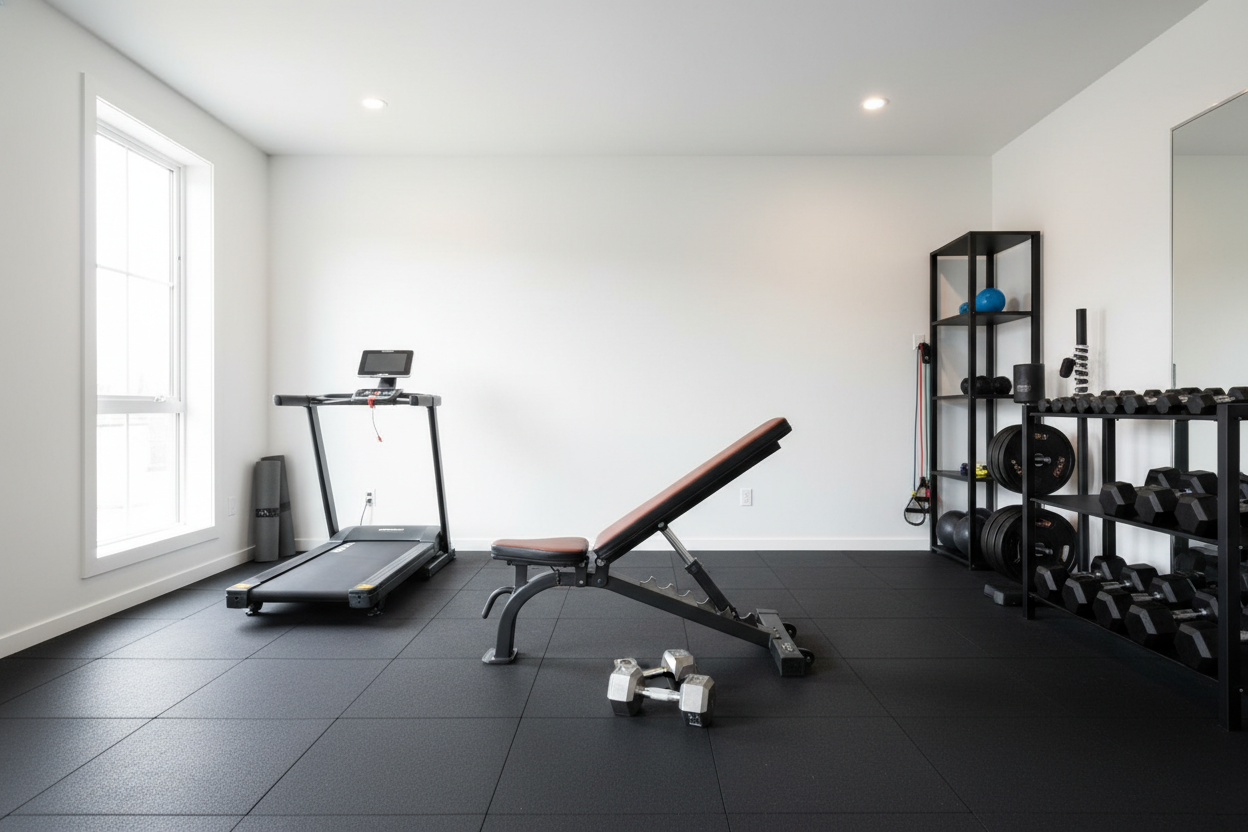
You don't need a 2,000-square-foot facility to get this done. I’ve done this exact routine in a cramped studio apartment and a cold garage. The most important thing is a solid foundation. If you’re pressing heavy dumbbells on a slick hardwood floor or a thin carpet, you’re asking for an injury. Your feet need to be planted firmly to generate power. I always recommend getting some decent gym flooring for home workout setups. It protects your floors from dropped weights and gives you the grip you need for those deficit push-ups.
Space-wise, if you have a 6x8 foot area, you have more than enough room. Keep your weights organized and off the floor when you're not using them. A cluttered gym is a dangerous gym. I’ve tripped over a stray 25-lb plate more times than I care to admit, and it’s a quick way to end a workout session early. Treat your home space like a professional weight room, and your brain will treat the workout with more respect.
The Golden Rule: What to Do Next Week
The biggest mistake beginners make is doing the exact same workout for six months. Your body is an adaptation machine. If you lift 20-lb dumbbells for 10 reps this week, and you do the same thing next week, your body has no reason to grow. You have to force it. This is called progressive overload. Next week, try to do 11 reps. The week after, try for 12. Once you hit 12 reps on all three sets, it is time to move up to the 25-lb dumbbells.
Keep a simple logbook or a note on your phone. Write down your weights and your reps. It sounds tedious, but it is the only way to guarantee results. Once you’ve mastered this basic routine and can no longer add weight easily, you can head over to our workout hub to find more advanced splits. But for now, stay the course. Consistency beats intensity every single time.
Personal Experience: The Volume Mistake
When I first started training in my garage, I thought more was better. I would do five different chest exercises and four different bicep curls every single day. I was sore, I was tired, and my lifts weren't going up. It took me a year to realize that I was just overtraining. I stripped my routine down to just three movements—the ones listed above—and my strength exploded. I went from struggling with 30-lb dumbbells to pressing 80s in a matter of months. Trust the process and don't feel the need to add 'just one more' exercise.
FAQ
Do I need a bench for the floor press?
No. The floor press is specifically designed to be done on the ground. It actually has a shorter range of motion than a bench press, which protects your shoulders while still hammering your chest and triceps.
How many times a week should I do this?
Twice a week is plenty for a beginner. Your muscles need time to repair the micro-tears you create during lifting. Give yourself at least 48 hours of rest between sessions.
Can I substitute push-ups for the floor press?
You can, but they hit the muscles differently. The floor press allows for easier progressive overload because you can just grab a heavier weight, whereas push-ups require you to change the angle or add a vest to increase difficulty.