Cardio Before or After Leg Day: Best Order to Train
Deciding whether to perform cardio before or after leg day is one of the most common dilemmas in strength training. Scheduling aerobic exercise around a demanding lower body session influences your lifting technique, energy reserves, and long-term progress. If your primary aim is building lower body strength or muscle hypertrophy, the sequence you select determines how much effort you can direct into heavy squats, lunges, and hinges.
Both cardio and resistance training place substantial demands on the body. Understanding how your training priority dictates session sequence helps you organize your week effectively, avoid unnecessary movement breakdown, and get the most value from your workouts. You can also explore our workout resource for broader programming ideas across different fitness goals.
Cardio Before or After Leg Day: Quick Answer
For most lifters whose main objective is building muscle, developing raw strength, or lifting heavier loads, strength training should come first. Performing heavy compound lifts before aerobic work ensures your leg muscles, stabilizer tissues, and nervous system remain fresh for demanding multi-joint movements.
Conversely, if your primary goal is cardiovascular endurance—such as preparing for a marathon, a cycling race, or a triathlon—performing your aerobic conditioning first makes sense. In that scenario, aerobic performance takes precedence, and weight training acts as secondary assistance. If your primary focus is general health or fat loss goals, both arrangements can function, though lifting first generally promotes better mechanical control under heavy resistance.
Why Cardio Before Leg Day Can Limit Strength
Embarking on a moderate to intense cardio session immediately before hitting heavy weights can interfere with lower body performance. Aerobic exercise taps into muscular glycogen stores and induces systemic fatigue before you touch a barbell or dumbbell.
- Reduced Power and Force Production: Pre-fatigued quadriceps, hamstrings, and glutes cannot produce maximum voluntary force during heavy squats or deadlifts.
- Decreased Core and Stabilizer Readiness: Prolonged running or cycling challenges trunk and hip stabilizers, leaving them fatigued when you need them to keep the spine rigid under load.
- Compromised Movement Quality: When lower body muscles are tired prior to compound lifts, movement form can degrade, increasing the likelihood of poor bar paths or awkward joint loading.
- Central Nervous System Drain: Sustained moderate-to-high intensity aerobic work dampens motor unit recruitment, making weights feel heavier than normal.
For these reasons, placing intense cardio before leg day frequently leads to sub-optimal training volume and diminished progressive overload on lower body lifts.
When Cardio Before Leg Day Makes Practical Sense
While an intense aerobic session right before lifting is generally counterproductive for strength, light aerobic exercise prior to training serves a genuine purpose when kept brief.
A short warm-up routine lasting five to ten minutes at an easy pace—such as light walking, slow cycling on a stationary bike, or easy rowing—elevates body temperature, circulates synovial fluid within hip and knee joints, and prepares the muscular system for lifting. In this context, short cardio before leg day acts purely as physical preparation rather than a fatiguing workout.
Additionally, dedicated endurance athletes whose primary sport revolves around running, rowing, or cycling should place their endurance work first. When aerobic capacity is the headline metric, lifting takes the secondary slot to support joint resilience and bone density without detracting from key cardiovascular splits.
Benefits of Doing Cardio After Leg Workouts
Transitioning to cardio after a leg workout allows you to pour your peak physical and mental energy into demanding multi-joint lifts. Once your primary strength sets are complete, using the remaining portion of your training window for aerobic work offers several distinct advantages:
- Maximized Lifting Performance: You approach heavy squats, hip thrusts, and leg presses with full glycogen reserves and complete neurological alertness.
- Effective Caloric Expenditure: Performing cardio after resistance training allows you to accumulate cardiovascular conditioning without sacrificing mechanical tension during lifting.
- Targeted Energy Allocation: Your muscles undergo the exact mechanical overload required for hypertrophy before aerobic fatigue enters the equation.
Lifters often find that choosing the right post-lift activity prevents excessive joint stress. If you want a deeper look at managing running volume around lifting days, consult our guide on cardio after leg day to balance road mileage with muscle retention.
Best Cardio Choices to Pair with Lower Body Training
When you complete a rigorous leg workout, your leg muscles are already fatigued. Pairing this state with high-impact activities like sprint intervals or outdoor road running can create excessive joint stress. Selecting gentle, lower-impact cardio formats keeps aerobic volume productive:
- Incline Walking: Walking on an incline treadmill raises heart rate and activates the posterior chain without high-impact heel strikes.
- Stationary Bike: Moderate pedaling on an upright or recumbent bike provides smooth resistance that flushes leg muscles without jarring joints.
- Rowing Machine: A steady rowing pace distributes work evenly across the back, core, and legs rather than isolating tired quadriceps.
- Elliptical Trainer: The continuous glide pattern of an elliptical provides full-body cardiovascular engagement with minimal foot strike impact.
Balancing these modalities across the training week helps keep your schedule sustainable. For more ideas on how to sequence lower body sessions alongside upper body work, our weekly workout split guide breaks down common split templates.
Home Gym Floor Setup for Safe Lifting and Cardio Transitions
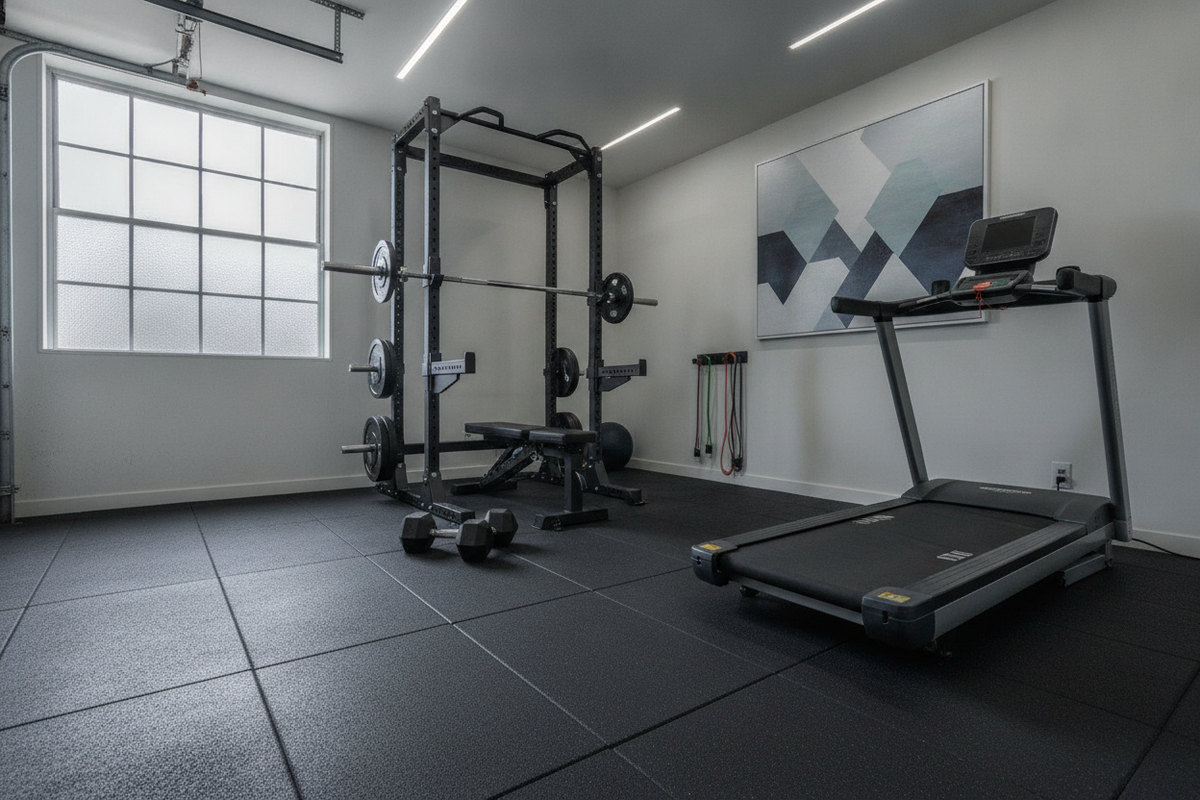
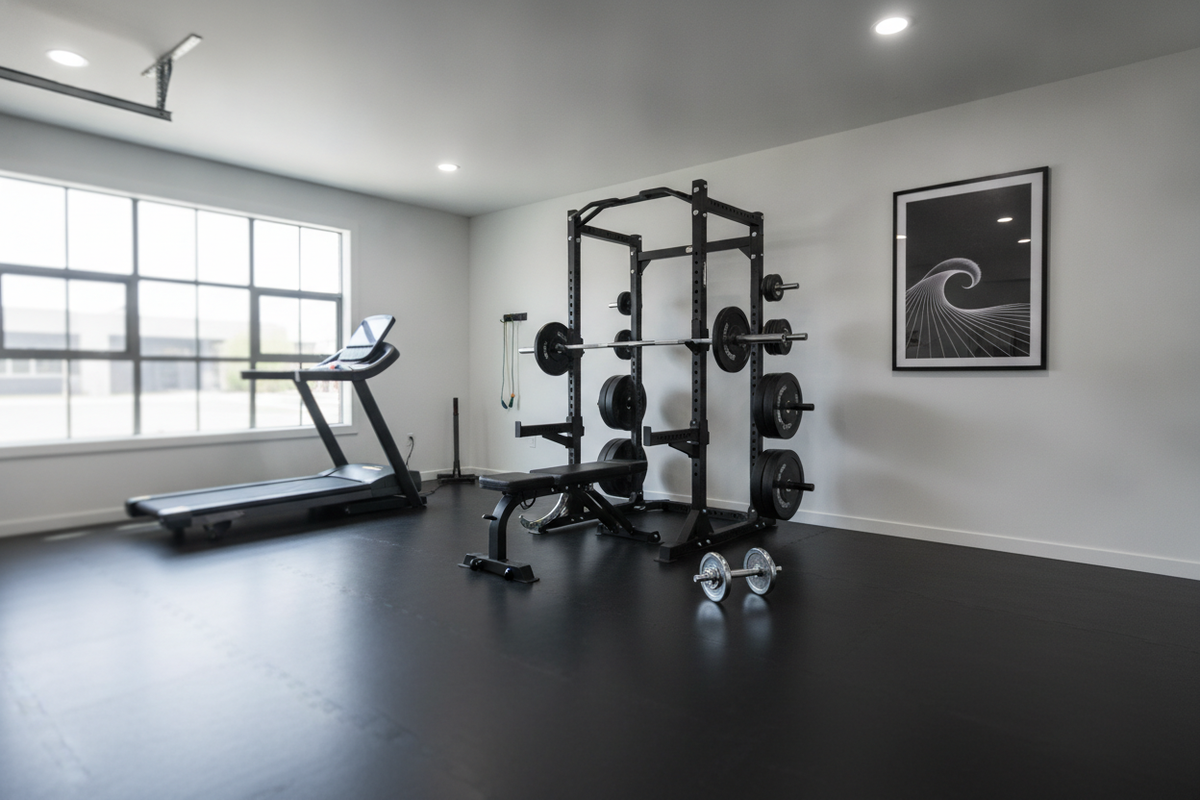
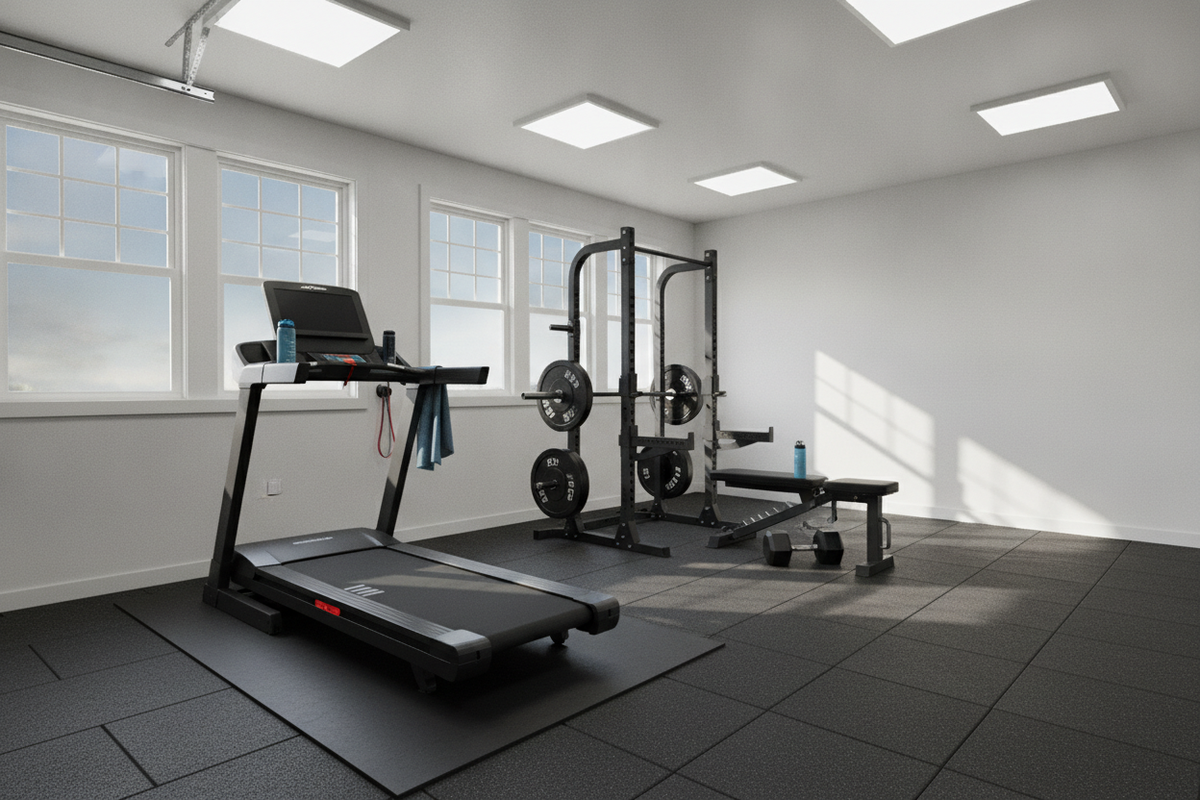
Executing both strength movements and conditioning inside a home gym requires deliberate attention to your training surface. Lower body compound exercises demand a stable, non-compressible foundation, whereas aerobic intervals or jumping rope benefit from traction and shock dispersion.
Placing heavy racks and weight plates directly on bare concrete or thin residential flooring can damage subfloors and compromise footing. Laying down a dedicated high-density surface, like a large 6x10ft exercise mat, establishes a clean, unified workout area. A firm gym mat provides:
- Firm Footing for Compound Movements: Heavy squats and deadlifts require complete ground contact without sinking, shifting, or squishing beneath the soles of your lifting shoes.
- Slip Resistance During Sweaty Conditioning: As you transition from the barbell to bodyweight circuits, kettlebell swings, or jump rope work, a textured surface maintains traction.
- Floor and Equipment Protection: Dropping dumbbells or setting down heavy kettlebells onto an unpadded hard surface can fracture tiles, dent wood, or damage weights.
- Noise and Vibration Dampening: High-density mats absorb acoustic impact, keeping training sessions quiet for the rest of your household.
Frequently Asked Questions About Leg Day and Cardio Timing
Should I do cardio before or after leg day for muscle growth?
For muscle growth, lift first and perform cardio after your session, or separate the two modalities onto different days. Lifting while fresh ensures you achieve high levels of mechanical tension and complete your planned training volume, which are central drivers for muscle hypertrophy.
Can doing cardio before leg day cause poor form?
Yes. Prolonged or intense cardio depletes muscular energy and tires stabilizer muscles in the hips, core, and lower back. When these muscles are exhausted prior to squats or deadlifts, maintaining an upright torso, neutral spine, and stable knee alignment becomes significantly harder.
Is low-impact cardio okay immediately after a leg workout?
Yes. Easy to moderate low-impact cardio, such as incline walking or steady stationary cycling, works well right after lifting. It allows you to build conditioning and burn energy without subjecting fatigued legs to repetitive joint impacts.
How long should I wait between leg day and intense cardio sessions?
If you prefer dedicated, high-intensity cardio sessions like sprint intervals, separating your leg workout and cardio by at least six to eight hours—or placing them on alternate days—allows your nervous system and muscles time to partially recover.
Does walking after leg day help with muscle soreness?
Light walking increases local blood flow and encourages joint mobility without adding structural fatigue. Many lifters find that taking a relaxed walk either immediately following their workout or on recovery days helps their legs feel less stiff.