Can You Replicate Commercial Machines for Working Out at Home?
We have all been there. You are standing in a crowded commercial club, waiting for the one decent functional trainer while some guy scrolls his phone. You start dreaming of a home setup, but you worry you will miss those heavy-duty machines for working out that make isolation training so effective. There is a specific locked-in feeling you get from a 5,000 dollar selectorized leg extension that a pair of dumbbells just cannot mimic.
I have spent the last decade building and tearing down garage gyms. I have realized that while you might not have room for twenty different exercises machines, you can replicate about 90 percent of that stimulus if you understand how resistance profiles actually work. You do not need a 10,000-square-foot facility to get the benefits of high-end weights machines in the gym.
- Commercial machines use cams and pulleys to manipulate the weight’s difficulty throughout the rep.
- You can mimic these profiles using resistance bands and specific angles with basic equipment.
- Lower body machines like the leg press are the hardest to replicate but can be faked with landmines and wedges.
- Quality flooring is non-negotiable when you start rigging heavy pulley systems.
The Magic of the Commercial Gym Floor (And Why We Miss It)
The allure of the fitness machine gym is stability. When you sit in a high-end chest press, the machine handles the stabilization for you. This allows your nervous system to focus entirely on driving force through the pectorals. At home, we often rely on free weights, which are great, but they require a lot of 'noise' from stabilizer muscles that can actually limit how much you can punish a specific muscle group.
I remember the first time I tried to move my entire leg day to a garage. Without the weight machines at gym facilities, my quads felt under-stimulated because my lower back gave out on squats long before my legs were finished. That is the gap we are trying to bridge. We want that surgical precision of a workout machine gym without the massive footprint or the monthly membership fee.
Cables, Cams, and Resistance Curves Explained Simply
Why does a bicep curl on a machine feel smooth while a dumbbell curl feels easy at the bottom and impossible in the middle? It comes down to the cam—that kidney-shaped wheel you see on expensive gym machinery equipment. The cam changes the leverage as you move, making the resistance heavier where you are strongest and lighter where you are weakest. It creates a 'flat' resistance curve that keeps tension on the muscle the whole time.
When you transition to free weight exercise equipment, you lose that mechanical advantage. Gravity only pulls straight down. To fight this at home, I use variable resistance. By hitching a light monster band to a barbell or a plate-loaded machine, you can mimic that cam-like feel. As the band stretches, the weight gets heavier, matching your muscle’s natural strength curve. It is a cheap way to make basic equipment in gym settings feel like a six-figure circuit.
Faking the Leg Press and Hack Squat Without a 1,000-Pound Sled
The leg press is the elephant in the room. Most of us do not have the space for a 45-degree sled that weighs half a ton. But you can get damn close with a landmine attachment and a squat wedge. By positioning the barbell in a landmine and leaning back into it, you create an arc that mimics the movement of a hack squat machine. It targets the quads with almost zero spinal loading.
Another trick for replicating weight lifting machines at the gym is the belt squat. If you have two sturdy boxes or a rack-mounted lever arm, you can hang the weight from a belt between your legs. This provides the pure lower-body isolation of a leg press while keeping you upright. I have found that using a 20-degree wedge block under my heels during these movements makes them feel even more like the specialized exercise equipment in a gym.
Replicating the Smooth Pull of Commercial Back Gear
Most home gym lat pulldowns feel like trash—they are jerky, the cables stretch, and the 1:1 ratio makes the weight jump. To get the feel of the most popular gym machines for lats, you need to look at your pulley's mechanical advantage. A 2:1 ratio (where 100 lbs feels like 50 lbs) usually provides a much smoother travel than a direct 1:1 pull. This is why the workout equipment in gym settings feels so buttery.
I recommend adding a high-quality swivel pulley to your power rack. If you use a coated aircraft cable and lubricate the guide rods with silicone spray, you can transform a cheap plate-loaded tower into something that feels like a selectorized fitness center machine. Do not settle for the thin, nylon pulleys that come with budget racks; swap them for aluminum wheels with sealed bearings. Your lats will thank you.
When Faking It Fails: Buying Dedicated Equipment
There comes a point where DIY rigging becomes a safety hazard or just plain annoying. If you are a competitive bodybuilder or someone who moving serious weight, you might need to stop 'faking' and start investing. You do not need twenty machines, but one or two multi-functional pieces can change everything. I usually point people toward a high-quality functional trainer or a plate-loaded leg extension/curl combo.
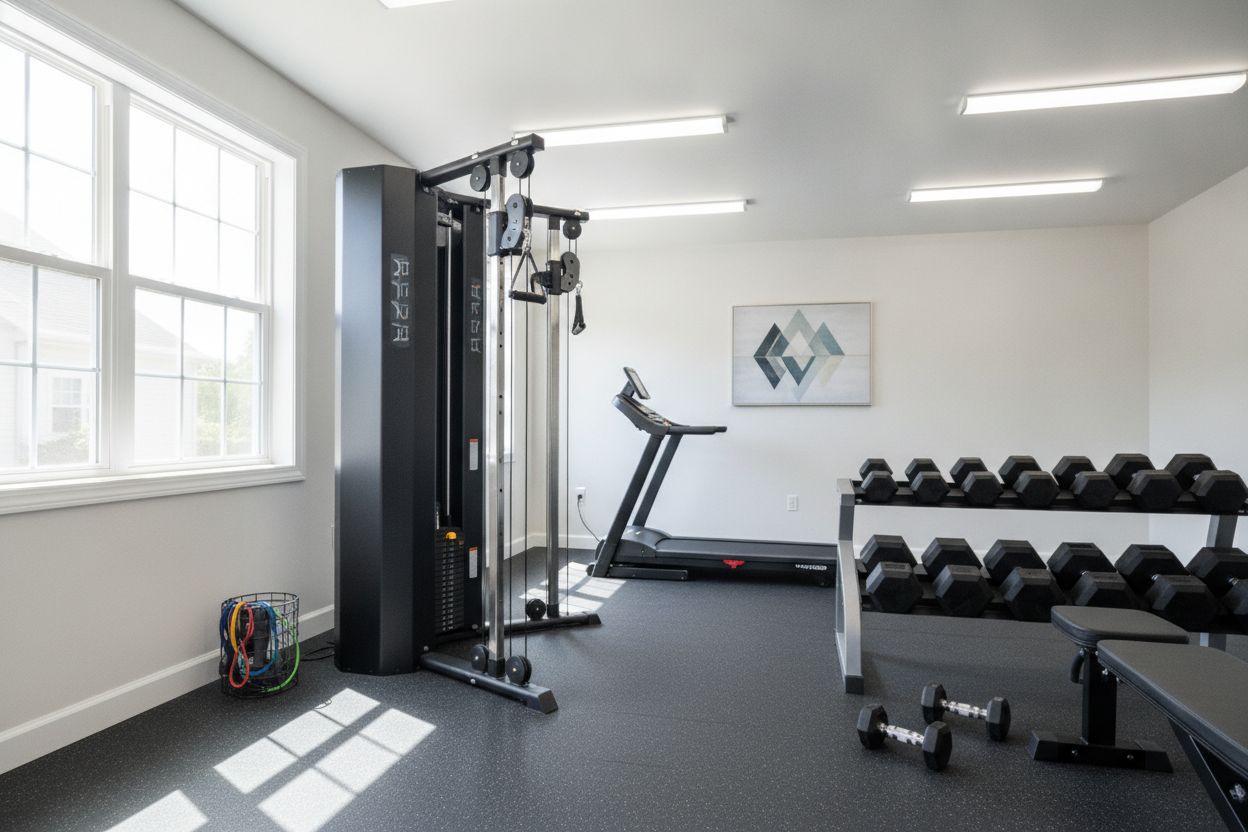
When shopping for the best weight training machines for every home gym, look for footprint-to-utility ratios. A selectorized functional trainer takes up about 15 square feet but replaces almost every cable machine for working out. It is better to have one piece of commercial-grade equipment than five pieces of 'prosumer' junk that shake when you load more than two plates.
Don't Wreck Your Foundation While Rigging Up Solutions
One thing people forget when they start dragging landmines across the floor or dropping heavy pulley stacks is their subfloor. Residential concrete is not meant to take the concentrated abuse of gym workout machines. If you are rigging up a heavy landmine or a belt squat station, you are putting a lot of shear force on one specific spot.
I highly recommend laying down a heavy-duty 6x8ft exercise mat or building a dedicated lifting platform. I once gouged a two-inch crater in my garage floor because I thought a standard horse stall mat was enough for my improvised hack squat. It wasn't. Protect your foundation before you start trying to turn your garage into a fitness centre.
Personal Experience: The Pulley Disaster
I once tried to save 300 dollars by building my own lat pulldown using hardware store pulleys and a clothesline. It worked for about a week. Then, during a heavy set of face pulls, the plastic pulley sheared off the bolt and the weight stack went crashing into my shins while the handle whipped back and nearly took out my overhead lights. I learned the hard way that when it comes to gym machinery equipment, you pay for the engineering. Now, I only use rated climbing pulleys and steel cables. Don't be cheap with things that hang heavy metal over your head.
FAQ
Are home gym machines as good as commercial ones?
Generally, no, because commercial gear is built for 24/7 abuse and has heavier stacks. However, high-end home brands now offer 'light commercial' specs that are indistinguishable in feel if you maintain the guide rods properly.
Can I build muscle using only machines?
Absolutely. Your muscles don't know if you're holding a piece of iron or pushing a lever. As long as you are applying progressive overload and hitting a full range of motion, machines are incredibly effective for hypertrophy.
What is the most versatile machine for a home gym?
A functional trainer (dual cable column) is the gold standard. It allows you to replicate almost every upper body machine and several lower body movements in a relatively small space.