Can You Actually Buy Exercise Machines Cheap That Don't Suck?
I remember the first time I bought a 'complete home gym' from a big-box retailer. It was a $299 special with a plastic-coated weight stack and cables that felt like they were rubbing against sandpaper. Three months later, the frame creaked louder than my knees, and the 'lat pulldown' felt more like a game of Jenga. If you are hunting for exercise machines cheap, you have to realize that most retail stuff is designed to be a clothes hanger by February.
- Commercial-grade used gear beats brand-new retail junk every time.
- Plate-loaded machines are safer budget bets than motorized ones.
- If the frame is made of 2x2 14-gauge steel, walk away.
- Marketplace alerts are your best friend for scoring liquidations.
Stop Buying Flimsy Big-Box Retail Junk
Most people looking for exercise equipment make the mistake of prioritizing convenience. They see the range exercise equipment at a local department store and think a $150 'multi-gym' will solve their problems. It won't. These machines have terrible biomechanics. The pivot points are often off-center, meaning the resistance curve feels wonky and puts unnecessary stress on your joints.
I’ve seen frames literally warp during a heavy set of chest presses. When a machine is that light, it lacks the stability to let you actually push to failure without the whole unit wobbling. You aren't just buying a machine; you're buying a potential injury. If it ships in a box that one person can carry, it isn't heavy-duty enough for serious training.
Where Can I Find Exercise Equipment That Actually Lasts?
The secret isn't a secret: buy used commercial gear. When a local gym goes out of business, they don't want to move those 400-lb functional trainers. They want them gone. This is where can i find exercise equipment that actually lasts a lifetime. I’ve scored $3,000 Life Fitness cable towers for $400 just by being the guy with a truck and a wrench set ready to go on a Tuesday morning.
My own journey involved a lot of trial and error, eventually realizing that the best at home exercise equipment isn't always the newest model. Set up Facebook Marketplace alerts for keywords like 'Hammer Strength,' 'Rogue,' or 'Gym Liquidation.' You want gear designed for 12 hours of daily abuse. In a home setting, that stuff will outlive your grandkids.
The 3 Budget Machines Actually Worth Your Money
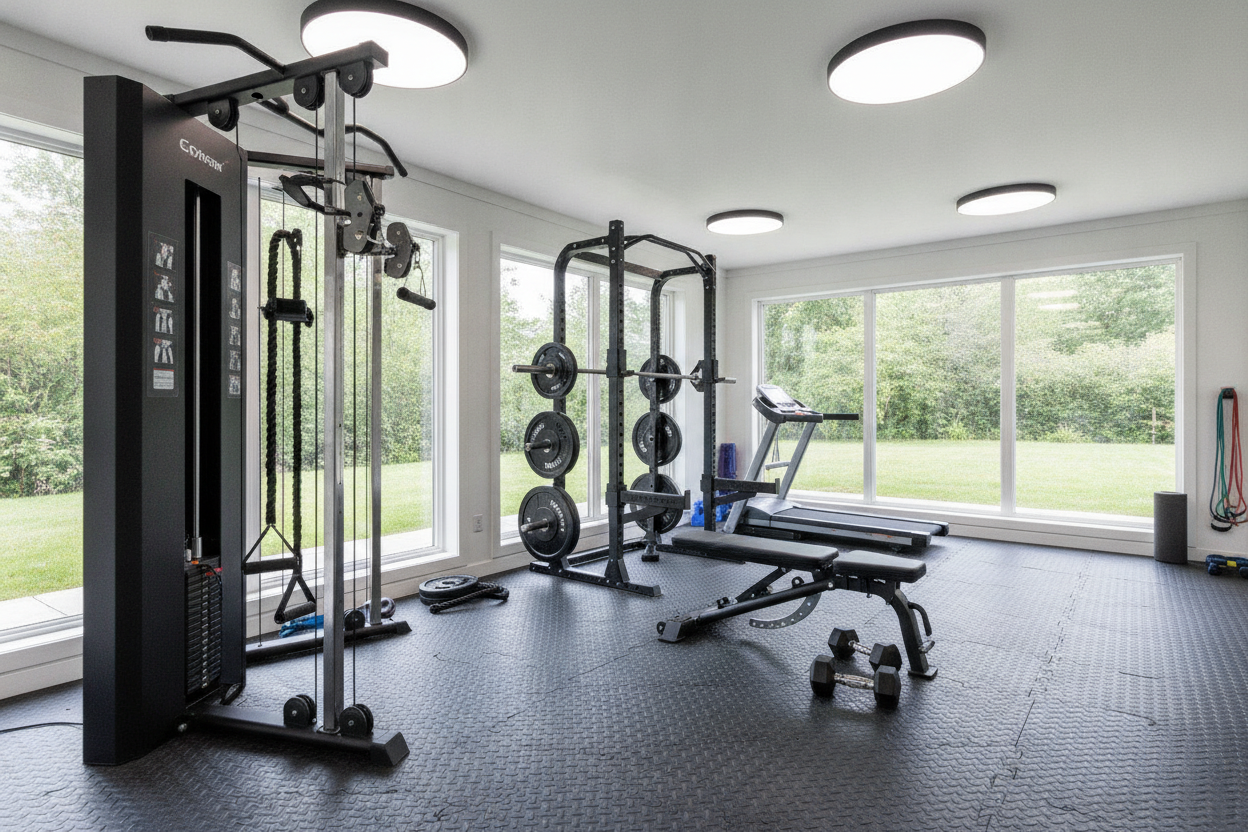
If you must buy new and cheap, stay away from anything with a motor. Instead, look for plate-loaded machines. A plate-loaded lat pulldown is basically just a frame, a cable, and two pulleys. There is very little that can go wrong. I have a generic plate-loaded row machine in my garage that cost me $150. I swapped the cheap pulleys for $20 aluminum ones, and now it feels like a $1,000 unit.
Simple cable crossovers and standalone pull-up towers are also safe bets. Look for units that use standard 2-inch Olympic plates. Avoid anything that uses proprietary weights or 'power rods.' You want a machine that utilizes the plates you already own, keeping your footprint small and your costs down. Just make sure the weight carriage slides on chrome-plated poles, not painted ones, or the friction will ruin your lift.
When to Just Skip the Machine Entirely
Sometimes, the budget version of a machine is so bad it’s worse than doing nothing. A $200 leg press is a prime example. The sled is usually jerky, the range of motion is shallow, and the safety catches are terrifying. In these cases, you are better off sticking to the basics. You can build massive legs with a sturdy pair of adjustable dumbbells and some grit.
If you're tight on space and cash, the best exercise for home without equipment can often yield better hypertrophy than a poorly designed, cheap chest press. Don't buy a machine just to say you have a 'gym.' If the budget doesn't allow for a stable, smooth-moving piece of equipment, invest that money into a high-quality barbell or a heavy kettlebell instead.
How to Inspect Used Gear Before Handing Over Cash
When you show up to a stranger's garage to buy a used piece, don't just look at it. Load it. Put some weight on the carriage and feel the movement. Is it hitching? Is there a grinding sound? Those are signs of worn-out bearings or bent guide rods—repairs that might cost more than the machine is worth.
Check the cables for 'bird-caging' or fraying. If the plastic coating is peeling, that cable is a ticking time bomb. Also, look for structural rust. Surface rust on a frame is just an aesthetic issue you can fix with some steel wool and spray paint. But if the rust is bubbling at the welds or eating through the bottom of the tubing, leave it where it sits. You want steel, not iron oxide.
Can I trust off-brand machines from Amazon?
Only if you check the steel gauge and the user reviews specifically for 'wobble.' Stick to brands that have been around a few years. If the brand name looks like a random string of capital letters, keep scrolling.
What is the best time of year to buy used gear?
Mid-February to March. That is when the 'New Year, New Me' crowd realizes their treadmill is taking up too much space and they want it gone before spring cleaning starts.
Are manual treadmills better for budget gyms?
Yes, because they don't have a motor to burn out. A cheap motorized treadmill is a liability. A manual curved treadmill is expensive, but a basic flat manual one is indestructible and great for sprints.