Can a 1 Month Gym Workout Plan to Gain Muscle Actually Work?
I remember staring at my power rack last January, feeling like I was spinning my wheels. I’d been doing the same 'chest Monday' routine for years, looking exactly the same while my gym membership fees kept climbing. If you’re tired of the plateau and want a 1 month gym workout plan to gain muscle that actually moves the needle, you have to stop training like a fitness model and start training like a mechanic. Real growth in 30 days isn't about finding a 'secret' exercise; it's about aggressive loading and high frequency.
Quick Takeaways
- Focus on four main compound lifts: Squat, Bench, Deadlift, and Overhead Press.
- Hit every muscle group 3 times per week to maximize protein synthesis.
- Eat a minimum of 300-500 calories over your maintenance level.
- Invest in floor protection so you can actually push to failure safely.
The 30-Day Growth Delusion (And The Reality)
Let’s be honest: you aren't going to look like a pro bodybuilder in four weeks. When people start a one month workout plan to gain muscle, they often mistake 'the pump' for actual muscle growth. That initial tightness you feel after a high-rep set of curls is mostly sarcoplasmic hypertrophy—cellular swelling from fluid and glycogen rushing into the muscle. It looks great in the locker room mirror, but it vanishes if you skip the gym for three days.
Actual contractile tissue growth (myofibrillar hypertrophy) is a slower, more stubborn process. In 30 days of perfect training and eating, a natural lifter might gain 1 to 2 pounds of actual muscle fiber. The rest of the scale weight will be water, glycogen, and hopefully a little less fat. However, those two pounds of muscle, when placed correctly on your frame through heavy compounds, change your entire silhouette. Don't chase the scale; chase the weight on the bar.
Why You Need to Shrink Your Exercise Menu
I see guys in my garage trying to do six different types of lateral raises. It’s a waste of time when you only have four weeks to force an adaptation. To make this 1 month gym workout plan to gain muscle work, you need to strip your routine down to the essentials. If an exercise doesn't allow you to add 5 pounds to the bar every week, it shouldn't be your priority right now.
You need to master the 'Big Four': the back squat, the bench press, the deadlift, and the overhead press. These movements recruit the most motor units and trigger the largest hormonal response. If you're unsure about your form—maybe your squat depth is shallow or your deadlift looks like a scared cat—check out a comprehensive workout hub to dial in your technique before you start adding heavy plates. Mastering these four lifts is the fastest way to see a visible change in your traps, quads, and chest within a 30-day window.
Ditch the Bro Splits for High Frequency
The traditional 'Bro Split' where you hit chest on Monday and don't touch it again for a week is a mistake for a short-term mass phase. Muscle protein synthesis (MPS) usually tops out around 36 to 48 hours after a workout. If you only hit your chest once a week, you’re spending five days in a 'neutral' state rather than a 'building' state. By switching to a full-body or upper/lower split, you can trigger MPS three times a week.
Mathematically, hitting a muscle 12 times in a month is vastly superior to hitting it 4 times. If you find that this high-frequency approach is too taxing on your CNS after a few weeks, you might want to look at a 3 week workout plan to gain muscle as a primer to build up your work capacity. For the next 30 days, we are trading variety for volume and frequency.
The Exact 4-Week Heavy Lifting Blueprint
This isn't a suggestion; it's a requirement. You will train four days a week, focusing on a heavy/light rotation to keep your joints from screaming. Week 1 is your baseline. Find a weight where you can perform 3 sets of 8 reps with perfect form, leaving maybe two reps in the tank. You aren't trying to break records on day one.
Week 2 is where the 'overload' starts. Add 5-10 pounds to your compound lifts and 2.5-5 pounds to your accessory lifts (like rows or weighted dips). Week 3 is the 'grind' week. This is where you push for 4 sets of 6 reps at a higher intensity, reaching near-failure on your final set. If you aren't sweating through your shirt and feeling a bit of dread before your top set of squats, you aren't lifting heavy enough.
Week 4 is a 'taper' or deload. You might think skipping this is better for growth, but this is actually when the tissue repairs. Drop the volume by 50% but keep the weight heavy. This allows your nervous system to recover so you can come back even stronger the following month. Without this phase, you'll likely end the month feeling burnt out rather than built up.
Protecting Your Floors (And Your Joints)
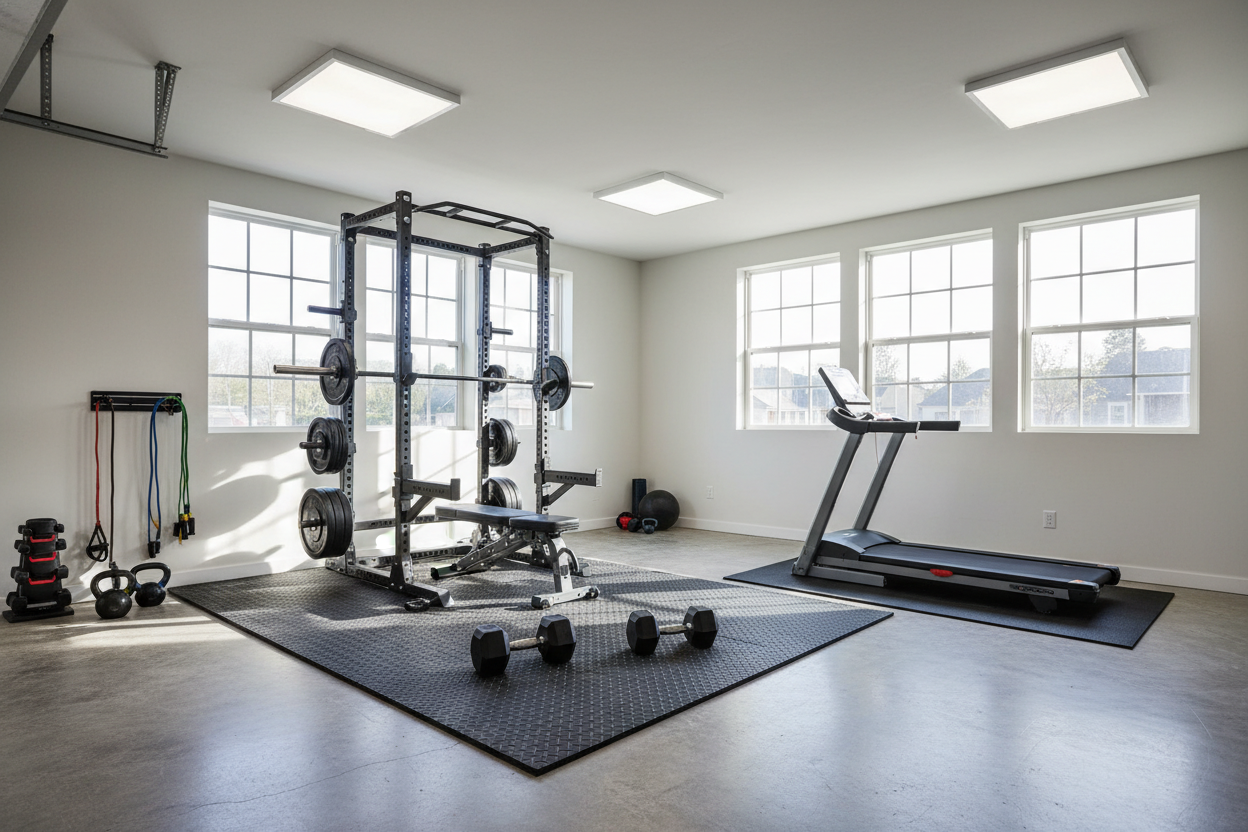
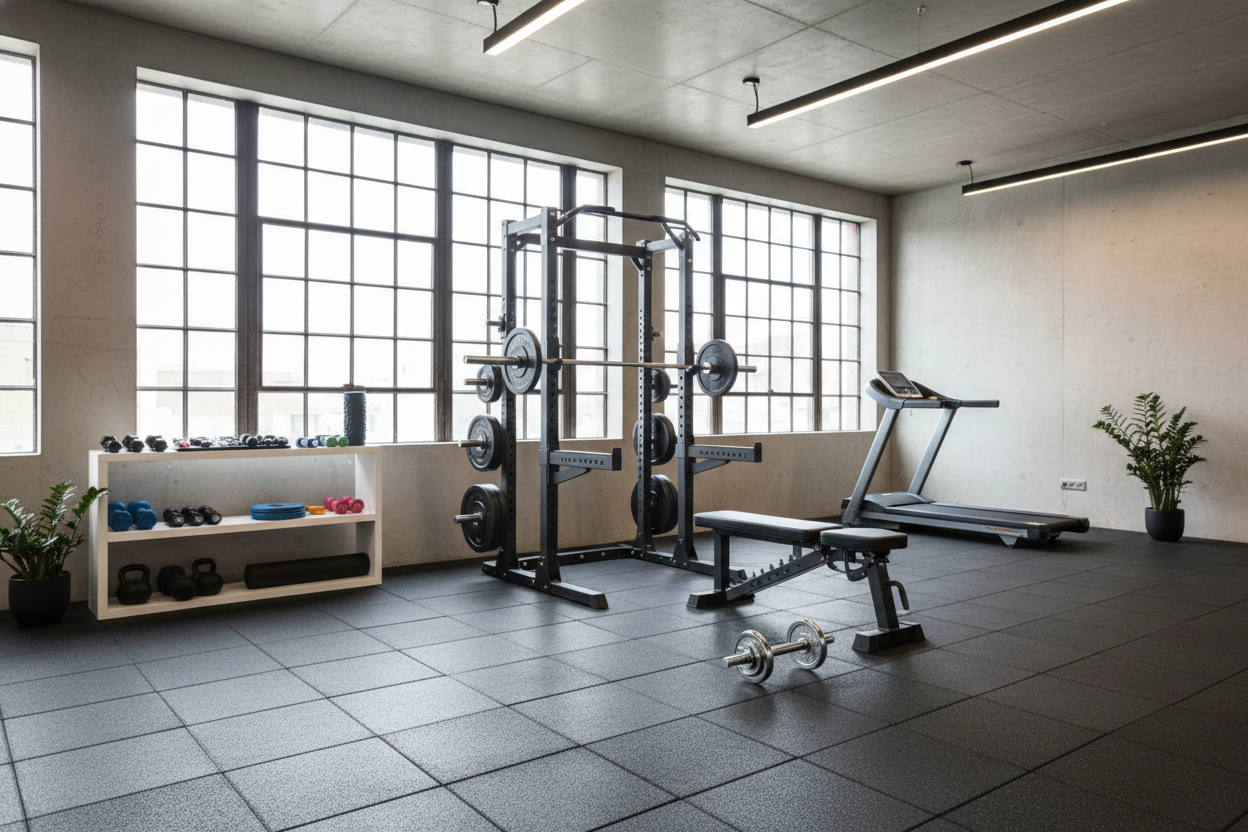
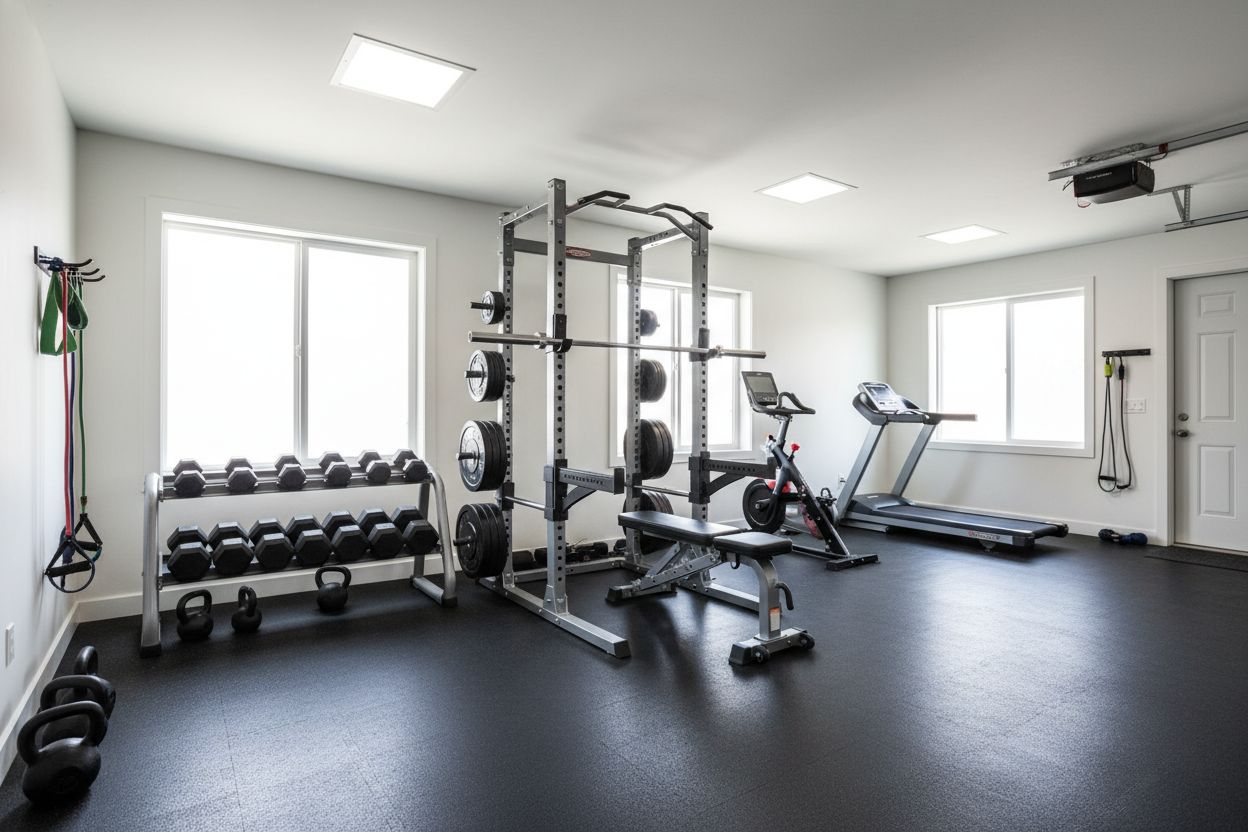
If you're training in a garage or a spare bedroom, you have to be able to drop the weight. You cannot build real mass if you are 'slow-playing' your deadlifts because you're afraid of cracking the concrete. I learned this the hard way when I chipped my foundation using cheap, thin stall mats. Pushing to failure means occasionally needing to bail on a lift or drop a heavy set of dumbbells.
I recommend laying down a 6x8ft exercise mat gym flooring as your base. It provides enough density to absorb the shock of a 300-lb deadlift and enough grip that your feet won't slide during a heavy bench press. Plus, your knees and ankles will thank you during those high-frequency squat sessions. A stable, protected surface gives you the mental 'green light' to actually push your limits.
Fueling the Fire: Eat Like It's Your Job
You cannot build a house without bricks, and you cannot build muscle without a caloric surplus. If you follow this 1 month gym workout plan to gain muscle while eating like a bird, you’ll just end up tired and skinny. You need protein—at least 1 gram per pound of body weight—and you need carbohydrates to fuel these heavy sessions.
Stop worrying about 'abs' for the next 30 days. Your goal is to be in a consistent 300 to 500 calorie surplus. If the scale isn't moving up by at least half a pound a week, you aren't eating enough. Track your macros for one week just to see how much you're actually consuming; most people realize they are significantly under-eating for the level of intensity this plan requires.
Personal Experience: My Concrete Mistake
A few years back, I tried a similar high-intensity mass plan. I was hitting heavy triples on squats and deadlifts three times a week. I thought I was being 'hardcore' by training on bare concrete with just a thin rug. Two weeks in, the vibration from racking 400 pounds over and over gave me shin splints so bad I couldn't walk, and I ended up with a hairline crack in my garage floor. I had to take three weeks off, which completely killed my progress. Now, I don't lift a single plate without proper high-density flooring underneath me. Don't let your environment be the reason you fail.
FAQ
Can I do cardio while on this plan?
Keep it to a minimum. A 20-minute walk is fine for health, but high-intensity interval training will eat into the recovery resources your body needs to build muscle. If you must do cardio, do it on your off days and keep it low-impact.
What equipment do I absolutely need?
At a minimum, you need a barbell, a rack, and enough plates to challenge yourself. If you’re working with dumbbells, ensure they go high enough—at least 50 lbs—to actually trigger growth in your larger muscle groups.
Is 30 days enough to see a difference?
Yes, especially in your posture and muscle fullness. While you won't gain 10 pounds of pure muscle, the increase in glycogen and the initial strength gains will make you look significantly more 'athletic' and solid in your clothes.