Cable Crossover: How to Do It for a Bigger Chest
Quick answer: To do a cable crossover, set both pulleys of a cable machine high, above shoulder height, and grab a handle in each hand. Step forward into a staggered stance so the cables are under tension, lean your torso slightly forward and keep a slight bend in your elbows. Bring your hands down and together in a wide arc in front of your lower chest, crossing them slightly, and squeeze your chest muscles. Return slowly to the starting position with control until you feel a stretch across the chest. Do 3 sets of 10–15 reps. The cable crossover keeps constant tension on the chest through the whole motion and lets you adjust the angle to target different parts of the chest.
Primary muscles worked
| Muscle | Role |
|---|---|
| Pectoralis major | Main mover; brings the arms together |
| Front shoulders | Assist |
| Biceps and forearms | Hold the slight elbow bend |
| Core | Stability in the staggered stance |
How to do a cable crossover
- Set the pulleys at the highest position and attach single handles.
- Grab the handles and step forward to the middle, one foot in front of the other.
- Starting position: arms out to the sides, slight bend in the elbows, chest up, shoulder blades pulled back and down.
- Bring the hands together in a downward arc until they meet in front of your hips or lower chest.
- Squeeze the chest for one second; cross the hands slightly for a stronger contraction.
- Return slowly, keeping the same elbow angle, until you feel a stretch.
Change the height, change the target
| Pulley height | Direction | Target |
|---|---|---|
| High (high-to-low) | Hands finish low | Lower chest |
| Middle (chest height) | Hands finish in front of the chest | Middle chest |
| Low (low-to-high) | Hands finish at upper chest height | Upper part of the chest |
Using all three angles over a week gives comprehensive chest development. For more, see the cable chest fly guide.
Common mistakes
| Mistake | Fix |
|---|---|
| Bending the elbows into a press | Keep a fixed slight bend |
| Too much weight, body swinging | Lighter load; slow tempo |
| Shoulders rolling forward | Keep the shoulder blades back and down |
| Rushing the return | Control the stretch |
Cable crossover vs free weights
With free weights like a dumbbell fly, tension drops at the top as the weights line up over the shoulders. Cables pull from the side, so the chest stays loaded through the whole movement. Cables are also easy to adjust and quick to change, which gives them great versatility. Free weights and presses still build more overall strength; use crossovers as an accessory after the bench press or incline bench press.
Sets, reps and a sample chest workout
| Exercise | Sets × reps |
|---|---|
| Bench press | 4 × 5–8 |
| Dips | 3 × 8–12 |
| Cable crossover (high-to-low) | 3 × 12–15 |
| Cable crossover (low-to-high) | 2 × 12–15 |
Cable crossovers at home
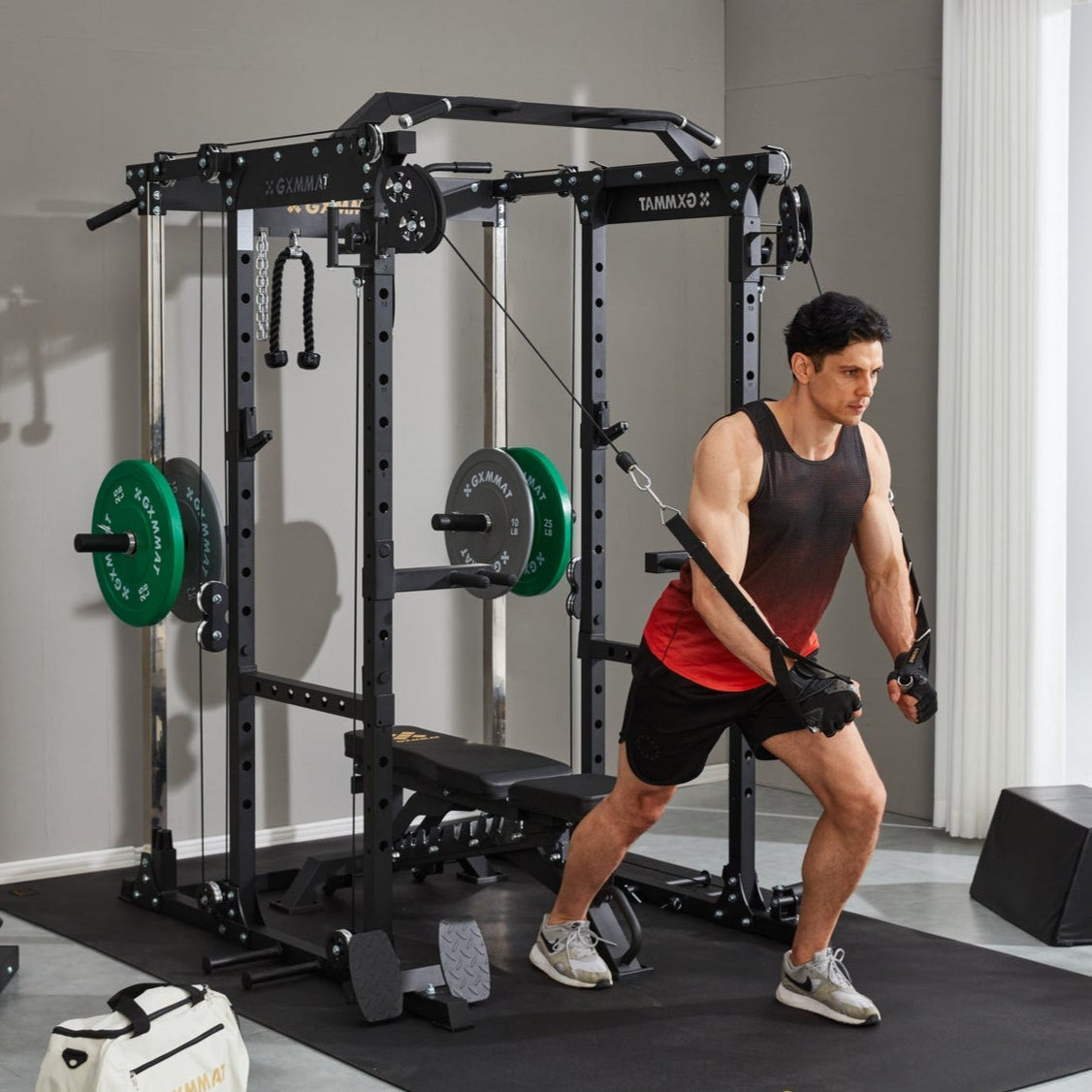
You need two independent cables. The GXMMAT X6 power rack has dual independent 1:1 cables on adjustable pulleys, so you can set both sides to any height for high-to-low, middle and low-to-high crossovers. The V6 also works well for cable flys. Add change plates for small jumps and a non-slip large exercise mat for a stable stance. See the cable attachments guide and X6 vs V6 vs G5 to compare cable setups.
FAQ
What does the cable crossover work?
Mainly the chest muscles, with help from the front shoulders.
Is the cable crossover good for building the chest?
Yes, as an accessory to pressing. Constant tension and a full stretch make it effective for muscle growth.
How heavy should cable crossovers be?
Moderate: a weight you can control for 10–15 reps without swinging.
High or low pulley for cable crossovers?
High-to-low targets the lower chest; low-to-high targets the upper chest. Mix both.
Can I do cable crossovers with one cable?
Yes, one arm at a time, but two independent cables make the full movement possible.
Written by Yuvien Royer for GXMMAT. This article is general fitness information, not medical advice.