Bulletproof Your Delts: The Science on How to Improve Shoulder Strength
Shoulders are the most mobile joints in your body, which also makes them the most vulnerable. If you have hit a plateau on your bench press or find yourself nursing a nagging ache after push day, the issue usually isn't your chest—it is your deltoids. Learning how to improve shoulder strength isn't just about piling more weight on the bar; it is about mastering tension, stability, and anatomical balance.
Key Takeaways
- Prioritize Stability: You cannot build raw strength on an unstable foundation; train your rotator cuffs first.
- The Vertical Plane: The standing overhead press is the primary driver for overall shoulder mass and power.
- Rear Delt Focus: Most lifters neglect the posterior head, leading to forward-slumping posture and injury.
- Controlled Tempo: Shoulders respond better to time-under-tension than explosive, jerky movements.
Understanding the Architecture of Your Shoulder
Before grabbing dumbbells, you need to respect the machinery. The shoulder isn't one muscle; it is a complex interplay of the anterior (front), medial (side), and posterior (rear) deltoids, sitting on top of the rotator cuff.
Most gym-goers overdevelop the front delts because of excessive bench pressing and neglect the rear delts. This imbalance pulls the joint forward, creating that "caveman" posture and limiting your range of motion. To fix this, your programming must emphasize the back of the shoulder just as much as the front.
The Foundation: Vertical Pressing
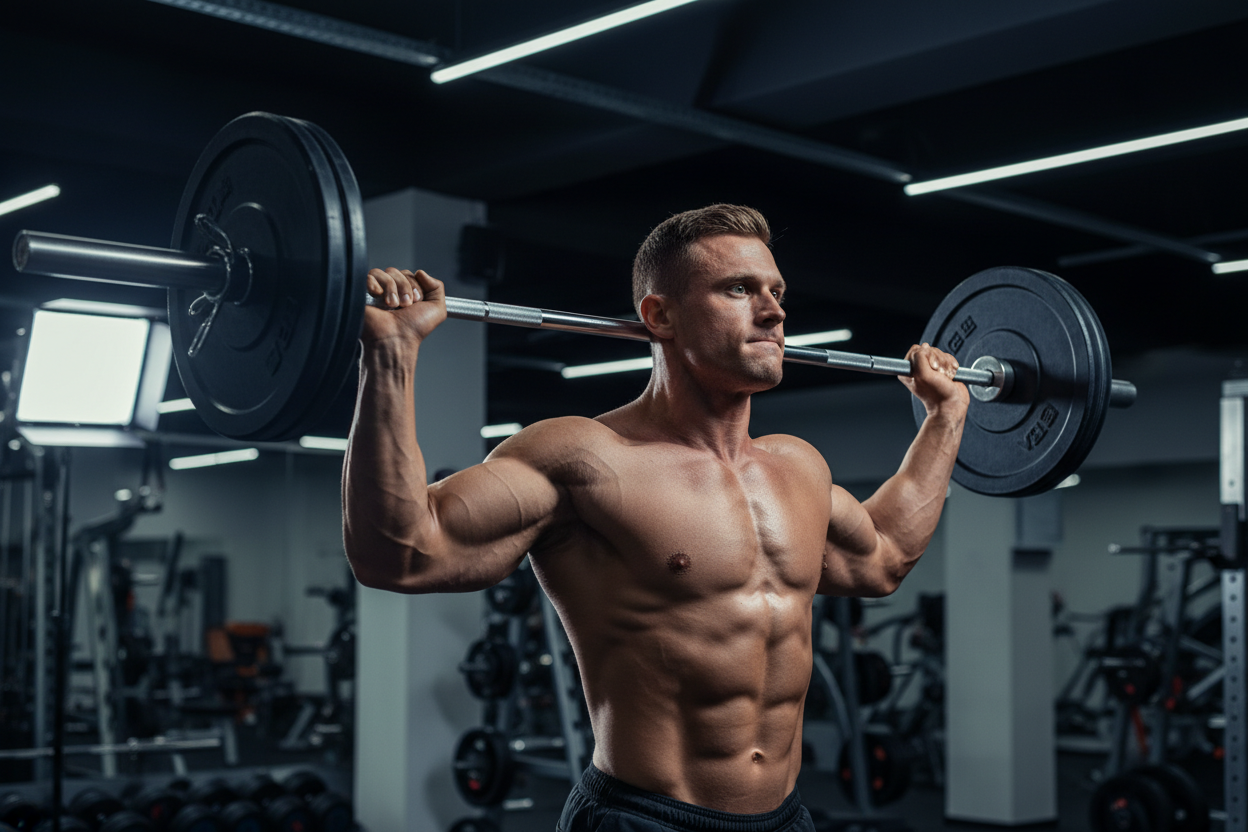
To build legitimate mass, you must move heavy loads vertically. The standing barbell overhead press is the king here. Unlike seated variations, standing forces your core and glutes to stabilize the load, translating to functional, real-world power.
When performing this lift, keep your elbows slightly tucked, not flared out at 90 degrees. Flaring your elbows puts unnecessary torque on the shoulder capsule. Think about driving your biceps toward your ears as you lock out the weight.
Isolation: The Secret to 3D Delts
Compound lifts build the size, but isolation movements carve the detail and ensure joint health. This is where selecting the right exercise to improve shoulder strength becomes nuanced. You don't need heavy weights here; you need perfect mechanics.
Lateral Raises Done Right
Stop swinging the weights. If you have to use your hips to get the dumbbells up, the weight is too heavy. Lean slightly forward and lead with your elbows, not your hands. Imagine you are pouring a pitcher of water out at the top of the movement. This slight internal rotation targets the medial delt specifically.
Face Pulls for Longevity
If I could only choose one accessory movement, it would be the face pull. It strengthens the rear delts and the external rotators simultaneously. Do these at high volume—sets of 15 to 20 reps—at the end of every upper body workout to counteract the internal rotation caused by sitting at a desk or heavy chest pressing.
My Personal Experience with how to improve shoulder strength
I learned the hard way that shoulders are unforgiving. A few years ago, I was chasing a 225lb overhead press. I got there, but I couldn't sleep on my right side because of the throbbing deep inside the joint.
The turning point wasn't a new supplement or a sleeve; it was dropping the ego. I remember specifically picking up the 5lb pink dumbbells—yes, five pounds—to do Y-raises and external rotations. It felt ridiculous. I was a big guy in a commercial gym struggling to hold 5lbs with straight arms for high reps. But the burn was different. It wasn't the lactic acid burn of a bicep curl; it was a deep, stabilizing heat right inside the socket.
I also changed how I did face pulls. Instead of just yanking the rope toward my face, I started focusing on the sensation of my thumbs trying to point to the wall behind me at the peak of the contraction. That specific external rotation cue cleared up my clicking shoulder in about six weeks. Now, I don't touch a heavy barbell until I've done my "boring" band work. The click is gone, and my press is stronger than ever.
Conclusion
Strong shoulders are the linkage for almost every other upper body movement. If you ignore the rear delts or skip the stabilizer work, you are putting a ceiling on your potential strength. Focus on form, control the tempo, and don't be afraid to use light weights to target the small muscles that keep the joint healthy.
Frequently Asked Questions
How often should I train my shoulders?
For most natural lifters, training shoulders twice a week is optimal. One day can focus on heavy overhead pressing (strength), and the second day can focus on higher repetition hypertrophy work (size).
Can I build shoulder strength with just bodyweight?
Yes, but it requires progression. Pike push-ups are excellent, and as you get stronger, you can elevate your feet to increase the load. Eventually, handstand push-ups provide a load equivalent to pressing your body weight.
Why does my shoulder click when I lift?
Clicking usually indicates a tendon snapping over a bony structure or an imbalance in the rotator cuff. If it is painless, it's generally harmless but signals a need for mobility work. If there is pain, stop immediately and consult a physio.