Build Stronger Legs Using Just a Weight Plate: The Minimalist Guide
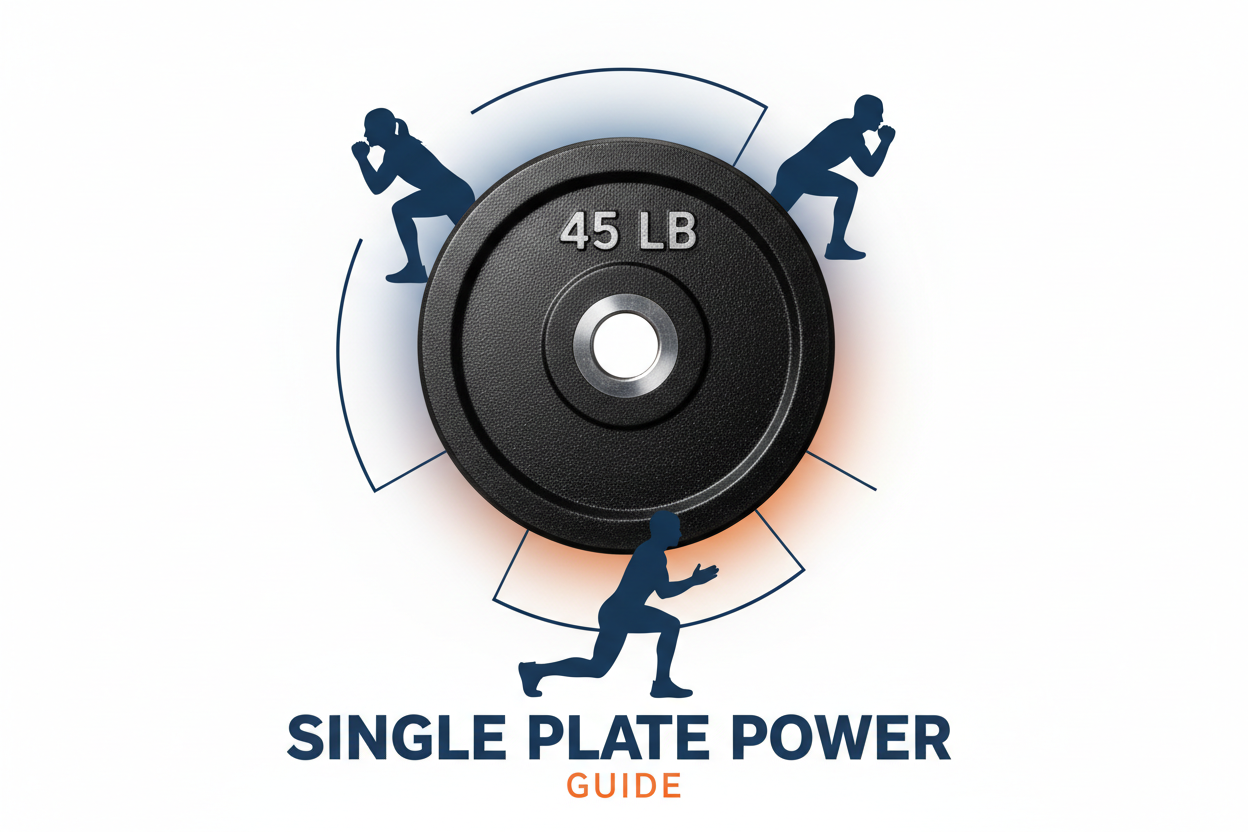
You don't need a squat rack, a leg press machine, or a collection of kettlebells to get a lower body pump that leaves you walking funny the next day. Many lifters underestimate the humble iron disk, viewing it merely as something to slide onto a barbell. However, a focused leg workout with weight plate resistance can challenge your balance, core stability, and muscular endurance in ways that machines simply cannot replicate. Whether the gym is packed or you are training in a garage with limited gear, a single plate is a versatile tool for building functional strength.
I remember walking into my local gym on a Monday evening—prime time. Every squat rack was occupied, the leg press had a line, and even the dumbbells up to 50lbs were gone. Instead of skipping leg day or waiting twenty minutes for a rack, I grabbed a single 45lb bumper plate and found a small patch of empty floor space. I decided to run a circuit using nothing but that plate. By the time I finished my fourth round of overhead lunges and goblet squats, my quads were on fire, and my heart rate was higher than it usually gets during heavy barbell sets. That session shifted my perspective on what is actually required to stimulate muscle growth. It forced me to focus on time under tension and strict mechanics rather than just moving heavy loads from point A to point B.
Why Plate Training Works
Using a plate changes the center of gravity during your lift. Unlike a barbell which sits on your back (posterior load), holding a plate usually involves anterior loading (holding it in front of you) or overhead positioning. This shift forces your core to engage aggressively to keep you upright. A proper plate leg workout turns simple movements into full-body stability challenges. It is particularly effective for fixing imbalances because you can't rely on the fixed path of a machine to stabilize the weight for you.
The Core Movements
To construct an effective routine, you need to hit the quads, hamstrings, glutes, and calves. Here are the most effective weight plate exercises for legs that cover these bases.
The Plate Goblet Squat
This is the bread and butter of plate training. By holding the weight at chest height, you act as a counterweight, which often allows people to squat deeper with better form than they can with a barbell.
Hold the plate by the sides (at 3 and 9 o'clock) or hug it close to your chest. Set your feet shoulder-width apart. As you descend, keep your elbows tucked in so they drop between your knees. This position forces your chest up and prevents your lower back from rounding. Because the absolute load is likely lighter than your max back squat, slow down the tempo. Take three seconds to go down, pause for one second at the bottom, and explode up.
Overhead Walking Lunges
If you want to test your mental fortitude, this is the move. This variation of a leg workout with plates engages the entire posterior chain and demands massive shoulder stability.
Press the plate directly overhead with arms locked out. Step forward into a lunge, ensuring your back knee gently taps the floor or hovers an inch above it. The key here is to not let your ribcage flare out or your elbows bend. If you find your arms bending, your core is likely giving out. This exercise exposes weaknesses quickly. If the overhead position is too difficult initially, you can modify this into a standard walking lunge holding the plate at your chest.
Plate Romanian Deadlifts (RDL)
For the hamstrings and glutes, the RDL is non-negotiable. While you might not be able to load this as heavy as a barbell, you can increase the intensity by performing it on one leg (single-leg RDL) or focusing on a deep stretch.
Grip the top of the plate with both hands or hold it by the sides. Stand with feet hip-width apart and a slight bend in the knees. Hinge at the hips, pushing your glutes back as far as possible while lowering the plate toward your toes. Keep the plate close to your shins. You should feel a deep stretch in the hamstrings. Squeeze your glutes to return to the standing position. This is one of the essential weight plate exercises for legs because it reinforces the hip hinge pattern without the spinal compression of a heavy bar.
Advanced Variations and Stability
Once you have mastered the basics, you can introduce lateral movements and swings to round out the weight plate leg workout. These moves prevent you from becoming too linear in your training.
Lateral Lunges (Cossack Squats)
Most people only train in the sagittal plane (forward and backward). Lateral lunges hit the adductors (inner thigh) and glute medius. Hold the plate at your chest and take a wide stance. Shift your weight to one side, bending that knee while keeping the other leg perfectly straight. Drive through the heel of the bent leg to return to center. The plate acts as a counterbalance, often allowing you to sink deeper into the stretch than you could with bodyweight alone.
Plate Swings
Similar to a kettlebell swing, this dynamic movement builds explosive power in the hips. Grip the plate firmly at the top (ensure your hands are dry or use chalk). Hinge forward and hike the plate between your legs, then snap your hips forward to propel the weight up to chest height. Your arms are just hooks; the power comes from the glutes and hamstrings. This adds a metabolic conditioning element to your plate exercises for legs, keeping your heart rate elevated.
Structuring Your Routine
You can organize these movements into a standard set-rep scheme or a high-intensity circuit. For hypertrophy (muscle growth), try the following structure:
- Plate Goblet Squats: 4 sets of 15-20 reps (focus on slow negatives)
- Overhead Lunges: 3 sets of 12 steps per leg
- Single-Leg RDLs: 3 sets of 12 reps per leg
- Plate Swings: 3 sets of 20 reps
- Calf Raises (holding plate): 4 sets to failure
Rest for 60 to 90 seconds between sets. Because the weight is fixed (you likely aren't switching plates constantly), you reduce downtime, keeping the intensity high. If 45lbs is too heavy, scale down to a 25lb or 35lb plate. If it is too light, increase the reps or slow down the movement speed.
Consistency with this style of training yields surprising results. It teaches your body to move as a cohesive unit. The next time you find yourself in a crowded gym or stuck at home, don't skip the session. Grab that iron disk and get to work.
Frequently Asked Questions
Can I actually build muscle with just a weight plate?
Yes, you can build muscle provided you apply progressive overload. Since you cannot easily add more weight, you must increase the number of reps, decrease rest times, or slow down the tempo (time under tension) to continue stimulating muscle growth.
Is a 45lb plate too heavy for beginners?
For many beginners, 45lbs might be too heavy for exercises like overhead lunges or single-leg RDLs. It is better to start with a 10lb or 25lb plate to master the form first. You can always increase the volume (reps) if the weight feels manageable.
How do I hold the plate comfortably for squats?
The most secure way is usually holding the plate by its sides at the 3 o'clock and 9 o'clock positions, pressing the edge into your chest. Alternatively, if the plate has handle cutouts, you can grip those. Ensure your wrists remain straight to avoid unnecessary strain.