Build Strong Legs Without Wrecking Your Knees: The Silent Burn Guide
You do not need to jump, stomp, or wreck your joints to build a powerful lower half. Many people mistakenly believe that a workout only counts if you are gasping for air after a series of box jumps or burpees, but true strength often comes from control rather than chaos. A well-structured lower body low impact workout relies on time under tension and strict biomechanics to fatigue the muscles without hammering the cartilage in your knees and hips. By slowing down the movement and removing the explosive momentum, you force the muscle fibers to do all the work, leading to significant strength gains and improved stability.
I learned the value of keeping my feet on the ground the hard way. A few years ago, I was obsessed with high-intensity interval training that involved endless plyometrics. It worked for a while, until a nagging ache in my patellar tendon turned into a sharp, debilitating pain every time I took the stairs. My doctor’s orders were clear: stop the jumping or schedule surgery. I wasn't ready to give up training, so I shifted my entire focus to slow, controlled movements. Surprisingly, after three months of strictly low-impact training, my quad definition had actually improved, and my squat mechanics were cleaner than they had ever been. The burn I felt from a slow-tempo split squat was far more intense than any box jump I had ever done.
Why Gravity is Your Best Training Partner
The science behind building muscle without impact is rooted in mechanical tension. When you jump, you use momentum to propel your body upward. When you remove the jump, you remove the momentum. This forces your muscles to engage throughout the entire range of motion to fight gravity. This continuous tension creates metabolic stress in the muscle tissue, which is a primary driver for hypertrophy (muscle growth).
For anyone dealing with joint issues or simply trying to train quietly in an upstairs apartment, no impact leg exercises are not just a safety modification; they are a superior way to isolate specific muscle groups. By keeping at least one foot on the floor, you increase your base of support, allowing you to focus entirely on the squeeze and the stretch of the muscle rather than worrying about landing mechanics or balance recovery.
The Essential Home Leg Routine
You don't need a rack of dumbbells or a leg press machine to get results. This routine focuses on the fundamental movement patterns: the squat, the lunge, and the hinge. Perform these movements in a circuit or as straight sets, aiming for quality over speed.
1. The Tempo Air Squat
The standard air squat is the king of bodyweight exercises, but we are going to tweak it to make it harder. Instead of dropping down and popping up, use a 3-1-1 tempo. Lower yourself for three seconds, pause at the bottom for one second, and stand up for one second.
Stand with feet shoulder-width apart, toes slightly turned out. Initiate the movement by pushing your hips back as if reaching for a chair behind you. Keep your chest tall and heels glued to the floor. The slow descent removes the "bounce" reflex at the bottom, forcing your quads and glutes to fire harder to get you back up. If you have knee pain, limit your depth to just above parallel.
2. The Reverse Lunge
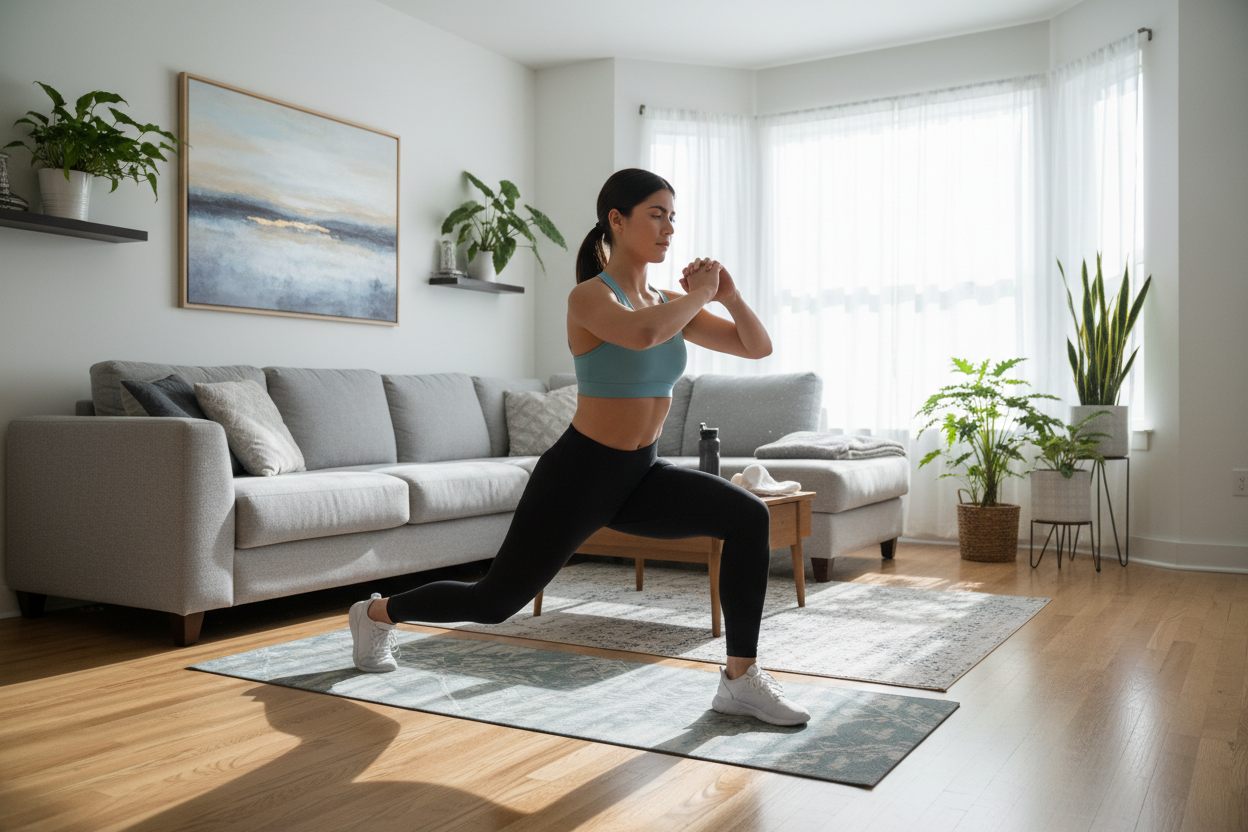
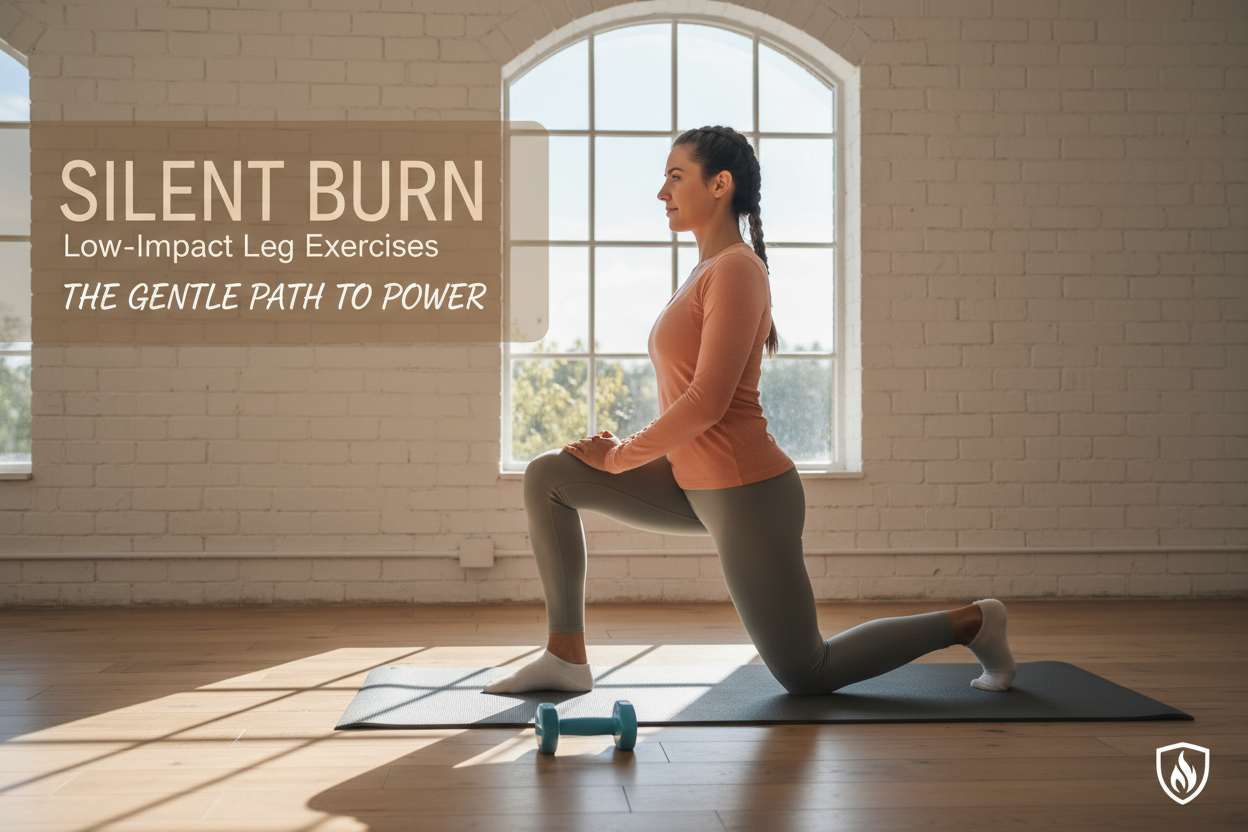
Forward lunges can put significant shearing force on the knee joint because the momentum carries your weight forward. The reverse lunge is a much friendlier alternative for the knees and is a staple in any low-impact leg workout at home.
Start standing tall. Step one foot back and lower your back knee toward the ground. Your front shin should remain relatively vertical. Drive through the heel of your front foot to return to the starting position. This movement targets the glutes and hamstrings more effectively than the forward variation and keeps the pressure off the knee cap. To increase the intensity, don't put your foot all the way down between reps—just tap it lightly and go again.
3. Single-Leg Glute Bridge
Floor-based exercises are zero impact by definition, but they can be incredibly challenging. The single-leg glute bridge isolates the posterior chain (the back of your legs) without putting any vertical load on the spine.
Lie on your back with knees bent and feet flat on the floor. Extend one leg straight out so your thighs are parallel. Drive through the heel of the grounded foot to lift your hips until your body forms a straight line from shoulders to knees. Squeeze your glutes hard at the top. This exercise corrects imbalances between your left and right side, which is often the root cause of back and knee pain.
4. Side-Lying Leg Raises
We often neglect the muscles on the side of the hips, specifically the glute medius. Weakness here leads to knee cave-in during squats and walking. This exercise looks deceptively easy but burns quickly.
Lie on your side with legs straight. Lift the top leg toward the ceiling, keeping your toes pointed forward (not up). If you point your toes up, you start using your hip flexors instead of your glutes. Lower the leg slowly. This small movement stabilizes the pelvis and protects the lower back.
Increasing Intensity Without Weights
Since you aren't using heavy barbells or explosive jumps, you need other ways to apply progressive overload. The body adapts quickly, so once the routine above feels easy, you must change the stimulus.
Pulse repetitions are a fantastic tool. During a squat or lunge, instead of coming all the way up, rise only halfway and then drop back down. Do this for 10 to 15 seconds at the end of a set. This keeps the muscle under constant tension and occludes blood flow, creating a massive pump without stressing the joints.
Another method is the "1.5 rep" style. Go all the way down, come halfway up, go back down, and then come all the way up. That counts as one rep. This doubles the time you spend in the hardest part of the movement.
Consistency Over Intensity
The beauty of low impact training is that you can do it more frequently. High-impact jumping requires days of recovery for your connective tissue. Controlled, grounded movements are easier to recover from systemically, allowing you to train your legs two or three times a week. This frequency is often the missing key for people who struggle to see definition in their lower body.
Building legs at home doesn't require noise or pain. It requires focus. By mastering the mechanics of how your body moves through space and slowing down the tempo, you can build a lower body that is not only aesthetically pleasing but also functional and pain-free for years to come.
Frequently Asked Questions
Can I actually build muscle mass with low impact exercises?
Yes, muscle growth is driven by mechanical tension and metabolic stress, not just heavy weights or jumping. By using slower tempos, higher rep ranges, and increasing the time under tension, you can stimulate significant hypertrophy in the legs without high impact.
How often should I do this leg workout?
Because low impact exercises are generally easier on the central nervous system and joints, you can perform this routine 2 to 3 times per week. Ensure you have at least one rest day between sessions to allow muscle fibers to repair.
Is walking enough for a low impact leg workout?
Walking is excellent for cardiovascular health and mobility, but it generally doesn't provide enough resistance to build significant muscle strength or size. To change the shape and strength of your legs, you need resistance exercises like squats, lunges, and bridges that challenge the muscles beyond their daily capacity.