Skip the Gym: How to Build Strong Legs in Your Living Room Without Weights
You do not need a gym membership, a squat rack, or heavy dumbbells to build a powerful lower body. In fact, relying solely on bodyweight movements can often improve your balance and functional mobility more effectively than machines can. If you are looking for easy at home leg workouts, the secret lies in mastering the fundamental movement patterns: squatting, hinging, and lunging. By manipulating tempo and rep ranges, you can stimulate muscle growth and tone your legs right in your living room.
Many beginners overcomplicate fitness. They search for the perfect routine when the most effective approach is simply consistency with basic movements. A solid home routine focuses on high-quality repetitions rather than heavy loads. This guide breaks down the most effective movements you can do with zero equipment, ensuring you get a safe and challenging workout without stepping out your front door.
Why Bodyweight Leg Training Actually Works
There is a misconception that you cannot build muscle without iron. While external weight is great for maximum strength, bodyweight training builds endurance, stability, and relative strength. When you strip away the barbell, you are forced to focus on your form. You can’t cheat a slow-tempo bodyweight squat. This focus on control recruits stabilizing muscles that often get neglected when you are just trying to move a heavy weight from point A to point B.
I learned this lesson the hard way a few years ago. After a minor lower back strain from lifting too heavy too quickly, I was forced to take a break from the gym. I assumed my legs would lose all their definition. I was wrong. I switched to a routine of high-volume lunges and single-leg squats in my garage. Within six weeks, my joint pain was gone, my balance was better than ever, and my legs actually looked more defined because I was performing the reps with strict control. It changed my perspective entirely on what constitutes a "hard" workout.
The Foundation: Mastering the Squat
The squat is the king of lower body exercises for a reason. It targets the quads, hamstrings, and glutes simultaneously. If you are searching for easy leg exercises at home, this is where you must start. However, "easy" refers to the accessibility of the movement, not the effort involved.
To perform a perfect air squat, stand with your feet slightly wider than shoulder-width apart. Your toes should point out slightly. Initiate the movement by pushing your hips back as if you are reaching for a chair behind you. Keep your chest up and your heels glued to the floor. Lower yourself until your thighs are at least parallel to the ground, then drive back up through your heels.
If you find standard squats too challenging or have knee issues, start with a "box squat." Place a sturdy chair behind you. Lower yourself until your glutes tap the seat, then stand back up. This removes the fear of falling and ensures you are using the correct range of motion.
Unilateral Strength: Lunges and Step-Ups
Life rarely happens on two feet perfectly planted side-by-side. Walking, running, and climbing stairs are all single-leg activities. Unilateral exercises—movements that work one leg at a time—fix muscle imbalances. Most people have one leg stronger than the other, and bilateral exercises like squats can hide that imbalance. Lunges expose it and fix it.
The Reverse Lunge
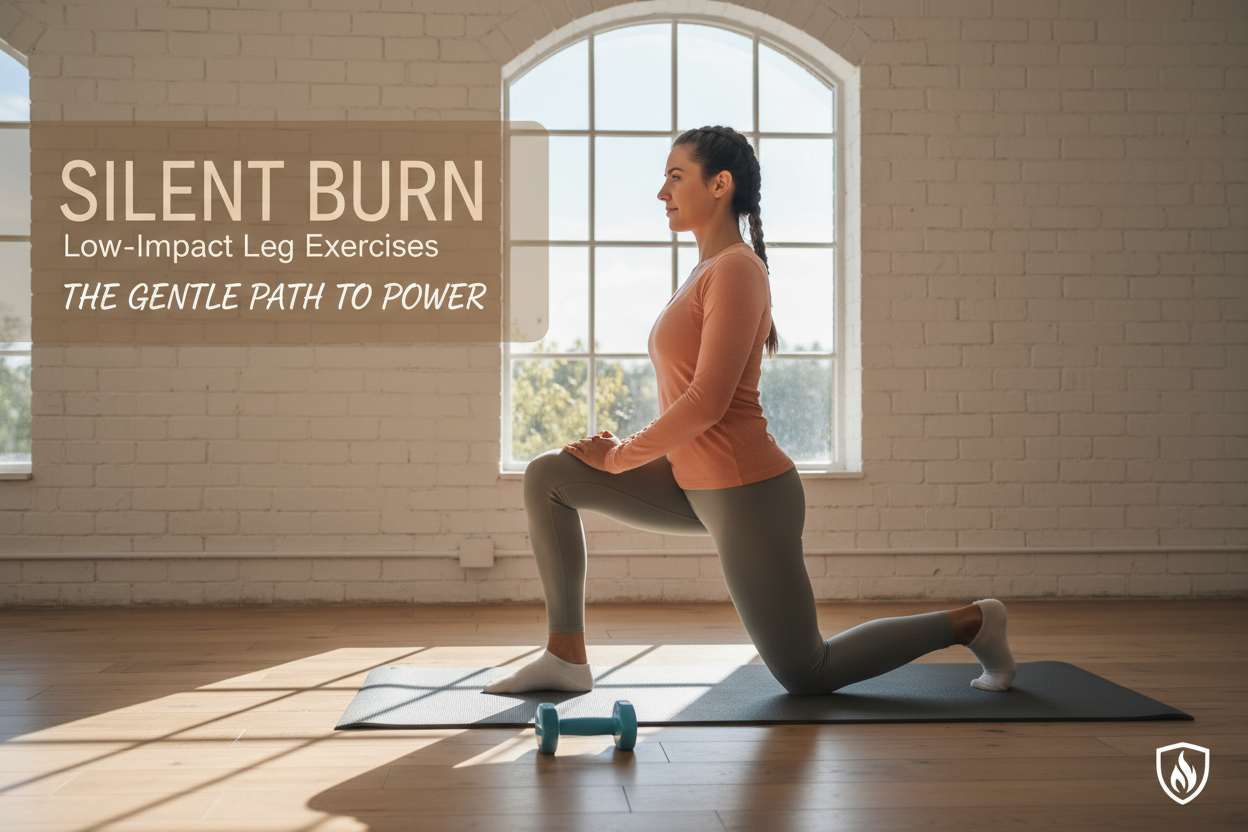
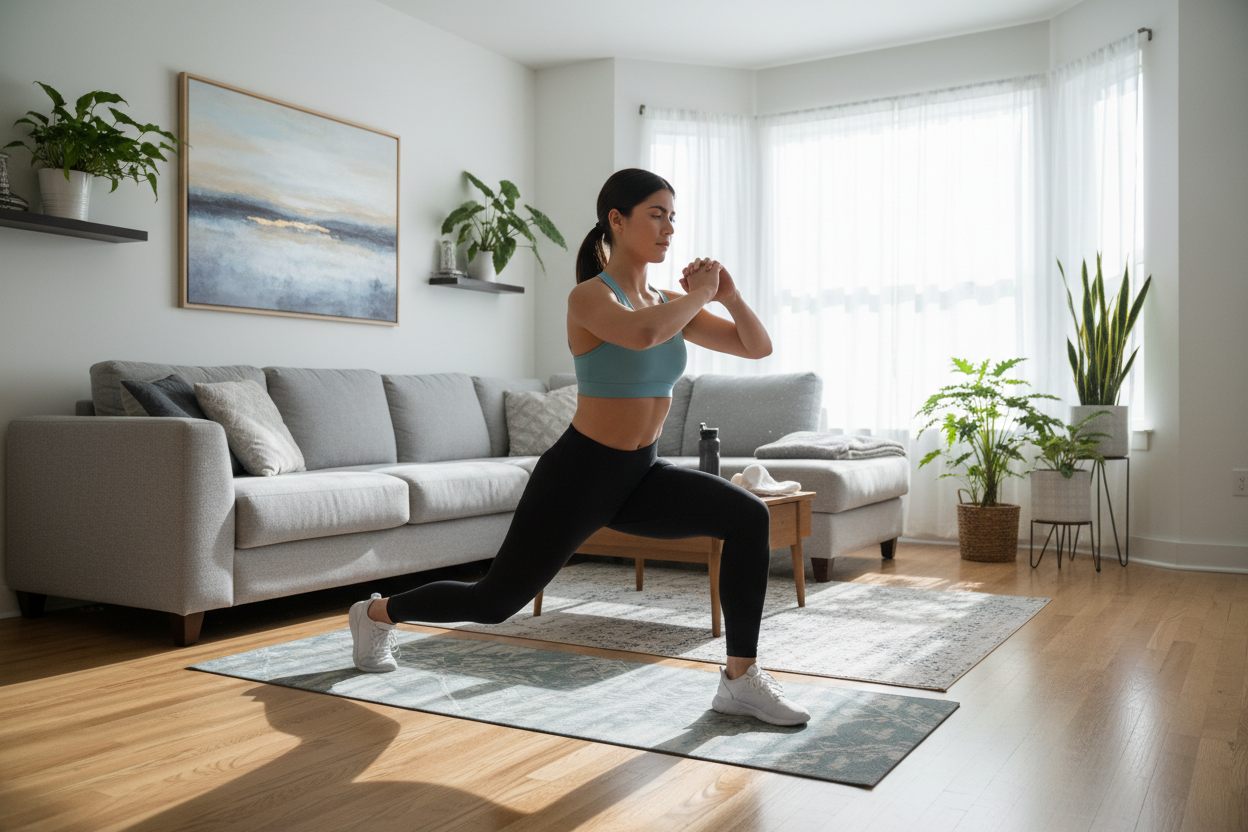
Forward lunges can sometimes aggravate the knees if you don't have perfect braking mechanics. Reverse lunges are generally safer and more beginner-friendly. Stand tall, take a large step backward with your right foot, and lower your hips until both knees form 90-degree angles. Your back knee should hover just above the floor. Push through your front heel to return to the starting position.
The Step-Up
Use a staircase or a sturdy chair for this. Place your entire foot on the elevated surface. Drive through that heel to lift your body up. Avoid pushing off with the bottom foot; make the top leg do all the work. This is one of the most functional easy at home leg workouts available because it directly mimics daily activities.
Posterior Chain: Glute Bridges
Modern life involves a lot of sitting, which causes the hip flexors to tighten and the glutes to become inactive. Weak glutes can lead to lower back pain and poor posture. The glute bridge is the antidote to the office chair.
Lie on your back with your knees bent and feet flat on the floor, hip-width apart. Press your lower back into the ground to engage your core. Squeeze your glutes to lift your hips toward the ceiling. Your body should form a straight line from your shoulders to your knees. Hold the top position for two seconds before lowering slowly. To make this one of the more challenging easy leg exercises at home, try doing it with one leg extended in the air.
The Finisher: Wall Sits
Static holds are an excellent way to build mental toughness and muscular endurance without moving a muscle. The wall sit is deceptive; it looks like you are doing nothing, but your quads will be screaming within thirty seconds.
Find a clear wall space. Lean your back against it and slide down until your thighs are parallel to the floor. Your knees should be directly above your ankles. Press your lower back firmly into the wall and hold. Aim for 30 seconds initially, working your way up to a full minute. This is a safe way to fatigue the muscles completely at the end of a workout without risking injury from poor form.
Structuring Your Home Routine
Knowing the exercises is only half the battle. You need to put them together into a cohesive plan. For a complete workout, perform these exercises in a circuit. This means you do one set of each exercise back-to-back with little rest in between. This keeps your heart rate up, turning a strength workout into a cardiovascular session as well.
Try this simple structure:
- Bodyweight Squats: 15 reps
- Reverse Lunges: 10 reps per leg
- Glute Bridges: 15 reps
- Wall Sit: Hold for 30-45 seconds
- Rest for 90 seconds
- Repeat 3 to 4 times
Consistency is the primary driver of results. Aim to perform this routine two to three times a week. As the movements become easier, do not just add more reps. Instead, slow down. Take three seconds to lower yourself into the squat and one second to stand up. Increasing the "time under tension" will make even the simplest movements feel intense.
Common Mistakes to Avoid
Even with bodyweight exercises, form breakdown can lead to nagging aches. A frequent error is allowing the knees to cave inward during squats and lunges. This puts unnecessary stress on the ligaments. Actively think about pushing your knees outward as you move.
Another issue is neglecting the warm-up. Just because you aren't lifting heavy weights doesn't mean your muscles are ready to go cold. Spend five minutes walking briskly or doing dynamic stretches like leg swings before you start your squats. This prepares your joints and increases blood flow, making the workout more effective and safer.
Frequently Asked Questions
How often should I do leg workouts at home?
For most beginners, training legs 2 to 3 times per week is ideal. This frequency allows for sufficient stimulation to build strength while providing enough recovery time (48 hours) between sessions for muscles to repair and grow.
Can I build muscle without using weights?
Yes, you can build muscle with bodyweight exercises by using progressive overload. Instead of adding weight, you increase the difficulty by doing more repetitions, slowing down the movement tempo, decreasing rest times, or switching to single-leg variations.
What if I feel pain in my knees during lunges?
Knee pain during lunges often comes from the front knee traveling too far forward or the heel lifting off the ground. Try switching to reverse lunges, which are generally easier on the knees, and ensure your front shin stays relatively vertical while keeping your weight in your heel.