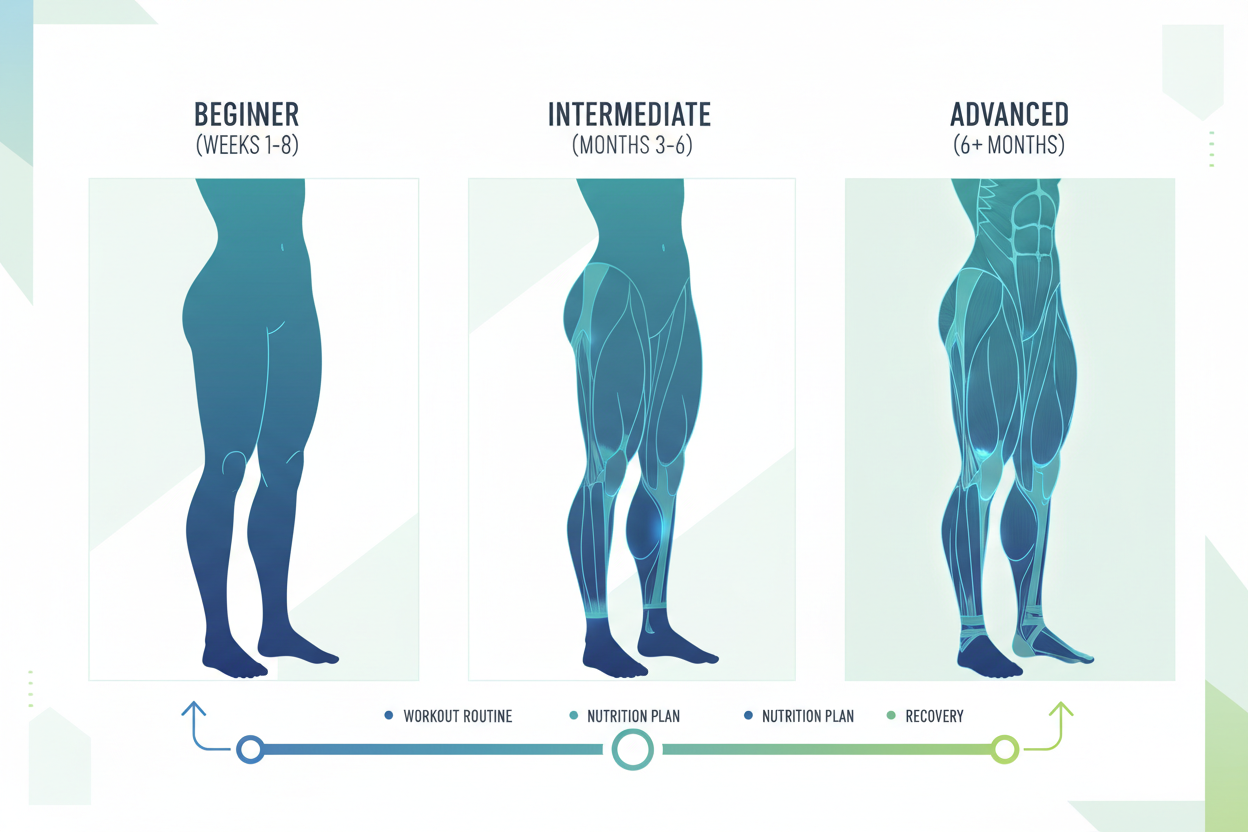
Why Your Legs Are Still Skinny: The Real Timeline for Lower Body Growth
You have been hitting the squat rack hard, limping down the stairs for two days afterward, and eating everything in sight, yet the mirror does not seem to show much difference. The frustration is real. If you are looking for a definitive answer on when you will see changes, here is the reality: noticeable muscle growth, or hypertrophy, typically takes about 8 to 12 weeks of consistent training. However, strength gains often appear much sooner, usually within the first 4 weeks, as your nervous system adapts to the new load.
Patience is arguably the hardest part of building a lower body. Unlike the biceps or shoulders, which can look pumped and defined relatively quickly due to lower body fat storage in those areas and smaller muscle bellies, legs are massive muscle groups. They require significant stimulus and caloric fuel to change shape. Understanding the physiological timeline helps manage expectations so you don't quit just before the magic happens.
The First Month: It’s All in Your Head (Literally)
During the first few weeks of a new program, you might feel stronger every time you step into the gym. You add 5 pounds to the bar here, another 10 pounds on the leg press there. It feels like rapid progress, but your jeans probably fit exactly the same. This phase is dominated by neuromuscular adaptation. Your brain is learning how to fire motor units more efficiently to contract the muscle fibers you already have.
I remember my first serious attempt at growing my legs. I was doing squats three times a week, convinced that I would wake up with tree trunks after a month. The only thing that grew was my appetite and my inability to sit down comfortably. It wasn't until month three that a friend actually commented that my legs looked bigger. That initial month is deceptive; you are building the foundation of strength that allows you to eventually move the heavy loads required for size, but the physical dimensions remain largely unchanged.
The Hypertrophy Phase: Weeks 8 to 12
Once your central nervous system has optimized its recruitment strategies, the body begins the structural work. This is where the actual muscle fibers tear, repair, and thicken. This process is metabolically expensive and slow. For the average lifter, gaining 0.5 to 1 pound of lean muscle per month is a realistic rate of gain. Since that weight is distributed across your entire body, the amount that settles specifically on your quads, hamstrings, and calves is minimal week-to-week.
To ensure you are actually in this phase, you must apply progressive overload. This doesn't always mean adding weight. It can mean adding reps, improving form, slowing down the eccentric (lowering) portion of the lift, or decreasing rest times. If you are doing the same workout with the same weight for three months, your legs have no reason to adapt.
Why You Might Be Stalling
If you have passed the three-month mark and still aren't seeing changes, the issue usually lies in intensity or nutrition. The legs are incredibly resilient. They carry you around all day. Walking on a treadmill or doing high-rep bodyweight squats often isn't enough of a signal to force growth. They need to be challenged with heavy compound movements like squats, lunges, deadlifts, and hack squats.
Nutrition is the other half of the equation. You cannot build a house without bricks. If you are in a caloric deficit, your body will prioritize energy for vital organs over building massive quads. A slight caloric surplus, combined with adequate protein intake (roughly 0.7 to 1 gram per pound of body weight), provides the raw materials necessary for hypertrophy.
The Importance of Tracking Data
Subjective feelings are terrible indicators of progress. The pump you feel during a session is just blood rushing to the muscle, not actual growth. To know if you are moving forward, you need hard data. Analyzing your leg workout result requires looking beyond just the mirror; you have to look at the numbers in your logbook. If your 10-rep max on the Romanian Deadlift has gone up by 20 pounds in two months, your hamstrings are growing, even if the visual change is subtle at first.
Anatomy of a Leg Day That Works
A routine that delivers results focuses on movement patterns rather than just specific machines. You need a knee-dominant exercise (like a squat), a hip-dominant exercise (like a deadlift), and single-leg work to fix imbalances.
- Squat Variation: Back squats, front squats, or goblet squats. These target the entire lower body with an emphasis on quads and glutes.
- Hinge Movement: Romanian deadlifts or kettlebell swings. These are crucial for the posterior chain (hamstrings and glutes).
- Unilateral Work: Bulgarian split squats or walking lunges. These are painful but necessary for isolating each leg and increasing stabilization.
- Accessory Lifts: Leg curls, calf raises, or leg extensions to finish off specific muscles.
Volume matters too. Research suggests that 10 to 20 hard sets per muscle group per week is the sweet spot for hypertrophy. If you are only doing 3 sets of squats once a week, you likely aren't hitting the volume threshold needed for significant growth.
Recovery: Where the Growth Happens
You break muscle in the gym; you build it in bed. Sleep is when growth hormone is released and tissue repair occurs. If you are training legs with high intensity but only sleeping five hours a night, you are short-circuiting your gains. Chronic stress can also elevate cortisol levels, which is catabolic and can hinder muscle growth.
Active recovery can also help. Light movement, stretching, or foam rolling can increase blood flow to the damaged tissues, potentially reducing soreness and speeding up the repair process. However, avoid heavy cardio immediately after a leg session if your primary goal is size, as it can send conflicting signals to your muscles regarding adaptation.
Realistic Expectations for Calves
A quick note on calves: they are stubborn. Genetics play a massive role here largely due to the insertion point of the muscle belly. If you have high insertions, you have less muscle to work with. However, they can still grow. The secret is usually volume and a full range of motion. Bouncing the weight at the bottom of a calf raise uses the Achilles tendon's elasticity rather than muscle contraction. Pause at the bottom, stretch, and drive up hard.
Building an impressive lower body is a marathon. It requires embracing the grind of heavy lifting and the discipline of proper eating. The visual rewards come slow, but the functional strength and metabolic benefits start almost immediately. Keep your logbook updated, focus on beating your previous numbers, and the size will follow.
Frequently Asked Questions
How often should I train legs for maximum growth?
For most natural lifters, training legs twice a week is superior to a single "bro-split" leg day. This allows you to hit the optimal volume (10-20 sets) while spreading the fatigue, ensuring higher quality reps and more frequent growth signals to the muscles.
Can I build big legs with just bodyweight exercises?
You can build an athletic, toned lower body with bodyweight training, but significant mass usually requires external resistance. To continue growing without weights, you must perform very high repetitions or difficult variations like pistol squats to maintain progressive overload.
Why do my legs get sore but not bigger?
Soreness (DOMS) is not a direct indicator of growth; it often just means you did something new or stretched the muscle under load. If you are consistently sore but not growing, you may be under-recovering (lack of food/sleep) or you aren't progressively increasing the weight over time.