Best Week Workout Schedule for Muscle Gain: Split Frameworks, Weekly Blueprints, and Home Floor Staging
Designing an effective weekly training split requires balancing stimulation frequency, total training volume, and adequate rest periods. Whether training in a commercial facility or a dedicated garage space, establishing a reliable rhythm allows muscle groups to recover between rigorous lifting sessions while keeping progressive overload consistent. When structured thoughtfully, the best week workout schedule for muscle gain aligns individual schedule constraints with sound mechanical principles.
Core Hypertrophy Principles for Weekly Workout Scheduling
Muscle hypertrophy responds favorably to regular, repeatable mechanical tension across primary movement patterns. Distributing work evenly across the week prevents extreme localized soreness that can compromise form in subsequent workouts. Rather than exhausting a single muscle group with excessive volume in one prolonged session, spreading sets across multiple days helps maintain high movement quality and power output.
Recovery allocation is just as vital as training execution. Muscle tissue adapts during periods between workouts, making rest days an active component of hypertrophy rather than empty calendar space. For comprehensive exercise variation breakdowns and foundational movement templates, explore our central workout resource.
Comparing the Most Effective Weekly Hypertrophy Splits
Choosing the best weekly workout plan for muscle gain depends on personal availability, training experience, and recovery tolerance. Different weekly split frameworks offer distinct trade-offs between session frequency, set volume per workout, and rest distribution.
The 3-Day Full Body Schedule for Maximum Efficiency
A three-day full body routine distributes major compound patterns across non-consecutive days, such as Monday, Wednesday, and Friday. Each session targets pushing, pulling, and leg movements in moderate amounts. This framework suits lifters with tight weekly schedules because it provides consistent systemic stimulation while leaving four full days dedicated to rest, mobility, and recovery.
The 4-Day Upper/Lower Split for Balanced Volume
The four-day upper/lower split divides the body into two upper-body days and two lower-body days, commonly scheduled as Monday/Tuesday and Thursday/Friday. This structure allows lifters to dedicate focused volume to specific regions without spending hours in a single session. Upper/lower splits offer an excellent balance between workload capacity and 48- to 72-hour recovery windows for each major muscle group.
When structuring targeted specialization phases within a broader annual plan, referencing a structured week workout guide helps balance volume distribution across primary and secondary muscle groups.
The 5-Day Push/Pull/Legs Blueprint for Higher Volume Trainees
A five-day push/pull/legs framework organizes workouts by movement vectors: pressing muscles (chest, shoulders, triceps), pulling muscles (back, rear deltoids, biceps), and lower body (quadriceps, hamstrings, calves). By grouping mechanically related muscle groups together, trainees can increase weekly volume on specific movement pathways while keeping joint stress organized.
Trainees looking to blend conditioning work alongside their primary hypertrophy sessions can consult a dedicated workout muscle guide to coordinate complementary work without interfering with resistance recovery.
How to Structure Intra-Session Movement Hierarchy
Regardless of which weekly split is selected, structuring individual sessions in a logical order preserves energy for the most demanding lifts. A reliable session layout follows a clear hierarchy:
- Primary Compound Lifts: Multi-joint exercises such as squats, deadlifts, presses, and rows demand the greatest coordination and output. Placing these at the start of a session ensures maximum focus and stability.
- Secondary Accessory Compounds: Variations like incline dumbbell presses, lunges, or lat pulldowns reinforce the primary movement patterns while allowing moderate load progression.
- Targeted Isolation Movements: Single-joint exercises such as lateral raises, leg curls, and arm work round out the session to fatigue specific muscle fibers without imposing excessive spinal or systemic fatigue.
- Core and Mobility Finishers: Dedicated midsection stability work and gentle stretching can conclude the session to transition the body into recovery mode.
Home Gym Staging: Flooring, Equipment Zones, and Room Protection
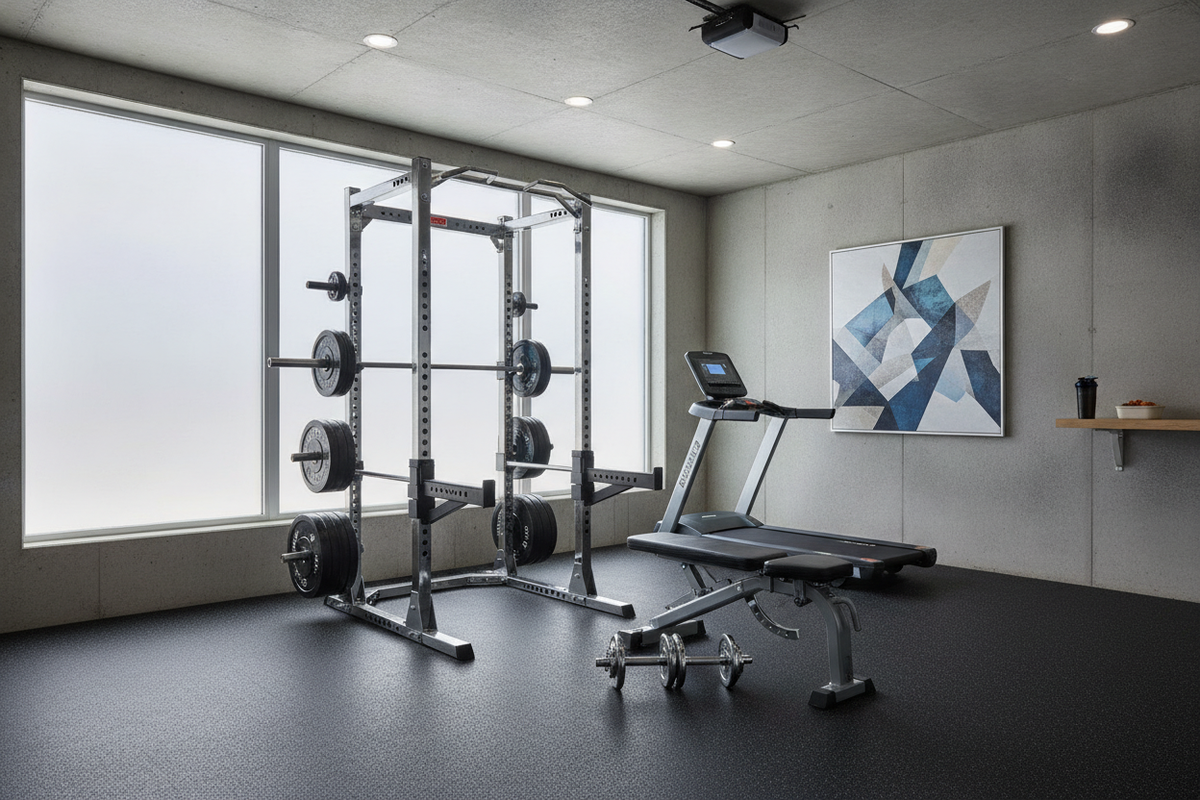
Executing heavy compound lifts at home requires a secure, stable environment. High-impact barbell movements, heavy dumbbell drops, and repeated foot repositioning place substantial demands on residential subfloors. Establishing a dedicated lifting zone with dense, slip-resistant surface protection ensures that equipment stays anchored and subfloors remain intact.
Establishing a secure, shock-absorbing training perimeter with a high-density workout product shields subfloors from heavy dumbbell and barbell work while providing firm traction during squats, deadlifts, and overhead presses. In our experience editing home gym layout plans, defining specific equipment zones—such as a dedicated rack area, a free-weight staging boundary, and an open mobility zone—keeps training spaces clutter-free and promotes consistent workout execution.
Weekly Deloads, Active Recovery, and Mat Maintenance
Sustaining consistent muscle gain over months and years requires structured periods of reduced volume. Incorporating an active recovery week or deload every few training blocks helps relieve accumulated joint fatigue while refreshing mental focus. On non-lifting days, floor-based mobility routines, light walking, and foam rolling support circulation without adding muscular damage.
Maintaining your home training surface is equally important for hygiene and longevity. Wiping down exercise mats after sweat-heavy workouts and periodically sanitizing high-contact floor areas prevents residue buildup and preserves traction for heavy lifting sessions week after week.