Best Way to Lift Weights to Gain Muscle: Hypertrophy Mechanics, Loading Blueprints, and Home Floor Staging
Finding the best way to lift weights to gain muscle requires moving past random exercise routines and adopting a structured approach grounded in mechanical tension, progressive overload, and movement consistency. Muscle hypertrophy occurs when targeted muscular structures experience sufficient mechanical demand through loaded ranges of motion, followed by adequate rest and systemic recovery.
Whether setting up a dedicated space at home or organizing structured training blocks, understanding how to apply load, manage fatigue, and secure stable footing creates a dependable foundation for long-term physical development.
Understanding the Foundations of Muscle Hypertrophy Through Weight Lifting
Effective lifting to gain muscle mass relies primarily on generating high levels of mechanical tension within the target muscles. When muscles contract against external resistance through controlled ranges of motion, individual fibers experience mechanical stress that initiates cellular adaptations.
To optimize lifting for muscle mass, training variables must balance three core elements:
- Mechanical Tension: Subjecting muscle fibers to active resistance across both lengthening and shortening phases.
- Proximity to Muscular Fatigue: Executing working sets close enough to technical limit so that high-threshold motor units are recruited without compromising joint alignment.
- Volume Management: Distributing productive working sets across the training week so individual muscle groups can recover and adapt before the next stimulus.
Core Movement Pillars: Compound Lifts to Gain Muscle Mass
The backbone of any productive hypertrophy routine centers on multi-joint compound movements. These foundational lifts to gain muscle mass recruit multiple muscle groups simultaneously, allowing lifters to handle heavier loads safely and develop balanced total-body density.
Key movement patterns include:
- Squat Variations: Front squats, back squats, and goblet squats recruit the quadriceps, glutes, and core musculature while demanding systemic stability.
- Hinge Movements: Romanian deadlifts and conventional barbell pulls target the posterior chain, strengthening the hamstrings, glutes, and spinal erectors.
- Upper-Body Presses: Overhead barbell presses and flat or incline dumbbell presses build the chest, anterior shoulders, and triceps. lifters often expand their setup with specialized gear found in a dedicated weight lifting collection to introduce varied resistance profiles.
- Upper-Body Pulls: Bent-over rows, chin-ups, and chest-supported rows develop the lats, rhomboids, rear deltoids, and forearms.
- Loaded Carries and Unilateral Work: Lunges, split squats, and farmer carries reinforce hip stability and eliminate bilateral strength imbalances.
Integrating these primary exercises to gain muscle weight forms the foundation for a sustainable big gains workout strategy without overcomplicating exercise selection.
Essential Weight Lifting Techniques to Build Muscle
Lifting weights effectively is not merely about moving an implement from point A to point B. Applying precise weight lifting techniques to build muscle ensures that tension remains directly on the intended muscle bellies rather than dissipating into passive connective tissues or relying on momentum.
To execute the best workout techniques to build muscle, prioritize these biomechanical standards:
- Controlled Eccentric Tempo: Lower the weight under strict control over several seconds to maximize tension during the lengthening phase, where significant muscular stimulation occurs.
- Active Full Range of Motion: Move through the full comfortable excursion of the joint to stretch and contract the muscle completely without shifting load onto passive ligaments.
- Mindful Muscular Engagement: Focus consciously on contracting the target muscle throughout the movement arc rather than swinging or utilizing body english to propel the load. For a deeper look at upper-body execution, explore this build mass weight guide.
- Standardized Pauses: Incorporating brief pauses at the stretched position removes rebound elasticity and reinforces strict positional control.
Progressive Overload Blueprints and Session Architecture
The primary driver of ongoing muscular adaptation is progressive overload. When pursuing lifting for mass gain, lifters must systematically demand more from their muscular system over time. However, progression is not limited strictly to adding weight to the bar; it encompasses several progression pathways:
- Load Progression: Gradually increasing external resistance while maintaining identical movement mechanics.
- Repetition and Set Density: Performing additional clean repetitions with a given load or completing the same workload in less total time.
- Technical Mastery: Improving movement efficiency, range of motion, and eccentric control under identical loading parameters.
Structuring weekly training requires balancing high-tension resistance training with overall energy demands. Lifters managing mixed-modality conditioning alongside heavy loading can consult this workout weights build guide to balance intensity across different training formats.
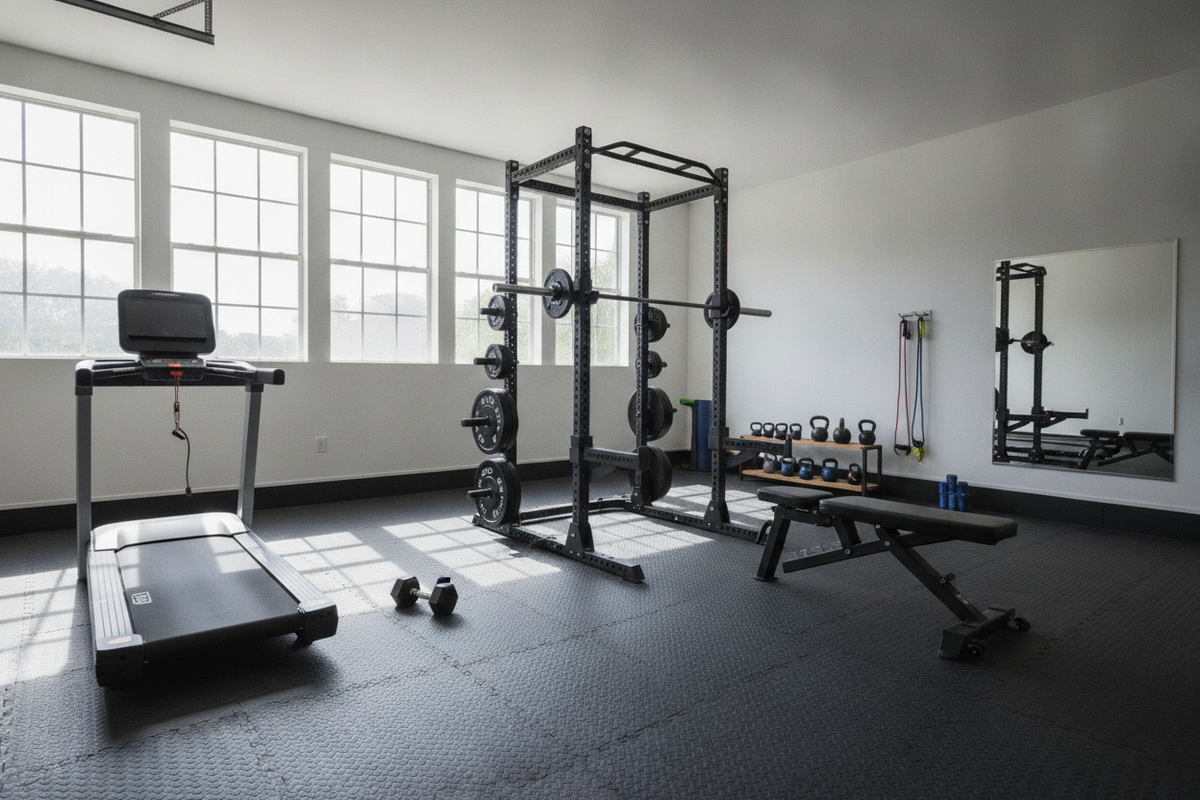
Creating a Stable Home Lifting Environment: Floor Protection and Staging
Lifting heavy weights at home demands a secure, stable, and protective environment. Subfloor surfaces can easily suffer structural damage from heavy dumbbells, kettlebells, or barbells, while hard, slick floors introduce slip hazards during maximal efforts.
A dedicated, high-density workout mat or specialized rubber flooring provides several practical advantages:
- Subfloor and Equipment Protection: Dense gym flooring absorbs the kinetic energy of placed or dropped weights, preventing cracked tiles, damaged hardwood, and scuffed equipment.
- Traction and Joint Stability: A non-slip textured surface ensures firm footing during wide-stance squats, lunges, and overhead presses, allowing lifters to direct force straight into the ground.
- Point-Load Distribution: Spreading the downward force of heavy racks and free weights prevents permanent indentation in domestic flooring layers.
Setting up an expansive, dedicated surface such as a multi-purpose workout product creates a clearly demarcated training zone that supports compound lifts, mobility warm-ups, and auxiliary work in one cohesive space.
Common Muscle-Building Lifting Mistakes and How to Correct Them
Even motivated lifters often encounter plateaus when technical errors or planning flaws creep into their programming. Identifying and addressing these issues early helps sustain progress and supports longevity under the bar.
- Sacrificing Technique for Load: Increasing weight before mastering joint mechanics introduces momentum and shifts mechanical tension away from target muscles. Prioritize form consistency across every working set.
- Inconsistent Tracking: Failing to log loads, repetitions, and sets makes it difficult to verify whether progressive overload is actually occurring over consecutive training blocks.
- Neglecting Recovery Protocols: Muscle tissue adapts during rest periods outside the gym. Inadequate sleep, erratic nutrition, and excessive daily stress blunt hypertrophy adaptations.
- Unstable Ground Contact: Lifting on uneven, overly soft, or slippery surfaces impairs force transfer and destabilizes the feet and ankles during heavy compound lifts. Always lift on a flat, firm, non-slip base.