Best Full Body Exercise Equipment: A No-BS Guide for Home Gyms
Building a comprehensive home gym shouldn't require sacrificing your garage parking spot or emptying your savings account. If you are dealing with limited square footage or a tight budget, finding the best full body exercise equipment is the ultimate game-changer. It is the difference between a cluttered, chaotic workout space and a streamlined, highly effective training zone.
Whether you are trying to break through a frustrating plateau or just want a reliable way to train every major muscle group before your morning commute, this guide will help you cut through the marketing noise and find the machine that actually fits your needs.
Key Takeaways
- Space efficiency is paramount: The ideal machine should require less than 50 square feet of total operational clearance.
- Look for dual-action mechanics: Equipment that engages both the upper and lower body simultaneously (like rowers or fan bikes) maximizes calorie burn.
- Prioritize progressive overload: The best full body workout equipment allows you to easily increase resistance as you get stronger.
- Cable systems rule for versatility: Functional trainers offer the highest number of exercise variations per square foot.
What Makes a Machine Truly "Full Body"?
Not all all-in-one machines are created equal. When evaluating your options, the core focus should be on biomechanics and adaptability.
Resistance Types Explained
You will generally choose between selectorized weight stacks, plate-loaded systems, or dynamic resistance (like water, air, or magnetic). Weight stacks offer the fastest transitions for circuit training, while plate-loaded systems are incredibly durable and cost-effective if you already own bumper plates.
The Versatility vs. Footprint Trade-off
A massive 8-station jungle gym is phenomenal, but impractical for a 10x10 spare bedroom. The sweet spot for most North American homes is a compact functional trainer or a high-quality smart rower. These provide hundreds of movement patterns without dominating your floor plan.
Fitting It Into North American Homes
Space planning is where most home gym dreams hit a wall. You need to account for both the static footprint of the machine and the dynamic clearance required when it is in use.
Basements, Garages, and Apartments
If you are setting up in a basement, ceiling height is your biggest enemy. Standard racks often require 84 inches, but if you are doing pull-ups, you need at least 96 inches. For garage gyms, consider the slope of the floor and temperature fluctuations—powder-coated steel holds up best against humidity. When shopping for the best full body workout equipment for an apartment, noise dampening (like magnetic resistance or nylon-coated cables) is just as critical as the physical dimensions.
From Our Gym: Honest Take
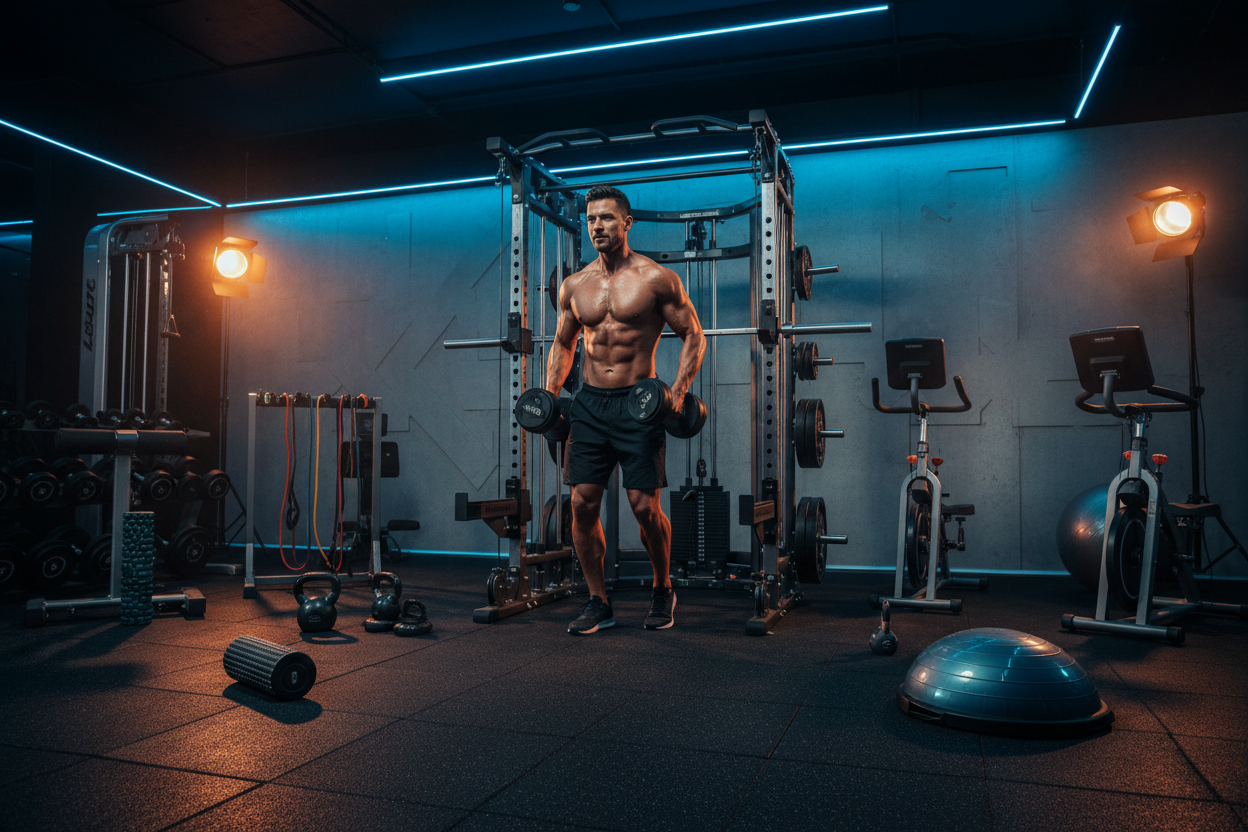
We recently spent three months rigorously testing a popular mid-tier functional trainer in our uninsulated garage facility. The dual 160-pound weight stacks provided plenty of resistance for everything from heavy lat pulldowns to cable pull-throughs.
However, here is the honest truth: at 6'2", I found the standard cable length slightly restrictive during walking lunges. I had to swap out the stock carabiners for low-profile ones just to get an extra inch of stretch. That said, the aluminum pulley wheels were buttery smooth, and after 90 days of daily use in a damp environment, the powder-coated frame showed absolutely zero signs of rust or wear. It is an incredible value, provided you measure your wingspan before buying.
Frequently Asked Questions
Is an all-in-one machine worth the investment?
Yes, provided you use it consistently. While the upfront cost is higher than buying individual dumbbells, a single versatile machine is vastly more cost-effective and space-efficient than trying to replicate a commercial gym piece by piece.
How much space do I actually need?
Most compact full body trainers require a static footprint of roughly 4x4 feet. However, you should always plan for an operational footprint of at least 6x6 feet to allow for full range of motion, especially for exercises like cable crossovers or deep lunges.
Can I build real muscle with just one machine?
Absolutely. As long as the equipment allows for progressive overload (the ability to consistently increase the resistance or difficulty) and you are eating a protein-rich diet, your muscles will grow. The body doesn't know what machine you are using; it only recognizes tension and fatigue.