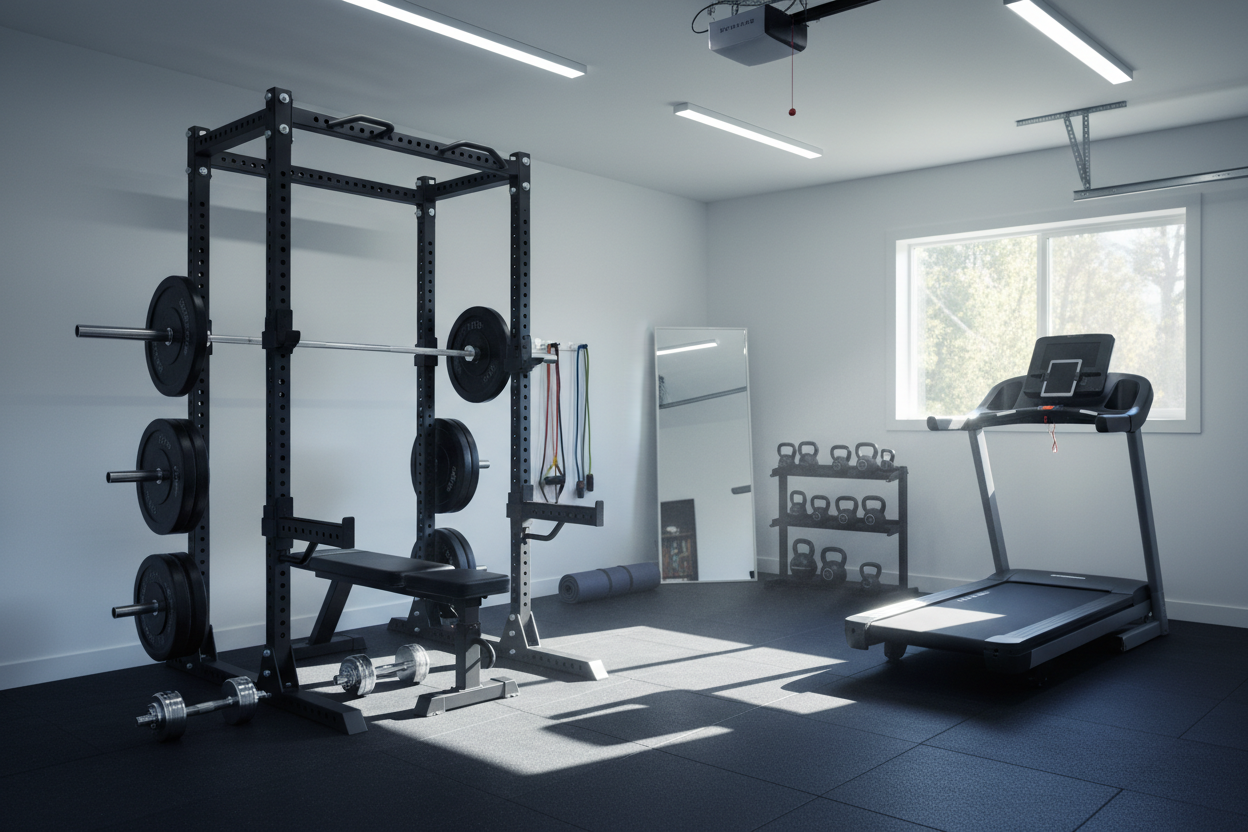
Best Exercise Program at Home: Stop Fighting Your Psychology
Last year, a client called me from her cramped 6x6 foot apartment living room, staring at a $2,000 smart mirror she had not turned on in three months. She thought buying the most high-tech gear would force her to work out. Instead, it just made her feel guilty. This happens constantly. People buy into a physiological trend instead of looking at their own psychological wiring. If you want to stop starting over, the best exercise program at home is the one that actually matches your personality.
When you train in your living room or garage, you are the trainer, the client, and the janitor. There is no peer pressure to keep you moving. I have built dozens of home gyms, and I can tell you that the secret to consistency is what I call behavioral compliance. You have to stop fighting your natural tendencies and start leaning into them.
Quick Takeaways
- Behavioral compliance beats perfect biomechanics every single time.
- Commercial gyms rely on peer pressure; home gyms rely on intrinsic motivation.
- Identify your psychological archetype (Tracker, Minimalist, Gamifier, Explorer) before buying gear.
- Design your physical space to eliminate setup friction.
Why the Perfect Routine is Failing You
I see it all the time. Someone decides they want to get fit, so they download a six-day-a-week hypertrophic bodybuilding split because a fitness influencer swore by it. Biomechanically, it might be the best fitness program at home. Psychologically, it is a disaster waiting to happen.
The perfect routine is failing you because it requires a personality transplant. If you naturally hate spreadsheets, tracking rest periods down to the second will burn you out in two weeks. If you need a coach yelling at you, a quiet, self-guided yoga session will leave you bored and scrolling on your phone.
Behavioral compliance means choosing a routine that you actually look forward to doing. It is the acknowledgement that a suboptimal workout you do consistently will always yield better results than a flawless workout you quit after a month. Stop trying to force yourself into a mold that does not fit.
The Role of Psychology in Home Gym Success
Working out at a commercial gym is a social contract. You pack your bag, drive 15 minutes, swipe your card, and suddenly you are surrounded by people lifting weights. The environment does the heavy lifting for your motivation. At home, that external pressure vanishes completely.
In your garage or spare bedroom, your workout is competing with the laundry, the television, and the couch. This is why the psychological aspect of home training is so critical. Your chosen routine must inherently motivate you, or the friction of starting will simply be too high.
When I design spaces for clients, the first question I ask is not about their 1-rep max. I ask them what video games they play, how they organize their digital calendars, and whether they prefer a loud party or a quiet morning. These answers dictate the equipment we buy and the programming we select. If your home gym feels like a chore, you built the wrong gym.
Identifying Your Home Training Personality
Before you spend another dime on dumbbells or apps, you need to figure out how your brain works. The best home exercise programs are highly specific to the user. Are you motivated by data and measurable progress? Do you crave efficiency and hate wasting time? Do you need external competition to push yourself? Or do you get bored easily and need constant variety?
Take a hard look at your daily habits. Once you know your archetype, building your routine becomes incredibly simple.
The Data-Driven Tracker: Structured Progression
If you love balancing your budget, organizing spreadsheets, and seeing a line graph move up and to the right, you are a Tracker. You do not need flashy instructors or loud music. You need measurable, linear progression. The best workout program home setup for you is built around classic strength training principles: progressive overload, strict rep ranges, and tracked volume.
Trackers thrive on predictability. You want to know exactly what you are lifting today compared to last week. Because of this, you will likely prefer mechanical, consistent resistance. This is where investing in heavy-duty at home exercise machines or a solid power rack makes sense. You want equipment that provides exact numerical feedback.
Your ideal program runs in 4-to-8 week blocks. You hit the same compound movements—squats, deadlifts, presses—and incrementally increase the load by 2.5 to 5 pounds each week. Keep a physical logbook right next to your rack. The satisfaction of writing down a new personal record is what will keep you coming back to the garage day after day.
The Time-Crunched Minimalist: High Yield, Low Friction
If your calendar is a nightmare of back-to-back meetings and family obligations, you are a Minimalist. You do not have 20 minutes to set up a barbell or wait for an app to update. You need high-yield, intense sessions that take 30 minutes from warm-up to cool-down.
I am a Minimalist at heart. When I tested a popular 5-52.5 lb adjustable kettlebell for my own 10x10 foot spare room, I loved the space-saving aspect. But here is an honest downside I warn clients about: the internal locking mechanism rattled noticeably during ballistic swings. It drove me crazy. Minimalists need gear that is dead simple and instantly ready.
Your ideal setup is a heavy kettlebell, a pull-up bar, and a durable 6x4ft yoga mat that you can leave unrolled. You thrive on EMOMs (Every Minute on the Minute) and AMRAPs (As Many Rounds As Possible). The goal is zero friction. You should be able to walk into the room, kick off your shoes, and immediately start sweating.
The Competitive Gamifier: Interactive and Social
Some people need an opponent. If you play competitive sports, obsess over your smartwatch rings, or need a coach yelling your name, you are a Gamifier. A quiet room with a pair of dumbbells is your worst enemy. You need the best workout program at home to feature leaderboards, high-energy music, and virtual high-fives.
Gamifiers fail when they try to isolate themselves. You need an ecosystem. When selecting the best home fitness equipment, look for smart bikes, connected rowers, or heart-rate monitoring apps that sync with a global community. You want a screen that shows you exactly how hard you are working compared to the person in the virtual lane next to you.
Your programming should be class-based. Let the digital instructor dictate the pace, the resistance, and the intervals. Your only job is to show up and try to beat your previous output score. The gamification—earning badges, hitting milestones, and climbing the ranks—is the psychological hook that ensures you never skip a Monday.
The Movement Explorer: Variety and Flow
If doing three sets of ten bicep curls makes you want to pull your hair out, you are a Movement Explorer. You hate rigid structures. You view fitness as a physical practice rather than a mathematical equation. The best home workout guides for you focus on mobility, animal flow, calisthenics, and skill acquisition rather than pure muscle exhaustion.
Explorers need space, not heavy iron. Your workouts are multi-directional. You might start with yoga, transition into handstand practice, and finish with some light mace swinging. Because you are constantly moving across the floor, a standard tiny mat will not cut it. You need a sprawling 6x8ft exercise mat to safely support your sprawling, dynamic movements.
Your programming should be modular. Instead of a strict Monday-Chest, Tuesday-Back routine, pick three physical skills you want to master—like a pistol squat, a freestanding handstand, and a bridge. Spend 45 minutes a day playing with those movements. The desire to unlock a new physical skill is what will drive your consistency.
Designing Your Space to Match Your Program
Once you have identified your psychological archetype and selected the best home fitness programs to match, your physical space must reflect that choice. A cluttered, confused space leads to a cluttered, confused workout. If you are a Minimalist, hide the extra bands and gadgets. If you are a Tracker, put your whiteboard front and center.
Friction is the enemy of the home workout. If you have to move your coffee table, unroll a flimsy mat, and search for your resistance bands, you will quit before you begin. Dedicate a permanent zone for your training. At the absolute minimum, lay down a large exercise mat for home gym use. This creates a visual boundary. When you step onto that surface, your brain immediately recognizes that it is time to work.
Keep your space clean, well-lit, and temperature-controlled if possible. The easier it is to walk into your gym and start moving, the higher your compliance rate will be.
Final Thoughts: Committing to Your Path
Stop beating yourself up for failing at programs that were never designed for your brain. Fitness is not a one-size-fits-all endeavor. Whether you are tracking spreadsheets, swinging kettlebells, climbing a digital leaderboard, or mastering a handstand, your psychology is your most powerful tool.
Pick the archetype that resonates with you the most. Commit to a matched program for the next 12 weeks. Ignore the influencers, ignore the trends, and watch how easy consistency becomes when you finally stop fighting yourself.
Frequently Asked Questions
How many days a week should I work out at home?
For most people, 3 to 4 days of focused, intentional movement is the sweet spot for behavioral compliance. It allows for adequate recovery and prevents mental burnout while still driving physical adaptation.
Do I need heavy weights to see progress?
Not necessarily. While Trackers might prefer heavy barbells, Minimalists and Explorers can achieve incredible results using bodyweight leverage, resistance bands, and kettlebells. Intensity and consistency matter more than the specific tool.
What if my psychological style changes over time?
That is completely normal. You might spend a year as a Gamifier to lose weight, then transition into a Tracker to build strength. Reassess your goals and mental state every few months and adjust your programming accordingly.