
Best Exercise for Gluteus Medius: Stabilization Vectors, Abduction Mechanics, and Home Floor Staging
Identifying the single best exercise for gluteus medius development depends heavily on your training goals, whether you prioritize isolated muscle recruitment, pelvic stability during athletic movement, or functional single-leg strength. Because this fan-shaped muscle on the lateral aspect of the hip serves multiple mechanical roles, a complete training approach combines targeted isolation with closed-chain loaded patterns.
Understanding the Gluteus Medius: Anatomy, Planes of Motion, and Pelvic Stabilization
The gluteus medius originates on the outer surface of the ilium and inserts onto the lateral surface of the greater trochanter of the femur. Functionally, it is split into anterior, middle, and posterior fiber groups. The anterior fibers contribute to internal rotation and flexion, the posterior fibers assist with external rotation and extension, and the muscle as a whole serves as the primary hip abductor in the frontal plane.
Beyond moving the leg away from the midline, the most critical everyday function of the gluteus medius occurs during closed-chain single-leg stance. When one foot leaves the ground during walking, running, or stair climbing, the gluteus medius on the stance leg contracts to keep the pelvis level, preventing the opposite side of the pelvis from dropping. For a comprehensive overview of how this muscle functions in hip alignment, explore our detailed gluteus medius guide.
Evaluating the Contenders: The Best Exercise for Gluteus Medius by Movement Pattern
Rather than relying on a single movement, biomechanical efficiency requires categorizing exercises by their resistance vectors and joint actions. The most effective movements fall into direct isolation, dynamic standing abduction, and unilateral closed-chain stabilization.
Side-Lying Hip Abduction and Clamshell Variations for Direct Isolation
Side-lying hip abduction offers exceptionally clean isolation for the lateral hip musculature. By lying on your side with the working leg straight and slightly extended behind the midline, you minimize contribution from the anterior hip flexors, particularly the tensor fasciae latae (TFL).
- Execution Cue: Keep the working foot parallel to the floor or slightly internally rotated (toes pointing subtly downward) and raise the leg through a controlled arc without letting the pelvis roll backward.
- Clamshell Modifications: Elevating the feet or performing clamshells with a mini-band around the lower thighs shifts emphasis toward the posterior fibers through active external rotation.
Standing Cable and Banded Abductions for Constant Tension
Standing abduction drills provide progressive loading throughout the entire active excursion. Unlike floor drills where gravity vectors change at the bottom of the movement, resistance bands and cables maintain continuous tension across the active range.
- Lateral Band Walks: Placing a band around the forefeet or ankles during a quarter-squat lateral shuffle challenges both the moving leg (dynamic abduction) and the trailing leg (isometric stabilization).
- Standing Cable Abductions: Anchoring a cable cuff to the ankle and abducting across the body allows for precise micro-loading while demanding upright posture and core bracing.
Single-Leg Closed-Chain Exercises: Bulgarian Split Squats and Step-Downs
For functional athletic transfer, closed-chain unilateral exercises challenge the gluteus medius in its primary stabilizing role. In these movements, the muscle contracts isometrically and dynamically to prevent knee valgus and maintain level hips under load.
- Deficit Step-Downs: Standing on a raised platform and slowly lowering the free foot toward the floor forces the stance-side lateral hip to control pelvic rotation and tilt throughout the descent.
- Bulgarian Split Squats: Elevated rear-foot split squats create a challenging balance environment that demands continuous frontal-plane stabilization from the lead leg.
Common Technical Compensations and How to Correct Form
Because the lateral hip complex works closely with surrounding musculature, poor mechanics often shift loading away from the gluteus medius onto secondary movers. Recognizing these compensations preserves training intent:
- Pelvic Hiking: Lifting the hip bone toward the rib cage rather than abducting the femur recruits the quadratus lumborum (lower back) instead of the lateral glute. Focus on keeping the pelvic crests anchored.
- External Foot Rotation: Turning the toes upward during straight-leg raises transfers tension to the hip flexors. Keep the heel leading the movement.
- Lumbar Arching: Excessive extension of the lower spine often masks limited hip range of motion. Maintain an active brace through the abdomen during all standing and floor drills.
Programming Blueprint: Structuring Gluteus Medius Training Across the Week
A balanced weekly routine incorporates both heavy closed-chain training and targeted isolated work. Below is a structured layout that integrates lateral hip development without overtaxing recovery:
- Session A (Lower Body Strength): Begin with dynamic lateral band walks as a warm-up, follow with heavy Bulgarian split squats or barbell step-ups, and conclude with side-lying abductions for high repetitions.
- Session B (Unilateral & Accessory): Feature deficit step-downs paired with standing cable abductions, focusing on controlled eccentric tempos and full range of motion.
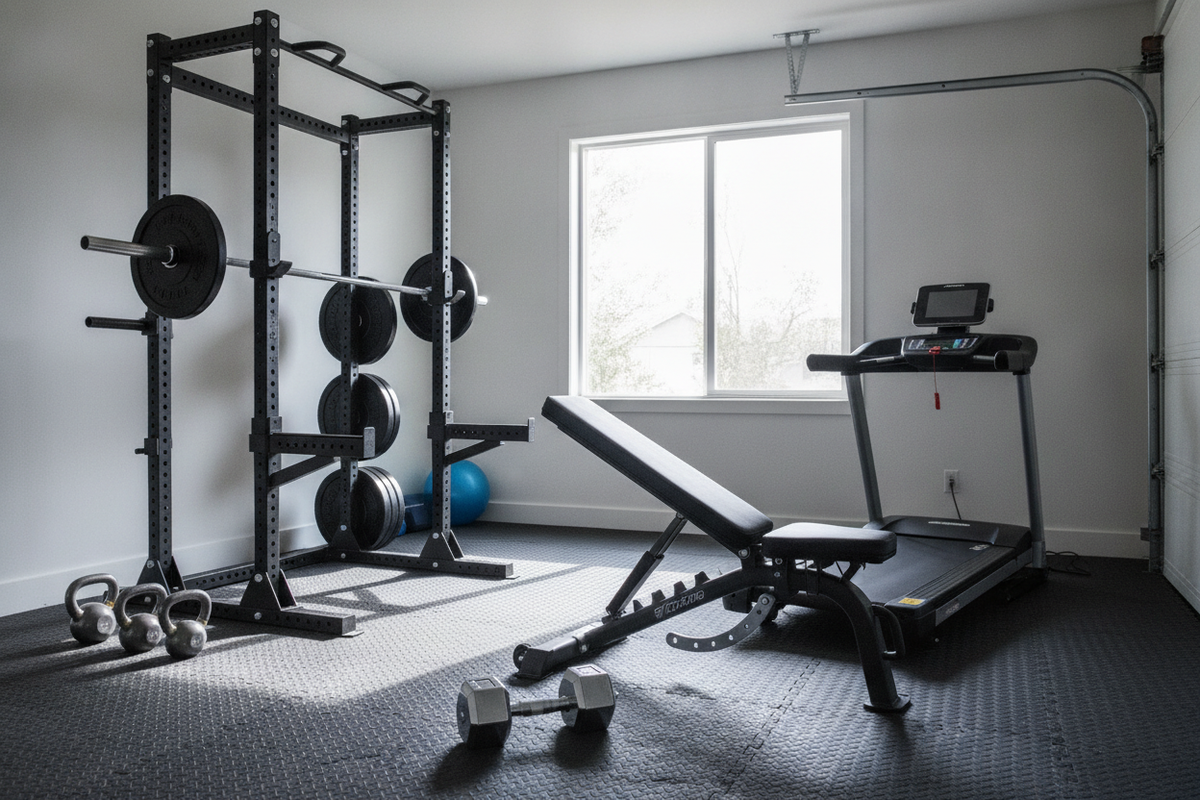
Home Gym Floor Staging and Setup for Hip and Lateral Drills
Executing lateral hip work at home requires intentional floor setup. Because these routines alternate between ground-based pressure points and dynamic standing footwork, standard hard floors can create discomfort and limit movement stability.
Pressure Distribution and Cushioning for Side-Lying Work
Floor-based abductions place direct bodyweight pressure onto the greater trochanter and lateral pelvic bones. Performing high-volume reps on hard flooring can cause discomfort that compromises your exercise cadence. Choosing supportive padding from an exercise collection ensures that hip contact points remain comfortable throughout isolation sets, allowing you to maintain strict pelvic alignment.
Surface Grip and Footing Stability for Dynamic Single-Leg Movements
Dynamic standing drills—such as lateral monster walks, split squats, and single-leg balance work—require a non-slip foundation. Mats that bunch up or slide across hard subfloors create unstable footing and disrupt balance. Setting up a dedicated training space with a 6x10ft exercise mat yoga mat gym flooring for home workout provides the surface area and grip needed to perform multi-directional strides and single-leg drills safely in a home gym environment.
Frequently Asked Questions About Gluteus Medius Training
How often should I train the gluteus medius?
For most fitness routines, training the lateral hip two to three times per week provides an effective balance of stimulus and recovery, particularly when alternating between light activation drills and loaded compound movements.
Are resistance bands better than bodyweight alone?
Bodyweight is sufficient for learning movement patterns and initial activation. Adding progressive band or cable resistance is valuable once bodyweight repetitions no longer provide an adequate training stimulus.


