At Home Exercise Schedule: The Modular Block Approach
It happens to my clients every week. You block out a full hour for training, but a Zoom call runs late, the dog throws up on the rug, and suddenly you only have 20 minutes left before dinner. If you follow a traditional routine, you probably just skip the session entirely.
As a personal trainer who has built and tested dozens of living room and garage gyms, I see this all-or-nothing mindset destroy consistency. You do not need a solid, uninterrupted hour to get results. Instead, you need a flexible at home exercise schedule built around what I call the modular block approach. By breaking your training into stackable 15-minute segments, you can adapt on the fly and never miss a day just because life got messy.
Quick Takeaways
- Ditch the 60-minute commercial gym mindset for 15-minute modular blocks.
- Stack or split your blocks throughout the day depending on your availability.
- Focus on weekly block volume rather than daily perfection.
- Keep a dedicated, always-ready floor space to eliminate setup friction.
Why Traditional Routines Fail Outside the Gym
When you train at a commercial gym, you naturally follow a specific timeline. You spend 10 minutes warming up, 40 minutes moving between squat racks and cable machines, and 10 minutes cooling down on a treadmill. It works because you are a captive audience. You drove there specifically to do that one task.
Trying to replicate that exact 60-minute timetable in your living room is a recipe for burnout. At home, your environment is full of competing priorities. Your brain knows the laundry needs folding and the inbox is pinging. When you attempt a rigid hour-long routine and get interrupted at minute 25, it feels like a failure. That frustration builds up, and eventually, you start skipping training days altogether because you just don't have the time to do it perfectly.
I tested a standard 5-day bodybuilding split on a group of busy dads last year. Within three weeks, an 80% compliance rate dropped to 30%. They didn't quit because the workouts were too hard; they quit because finding 60 uninterrupted minutes in a busy house was nearly impossible.
The Modular At Home Exercise Schedule Explained
The solution is to stop thinking of your workout as a single, monolithic event. Instead, break your fitness into 15-minute 'stackable' blocks. This is the foundation of a sustainable home exercise schedule. If you only have 15 minutes before your morning shower, you execute one block. If you have 30 minutes while the baby naps, you stack two blocks. If you have 45 minutes on a quiet Sunday, you stack three.
This modular approach completely removes the excuse of not having enough time. A 15-minute block is short enough to squeeze into the tightest margins of your day, but long enough to accumulate serious training volume if you keep your rest periods strict.
For example, a typical 15-minute strength block might consist of 40 seconds of work followed by 20 seconds of rest. Over 15 minutes, that equals 15 working sets. If you do that twice a day—once in the morning and once before dinner—you just completed 30 working sets without ever stepping foot in a gym or blocking out a massive chunk of your calendar.
Core Components of a Good At Home Workout Plan
To make this system work, you need to categorize your 15-minute blocks into three distinct buckets: Mobility, Strength, and Conditioning. A good at home workout plan balances these three elements over the course of the week.
Mobility blocks focus on joint health and movement quality. Think 90/90 hip stretches, thoracic spine rotations, and deep goblet squats holding a light 15-pound dumbbell. I prescribe these blocks for early mornings or right after a long stint sitting at a desk.
Strength blocks are the meat and potatoes of your routine. At home, you might not have a 300-pound barbell to force adaptation. You have to build intensity using unilateral moves like Bulgarian split squats, single-leg Romanian deadlifts, and archer push-ups. By focusing on one limb at a time, a standard pair of 5-52.5 lb adjustable dumbbells is more than enough to trigger muscle growth.
Conditioning blocks are designed to spike your heart rate. Kettlebell swings, jump rope intervals, and burpees fit perfectly here. Because these blocks are only 15 minutes long, you can push the pace much harder than you would during a 45-minute jog.
Designing Your Floor Space for Modular Workouts
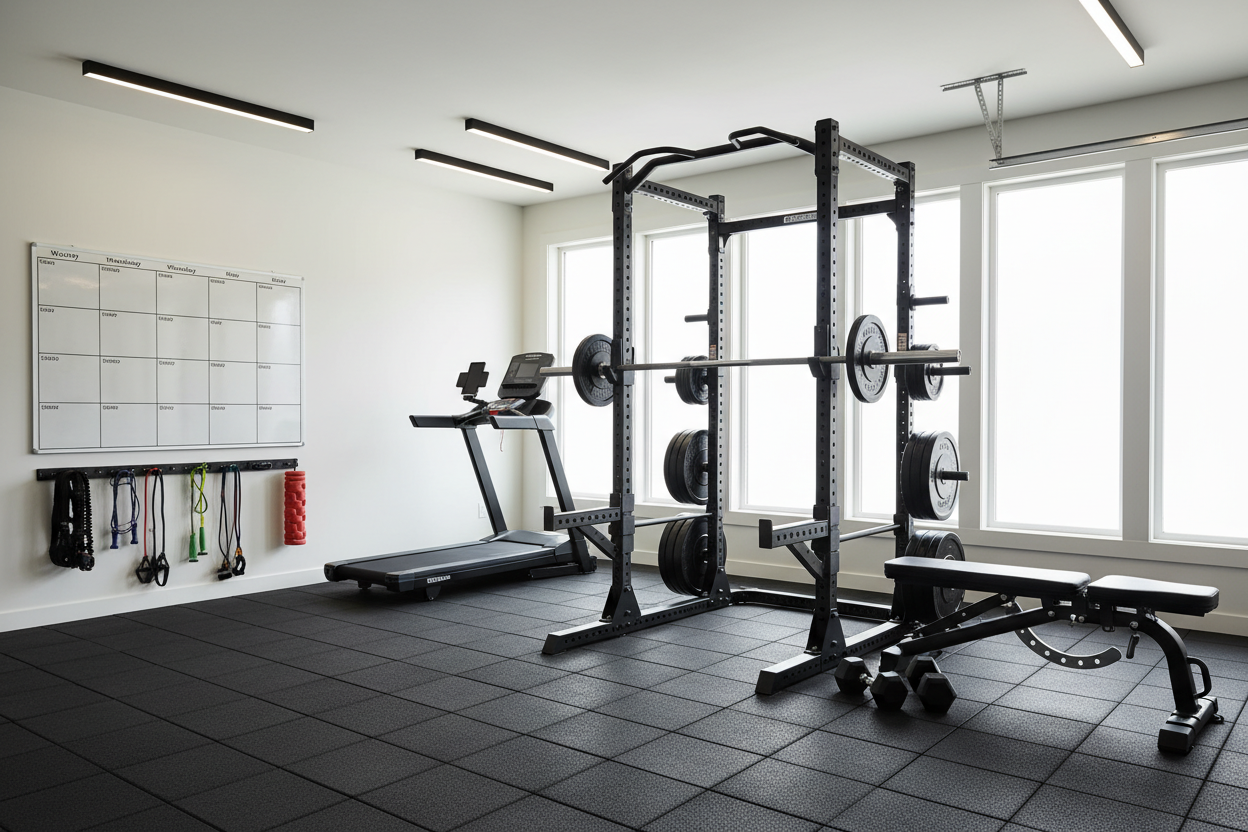
If you have to move the coffee table, sweep the floor, and unroll a flimsy yoga mat every time you want to train, you will never execute a 15-minute block. Setup friction is the enemy of consistency. You need an 'always-ready' training area.
You don't need a massive two-car garage. A dedicated 6x6 foot footprint in the corner of a home office or basement is plenty. The secret is making that space permanent. Investing in a large exercise mat for home gym use signals to your brain that this area is strictly for training. You can leave your adjustable dumbbells and kettlebells sitting right on the edge of it, ready to go.
I highly recommend putting down a durable 6x8ft exercise mat for this purpose. I used to train clients on cheap foam puzzle mats, and it was a disaster. During a set of lateral lunges, the puzzle pieces separated, and a client nearly rolled an ankle. A single-piece, heavy-duty mat provides the permanent traction you need to safely execute explosive conditioning blocks without sliding across the hardwood.
Sample Modular Home Exercise Schedules
How you stack these blocks depends entirely on your daily schedule. Here are three concrete examples of how to apply this to your life.
The 15-Minute Day (High Stress/Low Time)
When everything goes wrong, just get one block done.
Block 1 (Strength): 5 rounds of a 3-minute EMOM (Every Minute on the Minute). Minute 1: 15 Push-ups. Minute 2: 15 Goblet Squats. Minute 3: 15 Dumbbell Rows. You hit your entire body in exactly 15 minutes.
The 30-Minute Day (Standard Baseline)
This is the bread and butter for most of my clients.
Block 1 (Mobility): 15 minutes of dynamic stretching and core activation before breakfast.
Block 2 (Strength): 15 minutes of heavy lower-body unilateral work during your lunch break.
The 45-Minute Day (Weekend Warrior)
When you have a bit more breathing room, stack three blocks back-to-back.
Block 1: Mobility warmup.
Block 2: Upper body strength (overhead presses, floor presses, pull-ups).
Block 3: High-intensity conditioning (kettlebell swings and burpees).
Tracking Progress Without Rigid Timetables
The beauty of the modular system is that you stop measuring success by daily perfection and start measuring it by weekly volume. I tell my clients to aim for 10 to 12 blocks per week. That equals 150 to 180 minutes of total exercise.
If you miss a strength block on Tuesday because your kids got sick, you don't have to throw the whole week away. You simply tack an extra 15-minute block onto Thursday or Saturday. By tracking your total blocks in a notebook or app, you maintain long-term consistency. You learn to adapt to your shifting workload rather than fighting against it.
Frequently Asked Questions
Do 15-minute workouts actually build muscle?
Yes, provided you take your working sets close to muscular failure. Muscle growth is driven by mechanical tension, not the length of your workout. If you perform 15 sets of heavy split squats and push-ups in 15 minutes with strict rest periods, you will stimulate hypertrophy.
How much equipment do I really need for this schedule?
Keep it minimal. A pair of adjustable dumbbells (typically 5 to 50 lbs), a high-quality 6x8 floor mat, and a doorway pull-up bar are all you need to execute hundreds of different modular blocks effectively.
Should I combine strength and conditioning in the same 15-minute block?
I recommend keeping them separate. If you mix heavy lunges with burpees, cardiovascular fatigue will force you to drop the weight on your lunges, shortchanging your strength gains. Dedicate one block to strength, and a separate block to conditioning.