At Home Exercise Plans: The Micro-Dosing Strategy for Busy Days
I remember staring at my living room floor at 7 PM after a brutal nine-hour workday. My dumbbells were tucked away in the closet, and the thought of unrolling my yoga mat for a solid hour of sweating sounded like absolute torture. I skipped the workout entirely. That is the reality for most of my clients who try to force traditional gym routines into their living spaces. If you are struggling to stick to at home exercise plans, you aren't lazy. You are just using the wrong strategy for a busy life.
Quick Takeaways:
- Micro-dosing splits your daily volume into three or four 10-minute blocks.
- Shorter sessions eliminate the mental friction of starting a long, grueling workout.
- Leaving your equipment out permanently is the secret to consistency.
- Tracking weekly volume matters more than the length of a single session.
Why Traditional At Home Exercise Plans Often Fail
Most people approach their living room the exact same way they approach a commercial facility. They block off 60 to 90 minutes, put on a specific outfit, and try to hammer out five sets of six different exercises. When you are dealing with traditional at home exercise programs, this mindset is a massive trap. Your home is filled with distractions. The couch is right there. The laundry needs folding. The mental hurdle of committing to a full hour of intense physical exertion after a long day of work is simply too high for most mere mortals.
I've seen dozens of clients burn out within the first three weeks of starting exercise programs home style. They go hard for a few days, get aggressively sore, and then hit a wall. When they miss one 60-minute session, they feel like they failed the whole week. That all-or-nothing mentality is the enemy of progress.
You do not need to destroy yourself in a puddle of sweat on your living room rug to build muscle or improve your cardiovascular health. The physiological triggers for hypertrophy and strength do not care if you do all your sets consecutively or spread them out, as long as the total weekly volume and proximity to failure are adequate.
The Micro-Dosing Method: Redefining the Exercise At Home Program
Enter the micro-dosing strategy. Instead of dreading a monolithic hour of pain, you break your exercise at home program into bite-sized, 10-minute exercise snacks scattered throughout your day. Think of it as accumulating reps the way you accumulate loose change in a jar. By the end of the week, you have banked a massive amount of training volume without ever feeling exhausted.
When I structure fitness programs at home for busy professionals, I prescribe three or four short bursts of activity. You might do 10 minutes before breakfast, 10 minutes before lunch, and 10 minutes right after shutting down your laptop for the evening. This drastically lowers the barrier to entry. Everyone has 10 minutes. You don't even need to change your clothes.
This isn't a watered-down approach, either. In fact, this mirrors many of the programs gym veterans use at home to maintain heavy muscle mass when they can't get to the weight room. By hitting a muscle group fresh multiple times a day, you can actually push closer to true muscular failure with better form. You avoid the junk volume that happens at the end of a long workout when you are just going through the motions.
Morning Activation: Priming Your Body for the Day
Your first micro-dose should happen within 30 minutes of waking up. The goal here isn't to set a personal record on the deadlift; it is to lubricate your joints, activate your core, and shake off the stiffness of sleep. I usually program this as a continuous circuit.
Start with two minutes of dynamic stretching—think arm circles, cat-cows, and deep bodyweight lunges with a thoracic twist. Then, move into a simple bodyweight circuit. Do 15 air squats, a 30-second plank, and 10 glute bridges. Repeat that sequence for three rounds. It takes exactly eight to ten minutes.
This brief morning block is the foundational pillar of most successful workout at home programs. It spikes your heart rate just enough to wake up your central nervous system, effectively replacing that second cup of coffee. Because it is so short, you won't break a heavy sweat, meaning you can jump straight into the shower or head right to your home office desk feeling energized rather than depleted.
Mid-Day Strength: The Lunch Break Pump
The second block hits right around noon. You have been hunched over a keyboard for four hours, and your posture is probably suffering. This is where we inject the heavy, dense strength work. We treat this 10-minute window like a focused home workouts gym session, utilizing either adjustable dumbbells (I highly recommend a 5-52.5 lb set for versatility) or strict, challenging bodyweight variations.
Pick two opposing movements. A classic pairing is the dumbbell goblet squat and the push-up. Set a timer for 10 minutes. Perform 10 to 12 reps of the goblet squat, rest for 30 seconds, and then perform a set of push-ups leaving one or two reps in the tank. Rest another 30 seconds and repeat.
Because you are only working for 10 minutes, you can push the intensity hard. You will accumulate 40 to 50 high-quality reps of each movement before the timer goes off. The beauty of this mid-day pump is that the short duration prevents you from getting completely drenched in sweat, so you can easily wipe down and get back to your afternoon meetings.
Creating a Frictionless Space for Fitness Programs for Home
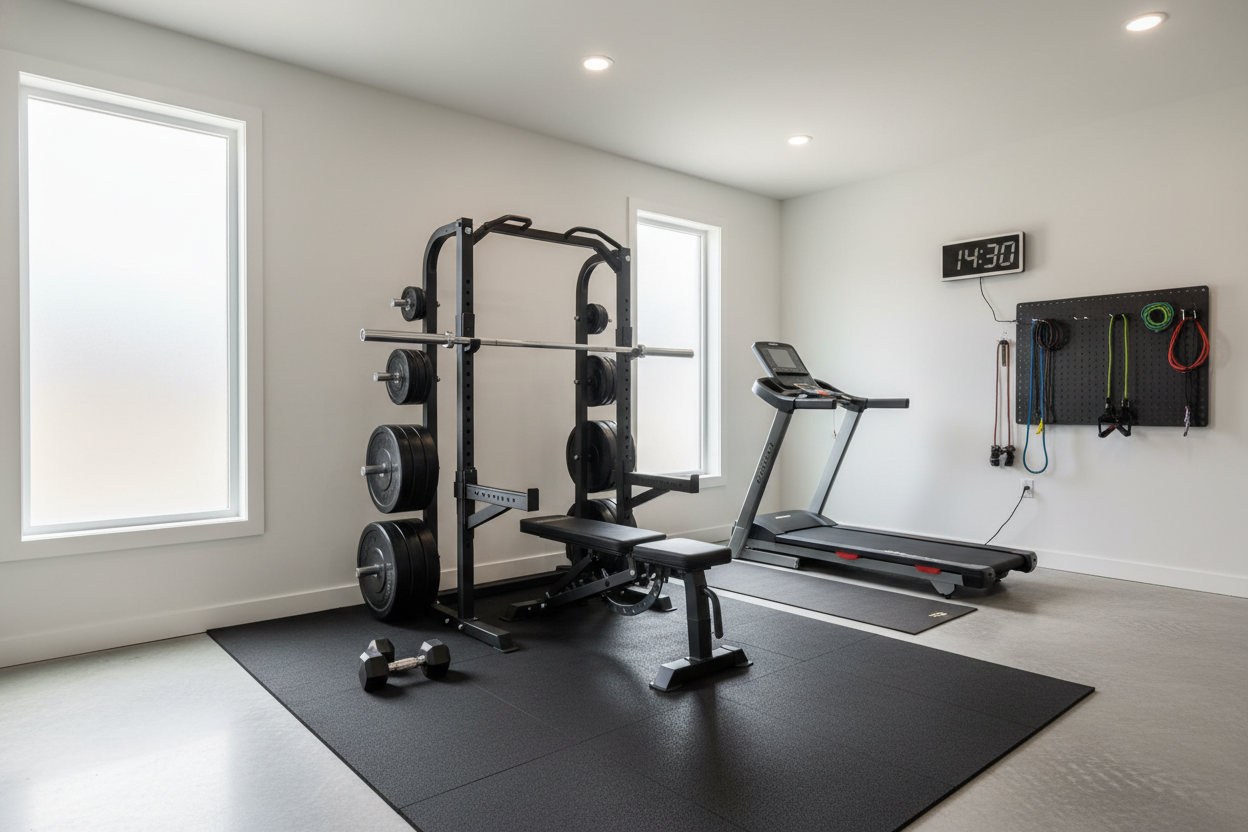
The micro-dosing strategy completely falls apart if you have to spend five minutes setting up your equipment for a 10-minute workout. Out of sight means out of mind. To make fitness programs for home actually stick, you must remove every ounce of friction between you and your workout space.
I learned this the hard way. Early in my training career, I kept my kettlebells in the garage and my resistance bands stuffed in a drawer. I never used them. It wasn't until I carved out a permanent, dedicated 6x6 foot space in the corner of my office that my consistency skyrocketed.
Stop unrolling a flimsy, curling yoga mat every time you want to do a quick set of push-ups. Invest in a permanent large exercise mat for home gym use. Having a dedicated, high-density surface permanently laid out signals to your brain that this is an active space. I personally tested a 6x4ft exercise mat in my own living room setup. It provides incredible grip for barefoot kettlebell swings and dampens the noise of dropping weights, which keeps my downstairs neighbors happy. The only downside is that a mat this heavy (around 15 lbs) isn't really portable, so you have to commit to its location. But that permanence is exactly what makes any fitness program at home successful. You walk by it, you do a set of curls, and you move on with your day.
Tracking Your Home Workout Training Volume
When you chop your workouts into tiny pieces, it is easy to lose sight of the big picture. Doing random sets of lunges whenever you feel like it is better than nothing, but it isn't a structured routine. To see real physiological changes from your home workout training, you still need to apply the principle of progressive overload.
Keep a simple notebook open on your desk or use a basic notes app on your phone. Every time you complete a 10-minute micro-dose, tally up the sets and reps. For example, if you do three sets of 15 push-ups on Monday, Wednesday, and Friday, you've accumulated 135 push-ups for the week. Next week, your goal is to hit 140.
This weekly volume tracking shifts your perspective. You stop worrying about having a flawless single workout and start focusing on the aggregate data. If you miss a Tuesday morning session because you overslept, it doesn't ruin the week. You simply tack an extra 10-minute block onto Thursday afternoon to make up the volume. It makes your training incredibly resilient to the chaos of daily life.
FAQ
Can I really build muscle with only 10-minute workouts?
Yes. Muscle growth is driven by mechanical tension and total volume. Four 10-minute sessions equal 40 minutes of high-quality work. As long as you take your sets close to failure, your muscles will grow.
Do I need to warm up before every micro-workout?
Keep it brief. Since the sessions are short and targeted, 60 seconds of arm circles or bodyweight squats is usually enough to get blood flowing before you pick up a dumbbell.
What equipment is best for micro-dosing at home?
A permanent floor mat and a pair of adjustable dumbbells are ideal. They require zero setup time, allowing you to walk over, lift, and get right back to your day.