6 Leg Sculpting Strategies: Movement Mechanics, Unilateral Balance, and Home Floor Staging
The Biomechanics of Leg Sculpting: Tension, Alignment, and Muscle Recruitment
Achieving defined lower-body tone requires a structured understanding of biomechanics rather than chasing random muscular fatigue. Effective leg sculpting relies on directing mechanical tension across the quadriceps, hamstrings, glutes, and calves through complete ranges of motion. When alignment remains stable, muscle fibers across the anterior and posterior chains engage uniformly, producing balanced muscular development without excessive joint irritation.
Knee-Dominant vs. Hip-Dominant Loading Patterns
A balanced lower body routine pairs knee-dominant patterns with hip-dominant movements. Knee-dominant exercises, such as goblet squats and forward lunges, emphasize the quadriceps and anterior compartment. Conversely, hip-dominant patterns, such as hinges and deadlifts, shift the primary workload to the gluteal complex and hamstrings. Cycling between these movement profiles prevents muscular overdominance and supports functional symmetry across the hips and knees.
The Value of Time Under Tension and Controlled Eccentrics
Rather than relying purely on heavy external loads, focusing on deliberate tempo enhances muscular recruitment. Controlling the eccentric, or lowering, phase of each repetition increases mechanical tension while encouraging joint stability. By slowing down transitions and eliminating momentum, you stimulate targeted muscle fibers efficiently within an at-home environment.
Essential Leg Sculpting Exercises for Complete Lower Body Tone
Targeting the lower body across multiple planes of motion builds comprehensive definition while strengthening stabilizing structures. Relying on a foundational blueprint for strong sculpted legs ensures that every muscle group receives adequate stimulus without redundant strain.
Unilateral Focus: Split Squats and Reverse Lunges
Unilateral exercises expose and resolve side-to-side strength discrepancies. Movements like Bulgarian split squats and reverse lunges challenge the primary working leg while forcing the pelvic stabilizers and core musculature to maintain level alignment. Step back smoothly during reverse lunges to maintain vertical shin positioning and direct loading through the heel and midfoot.
Posterior Chain Mechanics: Romanian Deadlifts and Floor Bridges
Developing tone across the back of the legs demands strict hinge mechanics. Romanian deadlifts emphasize hamstring length under load, requiring a soft knee bend and deliberate hip pushback. Pairing standing hinges with floor-based glute bridges allows for deep peak contractions at the top of the range while keeping spinal loading minimal. Reviewing effective movements for sculpted legs provides useful cues for maintaining a neutral spine throughout these variations.
Lateral and Rotational Control: Side Lunges and Curtsy Variations
Most daily activities and traditional lifts occur in the sagittal plane. Incorporating frontal-plane drills, such as lateral side lunges and curtsy lunges, engages the adductors, abductors, and outer glute complexes. These multi-planar drills complete the aesthetic definition of the lower body and improve dynamic balance.
Structuring an At-Home Sculpted Legs Workout Routine
An effective home session balances intensity, exercise order, and recovery intervals. Structuring your workout ensures that compound and unilateral movements receive maximum physical focus before fatigue sets in:
- Dynamic Warm-Up: Perform bodyweight hinges, ankle mobility drills, and lateral band walks to prime joint fluid and neuromuscular pathways.
- Primary Compound Lift: Begin with a foundational bilateral or heavy unilateral movement, such as a tempo goblet squat or Romanian deadlift, focusing on clean mechanics.
- Unilateral and Multi-Planar Pairings: Alternate between forward-back lunges and lateral step-outs to address all angles of the hip and thigh.
- Floor-Based Isolation: Conclude with controlled glute bridges, hamstring walkouts, or calf raises to exhaust targeted muscle groups without spinal load.
- Rest Intervals: Allow adequate recovery between sets to maintain movement quality and avoid sloppy repetitions driven by cardiovascular exhaustion.
Floor Staging, Traction, and Joint Cushioning for Lower Body Training
Dynamic lower-body training introduces significant shear forces, ground reaction pressure, and lateral friction. Exercising on unyielding hardwood, slick tile, or overly plush carpet can destabilize the feet and compromise knee tracking.
Preventing Knee and Ankle Shear on Resilient Mats
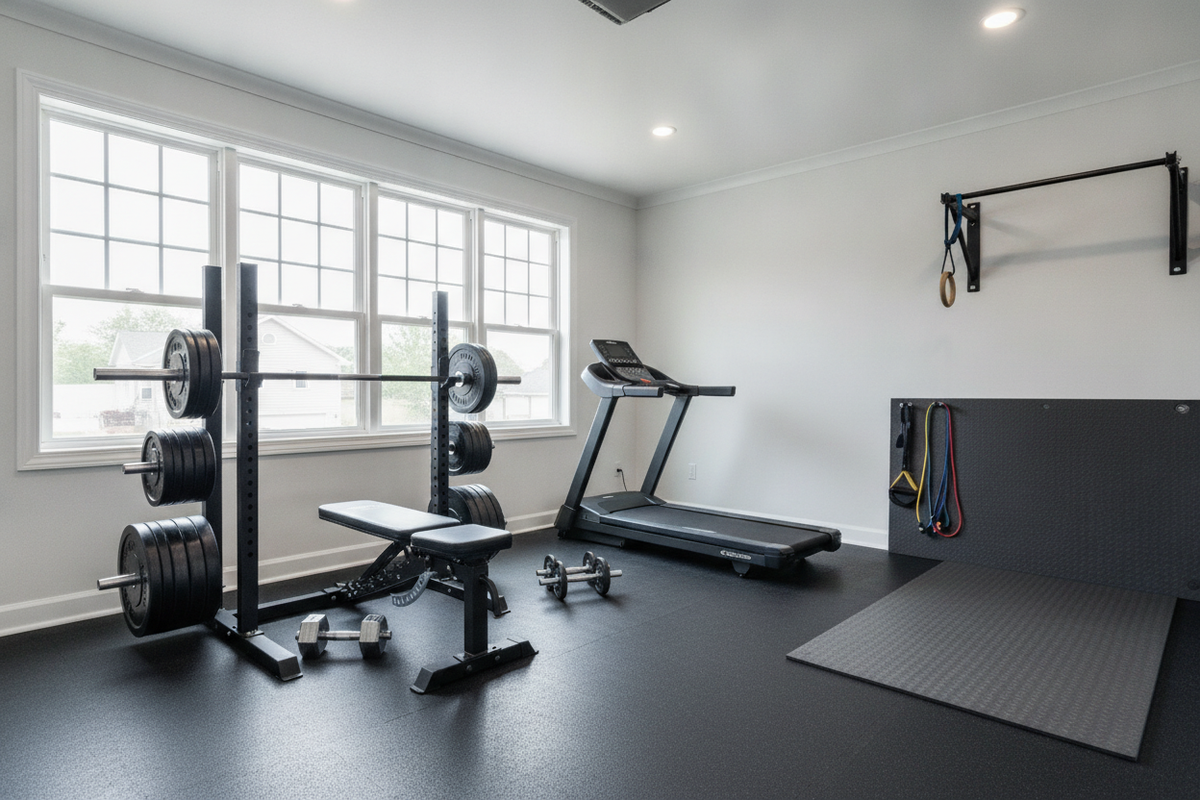
During wide-stance squats or deep lunges, the trailing knee and lead ankle rely on surface stability. A high-density, slip-resistant surface provides the firm base required for balance while absorbing the downward pressure of kneeling transitions. Setting up on a dedicated 6x10ft exercise mat gym flooring creates a dependable zone where shoes or bare feet maintain steady grip throughout wide lateral transitions.
Subfloor Defense and Dumbbell Staging
Lower body training often involves holding dumbbells, kettlebells, or resistance bands. Staging weights directly on residential floors risks surface scratching or structural impact marks during transitions. A resilient gym mat cushions floor contact when setting down equipment between sets and defines a clean perimeter free from household clutter.
Long-Term Progression, Floor Care, and Training Consistency
Sustained muscular definition results from progressive overload, regular training frequency, and smart equipment maintenance. Small adjustments in tempo, added repetitions, or incremental load increases ensure continuous neuromuscular adaptation. Simultaneously, maintaining your training surface by wiping away sweat and dust preserves mat traction and prolongs floor life. Establishing a dedicated training space with reliable footing makes consistent lower-body workouts both accessible and sustainable over the long term.