2-Week Workout Plan to Gain Muscle at Home: High-Density Routines, Biomechanical Tension, and Home Gym Floor Setups
Understanding Muscle Gain Timelines: The 2-Week Hypertrophy Primer
Starting a targeted training phase at home requires clear expectations regarding timelines and physiological adaptations. When undertaking a structured fourteen-day routine, the immediate benefits center around motor unit recruitment, improved neuromuscular coordination, and laying down baseline mechanical tension across prime movers.
Neuromuscular Activation and Muscle Tension Foundations
During the early days of a resistance routine, the nervous system adapts rapidly by coordinating muscle fiber recruitment. This neuromuscular efficiency allows you to generate stronger muscular contractions, stabilize joints during multi-planar movements, and prepare soft tissues for ongoing progressive overload. Establishing reliable movement patterns early ensures that every subsequent training block delivers meaningful stimulus directly to target muscle groups.
Setting Realistic Expectations for a 14-Day Hypertrophy Block
While substantial structural hypertrophy requires long-term consistency, a focused two-week routine serves as an intensive primer. It establishes movement discipline, optimizes lifting tempos, builds training density, and prepares connective tissue for sustained mechanical stress. Approaching the fortnight as a dedicated foundation block allows you to hone technique without accumulating excessive joint fatigue.
The 2-Week At-Home Hypertrophy Framework
Training at home often involves working with bodyweight, resistance bands, or moderate dumbbell loads. To generate sufficient stimulus without heavy commercial machines, the focus must shift toward training density, deliberate tempo control, and strategic movement selection.
Creating Overload Without Heavy Gym Machinery
Overload at home is achieved by manipulating mechanical leverage, reducing rest intervals, and increasing movement quality. Adjusting foot elevation during push-ups, lengthening the lever arm on lateral raises, or shifting into unilateral stances during leg training increases tension significantly without demanding specialized barbell apparatus. If you want to blend conditioning stimulus with resistance work, exploring a conditioning and muscle-building hybrid workout can illustrate how structured pacing elevates training density.
Tempo Manipulation, Isometric Pauses, and Time Under Tension
Time under tension serves as a primary driver of muscular stimulation when external loads are limited. Implementing a controlled lowering phase, followed by a momentary pause at the point of maximum stretch or contraction, eliminates momentum and forces target muscle groups to sustain high levels of tension throughout the full range of motion.
Structuring the 4-Day Upper/Lower Split Routine
An Upper/Lower split executed across four training days per week offers an optimal balance between targeted volume and local muscle recovery. The weekly schedule follows a repeatable structure:
- Day 1: Upper Body Focus (Push, Pull, and Arm Hypertrophy)
- Day 2: Lower Body Focus (Knee-Dominant, Hip-Dominant, and Calves)
- Day 3: Active Recovery or Mobility
- Day 4: Upper Body Focus (Mechanical Variations and Isometric Emphasis)
- Day 5: Lower Body Focus (Unilateral Balance and Posterior Chain)
- Day 6: Active Rest and Joint Decompression
- Day 7: Full Rest
Day-by-Day 2-Week Workout Plan to Gain Muscle at Home
This 2-week workout plan to gain muscle at home is divided into two distinct weekly progressions designed to build movement proficiency and elevate workload density.
Week 1: Establishing Mechanical Tension and Movement Mechanics
Week 1 focuses on strict posture, standard tempos, and clean execution across foundational movement patterns.
- Upper Body Session A: Push-ups with controlled eccentric tempo, standard floor inverted rows or bent-over household dumbbell rows, seated overhead shoulder presses, and plank shoulder taps.
- Lower Body Session A: Bodyweight split squats, Romanian deadlifts with resistance bands or hand weights, reverse lunges, and glute bridges with sustained contraction at lockout.
- Upper Body Session B: Incline or deficit push-ups, doorway or towel pull variations, lateral raises with controlled pauses, and diamond push-ups for tricep emphasis.
- Lower Body Session B: Goblet squats, single-leg Romanian deadlifts, side-to-side lateral lunges, and standing calf raises with full bottom-range stretches.
Week 2: Increasing Density, Volume, and Session Intensity
Week 2 introduces higher density by shortening transition times between sets and integrating brief isometric holds at peak contraction points. Repetition ranges expand slightly to challenge muscular stamina while keeping form uncompromisingly strict.
Exercise Blueprints: Movement Execution Guidelines
Maintaining proper joint alignment during home training ensures long-term training consistency. On push-ups, keep the core braced, glutes engaged, and elbows tucked at a comfortable angle relative to the torso. During split squats and lunges, distribute weight evenly across the front foot to maintain steady balance and uniform tension through the quadriceps and glutes.
Optimizing Your Home Training Environment and Floor Protection
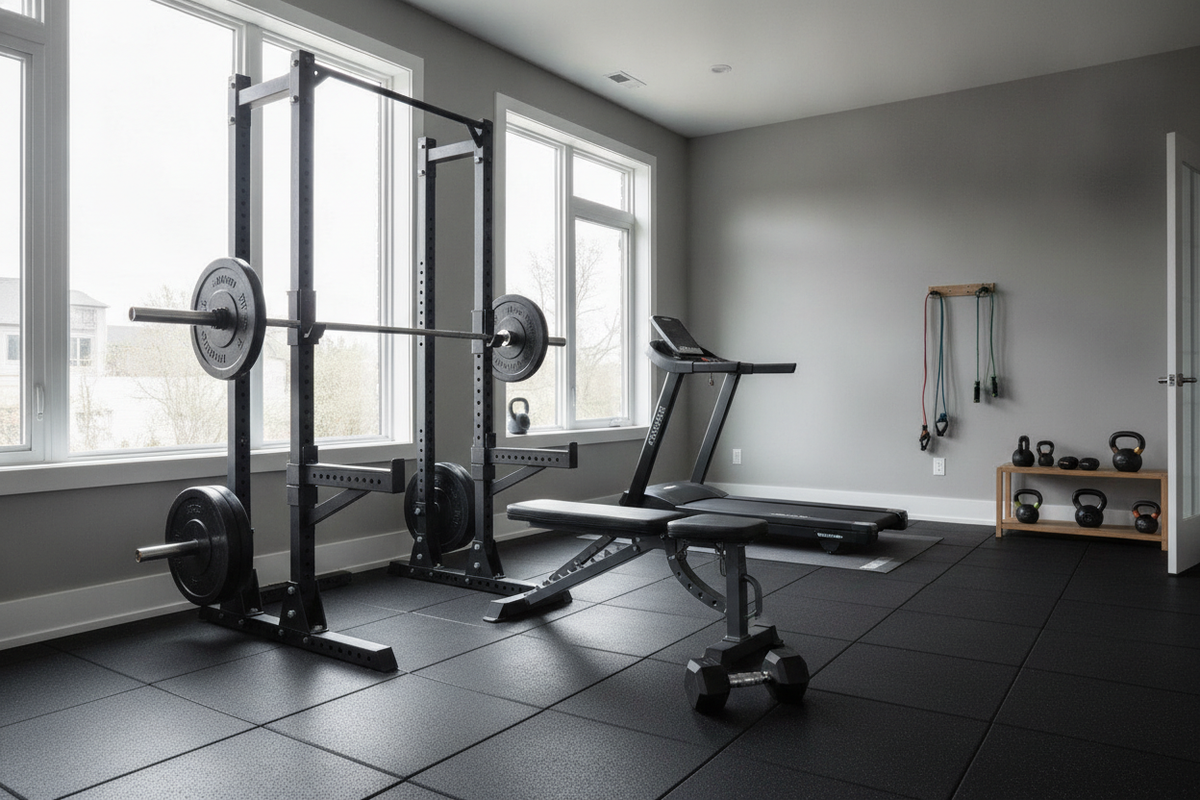
A successful home workout split requires a safe, functional training surface. Setting up a dedicated training zone shields your home subfloors from equipment abrasion and provides essential joint comfort during floor-based routines.
Impact Absorption and Joint Relief During High-Tension Lifting
Performing kneeling lunges, push-ups, and floor presses on hard subfloors like concrete or tile can place unnecessary pressure on knees, wrists, and elbows. Laying down a high-density gym flooring mat delivers supportive cushioning that distributes contact pressure evenly without sacrificing stability.
Equipment Placement and Subfloor Protection on Hardwood or Tile
Resting hand weights, kettlebells, or resistance anchors directly on finished floors can cause scuffs, dents, or scratches over time. Utilizing a large-format exercise mat for home workouts establishes a durable physical barrier that shields residential flooring while defining a structured exercise zone.
Mat Traction and Slip Prevention for Explosive and Unilateral Drills
Unilateral exercises such as walking lunges and split squats require dependable surface traction. A stable, non-slip textured surface keeps shoes or bare feet firmly anchored during stance transitions, allowing you to focus entirely on lifting technique rather than foot slippage.
Recovery, Nutrition, and Transitioning Beyond Two Weeks
Muscular development relies equally on targeted physical stress and proper systemic recovery. Adapting your daily habits during and after this fourteen-day block ensures that the stimulus translates into meaningful physical adaptations.
Hydration, Protein Pacing, and Sleep Quality for Tissue Repair
Consistent water intake supports cellular hydration and nutrient delivery to recovering muscle tissues. Distributing protein evenly across daily meals supplies the amino acids necessary for continuous tissue repair. Prioritizing structured sleep schedules further aids physical recuperation between demanding training sessions.
Transitioning from a 2-Week Kickstart to Sustainable Splits
Once you complete the initial fortnight, use your established momentum to step into longer-term programming. Moving into a structured multi-week muscle split allows you to progressively add load, increase volume, and refine target weak points. For a broader library of routines and training structures, explore the comprehensive workout training hub to continue expanding your home fitness journey.