2 Month Booty Transformation: Progressive Glute Workouts, Biomechanical Blueprints, and Home Floor Stability
The Anatomy of an 8-Week Glute Timeline: Realistic Adaptations and Expectations
Embarking on a 2 month booty transformation requires understanding how muscle tissue and movement mechanics adapt over time. When lifters look at visual milestones across a fitness journey, expectations must align with biological phases. A dedicated 1 month booty transformation largely establishes neuromuscular recruitment and baseline movement proficiency. During the opening four weeks, the nervous system becomes more efficient at activating the gluteus maximus, medius, and minimus during hip extension and abduction patterns.
As training extends into weeks five through eight, progressive overload creates consistent mechanical tension, supporting localized muscular development. When approaching a booty transformation in 6 weeks or evaluating progress toward a booty transformation 2 months in, visual changes typically manifest as improved glute firmness, posture refinement, and enhanced muscle tone under load. True long-term structural changes continue to compound across extended periods, which is why a one year glute transformation produces far more pronounced tissue density compared to short-term cycles. Approaching a natural booty transformation with a long-term mindset ensures training consistency without relying on unsustainable routines. For broader foundational concepts, review our comprehensive booty workout glute guide.
Core Biomechanical Movement Vectors for Glute Hypertrophy
An effective glute transformation workout must target muscle fibers across multiple movement planes. Relying solely on a single exercise leaves significant growth potential untapped. A comprehensive program organizes lower-body training into distinct mechanical vectors:
- Horizontal Hip Extension: Movements like barbell hip thrusts and glute bridges place peak tension on the gluteus maximus at full contraction (shortened position), minimizing spinal loading while maximizing horizontal force output.
- Vertical Hip Extension and Squatting: Deep squats, Romanian deadlifts, and step-ups challenge the gluteal complex in the lengthened position under significant stretch.
- Unilateral Movement Patterns: Split squats and Bulgarian split squats isolate individual limbs, correcting bilateral strength imbalances while engaging stabilizer muscles.
- Lateral and Rotational Abduction: Seated band abductions, lateral cable kickbacks, and side-lying clam variations recruit the gluteus medius and minimus, providing upper and outer hip fullness.
Structuring your booty transformation workouts around these primary vectors helps shift movement mechanics from an inefficient, quad-dominant pattern toward targeted glute engagement, supporting a balanced flat to thick transformation. To learn more about specialized gear and movement selection, consult our building glutes workout guide.
Phased 8-Week Glute Progression Blueprint
To maximize gains over an eight-week timeframe, your training cycle should be divided into two distinct four-week blocks. This modular approach allows for adaptation, volume management, and consistent progressive overload.
Phase 1: Foundation, Activation, and Movement Quality (Weeks 1–4)
The primary focus of Phase 1 is establishing high mind-muscle connectivity, reinforcing hip-hinge mechanics, and building tendon tolerance. Incorporating resistance loops during warm-ups helps prime hip abductors prior to compound lifts. While social media often displays exaggerated booty band before and after pics, the real value of mini-bands lies in dynamic activation and joint positioning rather than serving as the sole driver of hypertrophy.
- Barbell Hip Thrust: 3 sets of 10–12 repetitions with a 2-second pause at lockout
- Dumbbell Romanian Deadlift: 3 sets of 10 repetitions with a slow eccentric tempo
- Bulgarian Split Squat: 3 sets of 8–10 repetitions per leg
- Standing or Seated Resistance Band Abductions: 2 sets of 15–20 repetitions
Phase 2: Mechanical Overload and Density (Weeks 5–8)
Phase 2 increases training density and mechanical load. As movement confidence solidifies, lifters can progressively increase resistance while maintaining strict form, delivering the stimulus needed for visible booty building before after results.
- Heavy Barbell Hip Thrust: 4 sets of 6–8 repetitions
- Deficit Reverse Lunges: 3 sets of 8–10 repetitions per leg
- Barbell or Heavy Dumbbell Romanian Deadlift: 3 sets of 8 repetitions
- Cable or Heavy Banded Kickbacks: 3 sets of 12–15 repetitions
You can discover structured programming templates and training schedules in our workout resource.
Assessing Real Progress: Visual Tracking and Functional Milestones
Evaluating an authentic before after glutes progression requires objective tracking methods. Online comparison photos often distort reality through altered lighting, elevated footwear, strategic posing, or pelvic anterior tilt. For a reliable assessment of your booty workout before after trajectory, utilize standardized evaluation checkpoints:
- Consistent Visual Documentation: Take check-in photos under identical ambient lighting, at the same time of day, wearing consistent athletic clothing, and standing in a relaxed, neutral posture.
- Load Progression Tracking: Monitor training logs for improvements in working weight, rep volume, and pause duration on cornerstone lifts like the hip thrust and Romanian deadlift.
- Movement Mechanics and Stability: Noticeable reductions in knee valgus (inward collapse) during lunges and squats indicate improved gluteus medius strength.
- Circumference Measurements: Record hip and upper thigh measurements every two to four weeks with a standard tape measure placed around the widest point of the hips.
Home Training Floor Setup: Stability, Traction, and Subfloor Protection
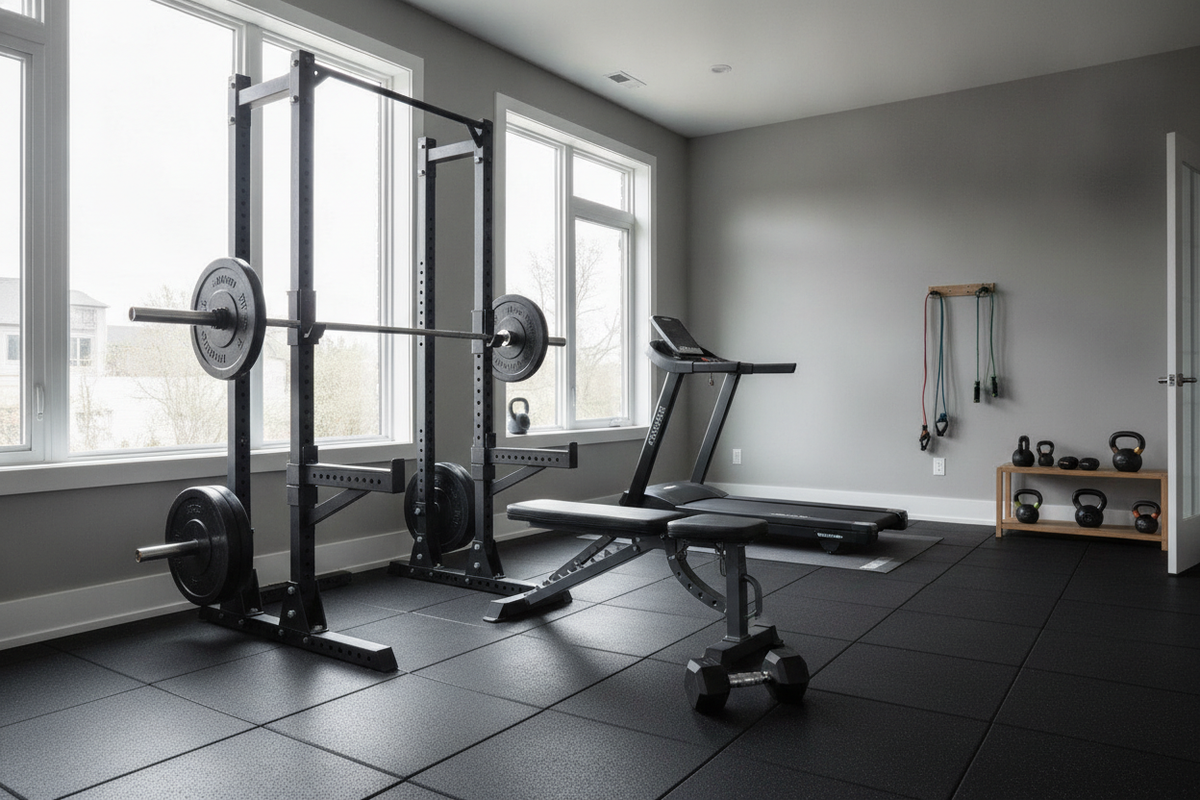
Executing heavy hip thrusts, dynamic lunges, and Romanian deadlifts at home requires a secure, stable surface. Standard residential flooring—such as smooth hardwood, laminate, or deep carpet—often creates stability challenges that compromise lifting technique.
During a heavy hip thrust, significant lateral and downward force is directed through the heels and back bench. On slick surfaces, unanchored benches slide backward, disrupting spinal alignment and reducing glute force transmission. High-density gym mats provide the surface grip necessary to lock your bench and planted feet securely in place. Integrating a durable workout product creates a dedicated training footprint that absorbs vibrations, minimizes equipment shifting, and protects subfloors from heavy dumbbell and barbell impact.
Mat Maintenance and Multi-Surface Stability for Home Gyms
Maintaining a dedicated workout zone ensures training hygiene and equipment longevity across demanding training blocks. Depending on your home gym subfloor, specific considerations apply:
- Over Hardwood and Tile: Use high-density mats with textured backing to prevent shifting during explosive lunges or step-backs.
- Over Residential Carpet: Dense, firm mats prevent equipment feet from sinking unevenly, preserving level bench positioning during thrusts.
- Hygiene and Surface Care: Sweat and shoe debris should be wiped down after intense sessions using mild, non-abrasive cleaners to maintain long-term material grip and texture.
Setting up your training environment with dependable equipment, such as a specialized workout product, provides the physical foundation necessary to execute your multi-week training plan safely, comfortably, and effectively.