
10 Minute Workout for Arms: Structured Home Circuits, Movement Tiers, and Floor Setup
Finding time for dedicated upper-body strength training does not require spending hours in a commercial facility. When organized thoughtfully, a 10 minute workout for arms delivers an efficient training stimulus by combining continuous muscular tension, minimal transition delays, and balanced movement patterns. Whether working out between meetings or finishing a broader conditioning routine, a focused short-duration session lets you target the biceps, triceps, and shoulders with precision.
Achieving meaningful results from a brief session comes down to exercise selection, tempo discipline, and maintaining a stable workout surface. By understanding how to sequence paired movements and stabilize your footing at home, you can get the most out of every repetition without unnecessary joint strain.
Why Short-Duration Arm Training Works at Home
Short-format training sessions thrive on workout density. In a standard hour-long gym session, substantial time is spent resting between heavy sets, setting up barbells, or waiting for machines. In contrast, an arm workout 10 mins in duration condenses work into continuous or short-rest intervals, keeping the target musculature engaged across the entire block.
Because the smaller muscle groups of the arms recover relatively quickly between individual movements, you can alternate between opposing muscle groups—such as moving directly from a curling pattern to an overhead extension. This antagonist pairing allows one muscle group to actively recover while the other works, maintaining a high level of quality across the entire ten minute arms sequence.
Core Movement Categories for Balanced Arm Development
A well-rounded arm session addresses all primary actions of the elbow and shoulder complex. Relying solely on standard curls can lead to muscular imbalances and plateaued progress. Structuring your 10 minute arm exercise library around three key movement categories ensures complete, proportionate stimulation.
Elbow Flexion Patterns: Biceps and Forearm Control
Elbow flexion targets the anterior upper arm, specifically the biceps brachii, brachialis, and brachioradialis. For a well-rounded 10 min dumbbell arm workout, incorporating varied wrist orientations shifts emphasis across these muscles:
- Supinated Biceps Curls: Palms face upward throughout the lift, maximizing recruitment of the biceps brachii and training peak flexion control.
- Neutral-Grip Hammer Curls: Palms face inward toward each other, shifting greater tension to the brachialis and forearm muscles while placing minimal torque on the wrists.
- Zottman Curls: Lifting with supinated palms and rotating to a pronated grip on the lowering phase challenges both the upper arm and forearm extensors during the eccentric portion.
Elbow Extension Patterns: Triceps Stability and Lockout
The triceps make up the majority of upper-arm volume and provide elbow extension strength. Balanced 10 minute arm workout light weights routines should feature movements that challenge the triceps across different shoulder angles:
- Overhead Triceps Extensions: Performed with elbows tucked and pointing forward, overhead positioning places the long head of the triceps under a deep stretch.
- Hinged Triceps Kickbacks: With the torso braced in a slight hip hinge, extending the forearm backward targets the peak contraction of the lateral and medial heads.
- Floor-Based Diamond Press or Narrow Push-Ups: Utilizing your own bodyweight with hands positioned beneath the sternum directs pressing tension straight into the triceps lockout.
Shoulder Elevation and Rotation: Deltoid Definition
To create a complete upper-arm contour, the deltoids must integrate smoothly with arm movements. Incorporating lateral raises, front raises, and upright pulls inside your 10 min toned arm workout provides full-shoulder involvement without requiring heavy joint loads.
During lateral and front raises, keep a slight soft bend in the elbows and lift smoothly to shoulder height. Avoiding aggressive jerking motions ensures that tension remains squarely on the anterior and lateral deltoid heads rather than transferring to the neck or upper traps.
Structuring Your 10-Minute Arm Circuit Framework
To maintain continuous pacing throughout your 10 minute standing arm workout, structure the session into distinct time-based blocks. Using fixed work-to-rest ratios keeps transitions swift and eliminates guesswork.
- Phase 1 (Minutes 0:00–3:00): Biceps & Triceps Superset: Alternate 40 seconds of hammer curls with 20 seconds of rest, followed by 40 seconds of overhead triceps extensions and 20 seconds of rest. Repeat for three unbroken rounds.
- Phase 2 (Minutes 3:00–6:00): Shoulder & Forearm Flow: Perform 40 seconds of controlled lateral raises, rest 20 seconds, followed by 40 seconds of slow-tempo Zottman curls and 20 seconds of rest. Repeat for three rounds.
- Phase 3 (Minutes 6:00–9:00): Tri-Set Finisher: Cycle through 30 seconds of wide bicep curls, 30 seconds of triceps kickbacks, and 30 seconds of upright raises, followed by 30 seconds of complete rest. Repeat for two rounds.
- Phase 4 (Minute 9:00–10:00): Isometric & Burnout Hold: Finish with a 30-second mid-range curl hold followed immediately by a 30-second plank hold on the mat to challenge core and arm stability simultaneously.
Dumbbell Selection and Pacing Strategies for Quick Burn Sessions
Choosing the correct resistance for a 10 min arm workout with weights differs from selecting weights for low-repetition maximum strength work. Because rest periods are brief, weights that feel light during the first minute can become challenging by minute seven.
Select a pair of dumbbells that allows you to complete 12 to 15 strict repetitions without momentum. Prioritize a controlled eccentric cadence—taking two full seconds to lower the weight on every rep. If you enjoy higher-volume training formats, exploring a longer workout toning light weights guide can show you how similar pacing principles scale across extended full-body conditioning routines.
Home Gym Floor Setup and Equipment Stability for Standing Work
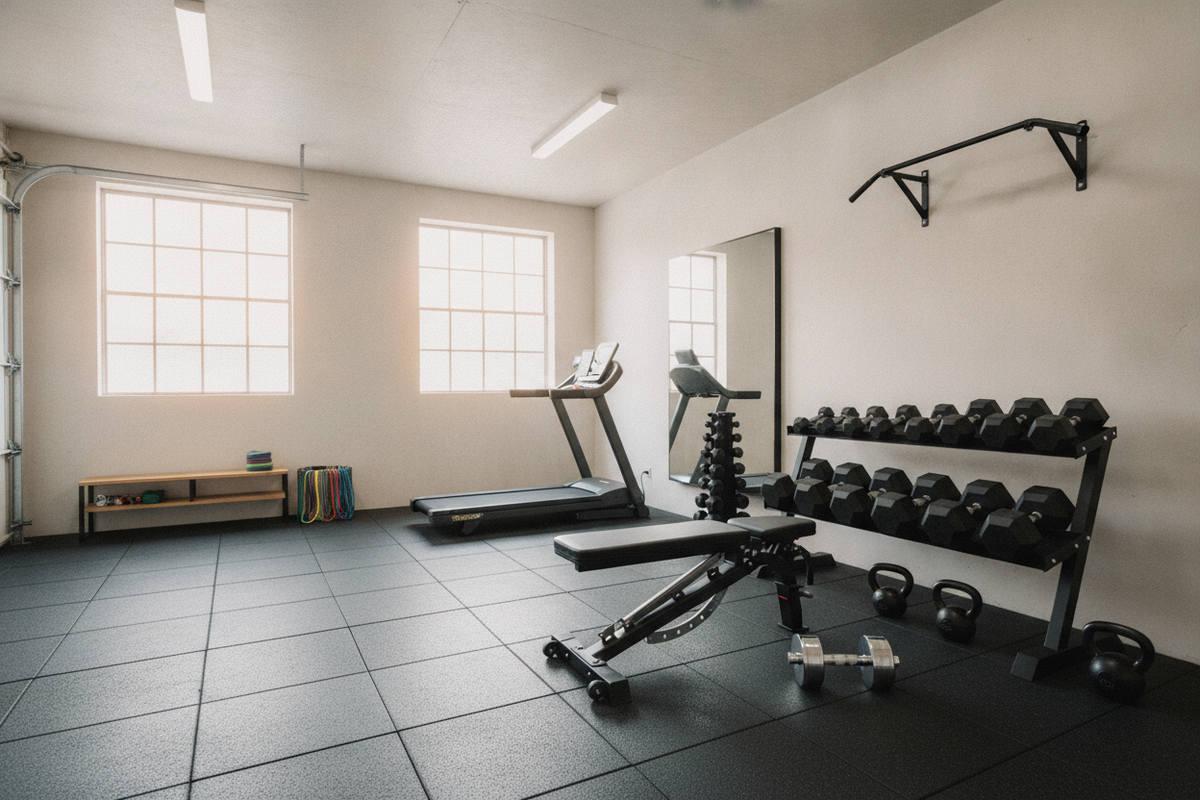
Performing standing arm circuits requires a dependable, slip-resistant foundation. When executing multi-directional raises or standing curls, your feet anchor your kinetic chain. Hardwood or tile surfaces can be slick in socks or athletic shoes, while thin temporary mats can bunch up during rapid stance transitions.
A dedicated, high-density surface from a dedicated exercise collection provides the necessary grip and stability to keep your feet planted firmly. Proper flooring also creates a sound-dampening barrier between your weights and the subfloor when setting dumbbells down between intervals. For larger home gym layouts where you alternate between standing dumbbell work and floor-based triceps planks, a spacious surface like a large format exercise workout mat ensures ample room to move without stepping off the padded boundary.
Troubleshooting Common Form Errors in Fast-Paced Workouts
Because short-duration workouts emphasize continuous movement, form degradation can happen quickly if fatigue sets in. Monitoring your technique prevents wasted effort and keeps tension focused on the target muscles.
- Torso Sway and Momentum: Swinging the hips or leaning back to complete a curl takes work away from the biceps and places unwanted strain on the lumbar spine. If you cannot lift without leaning, drop to a lighter pair of weights or perform the movement seated.
- Flaring the Elbows: During overhead extensions or narrow push-ups, letting the elbows flare out wide shifts stress onto the shoulder capsule. Keep elbows tracking forward and aligned with the wrists.
- Shrugging the Shoulders: As the deltoids fatigue during lateral raises, the upper trapezius often compensates by shrugging the shoulder blades upward. Keep your shoulders depressed away from your ears throughout the entire range of motion.
- Losing Wrist Neutrality: Allowing wrists to bend backward under dumbbell load strains the forearm tendons. Maintain a straight, rigid wrist position across all pressing, curling, and extension exercises.
By pairing focused movement sequencing with deliberate tempos and a stable home flooring foundation, a 10-minute arm session becomes an effective, sustainable component of any weekly home fitness schedule.


