Your Weight Gaining Program Is Failing Because You Lift Too Fast
I remember staring at my squat rack three years ago, realizing I had run out of 45-pound plates to slide onto the bar. I was eating 4,000 calories a day, but the scale wasn't moving and my shirts weren't getting any tighter in the sleeves. I thought I just needed more iron, but the real problem was my ego—I was moving the weight as fast as possible just to say I did the reps. If your weight gaining program feels like it has hit a brick wall, it is probably because you are treating every set like a race instead of a growth opportunity.
Quick Takeaways
- Momentum is the enemy of hypertrophy; slow down the eccentric (lowering) phase.
- Time Under Tension (TUT) allows you to trigger growth even when you do not have enough plates to go heavier.
- Pausing at the bottom of a lift eliminates the 'bounce' and forces muscle fiber recruitment.
- Rest longer between sets to ensure every rep is high-quality and controlled.
The 'Just Add More Iron' Trap of Home Lifting
Most lifters think progressive overload only means adding five pounds to the bar every single week. That is great in theory, but in a garage gym, you eventually hit a ceiling. Maybe your floor cannot handle 500-pound drops, or maybe you simply ran out of room on the sleeves of your budget barbell. When you hit that wall, an at home weight lifting program needs to evolve beyond just chasing a new one-rep max.
Building mass isn't about how much weight you can move from point A to point B by any means necessary. It is about how much stress you can force the muscle to endure during the journey. If you are just dive-bombing your squats to get the rep over with, you are leaving gains on the platform.
Time Under Tension: The Secret to a Home Gaining Weight Program
Hypertrophy is a biological response to mechanical tension and metabolic stress. If you are running a gaining weight program and you are snapping the weight up and letting it gravity-drop, you are only under tension for maybe 10 or 15 seconds a set. Your muscle fibers do not have a calculator; they have tension sensors. They do not know if there is 225 or 315 on the bar—they only know how hard they have to contract and for how long.
By slowing down the rep, you are forcing those fibers to stay engaged for 40 or 50 seconds. That is the sweet spot where the microscopic tears happen. If you cannot add weight to the bar, add time to the movement. It is a lot harder to do a 5-second descent than it is to just drop and pop.
Stop Bouncing Your Reps off Your Chest
We have all seen the guy who turns a bench press into a trampoline act. When you bounce the bar off your sternum, you are using the stretch reflex and pure momentum to bypass the hardest part of the lift. You are essentially cheating your pecs out of the very work they need to grow. Try stopping the bar an inch above your chest for a full, agonizing second. It is humbling, and your numbers will drop initially, but your chest will actually start to fill out.
How I Manipulate Tempo Without Buying More Plates
My favorite way to make light weight feel absolutely heavy is the 3-1-1-1 tempo. That is three seconds down, a one-second dead pause at the bottom, one second to explode up, and one second to reset at the top. If you try this on a squat with even 135 pounds, your quads will be screaming by the eighth rep. It turns a standard set into a marathon of muscle fiber recruitment.
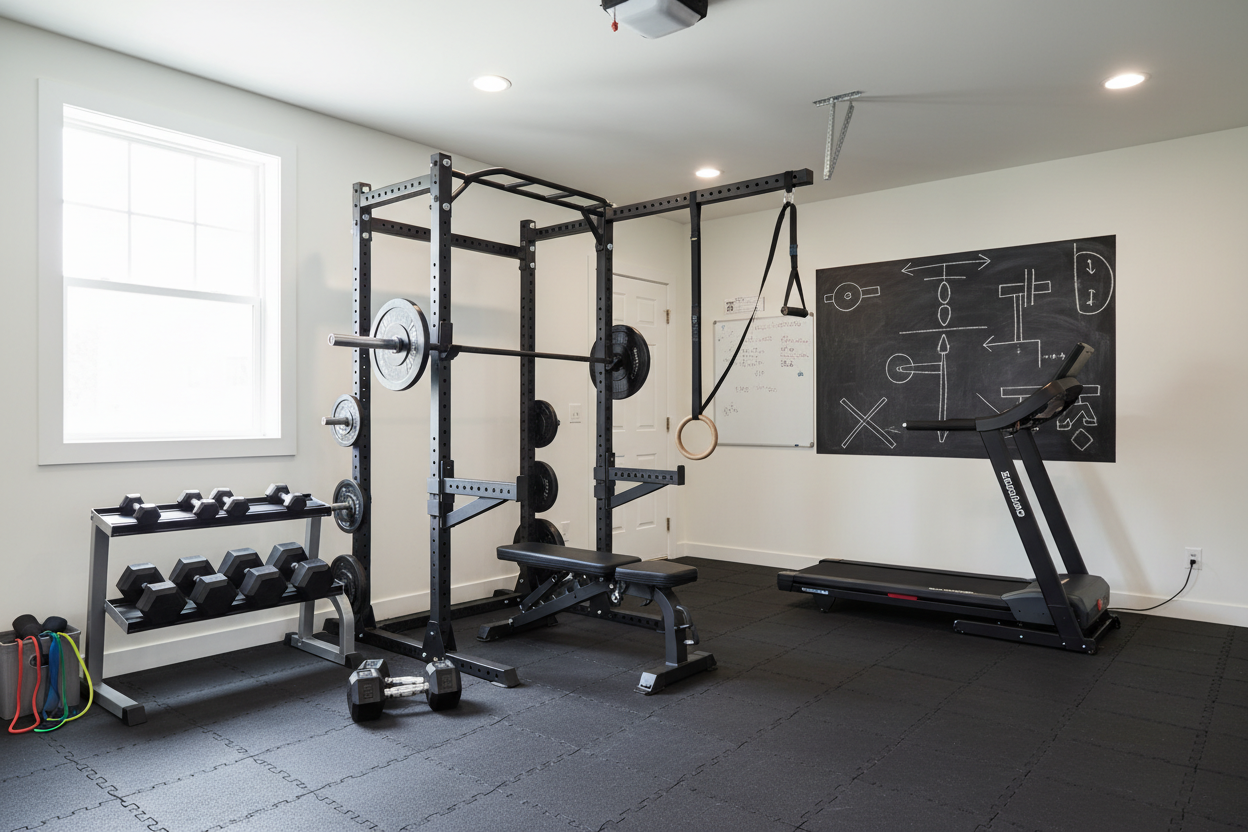
To do this safely, especially when you are training alone in a garage, you really need a solid power rack weight bench package with reliable spotter arms. Failing a slow, controlled rep is a lot safer than failing a fast, explosive one where the bar path is unpredictable. Having that safety net allows you to push the tempo until the muscle actually gives out.
The Pre-Exhaust Strategy for Stubborn Muscles
If your chest is weak but your triceps are dominant, your triceps will take over on every press you do. I like to hit a few sets of chest flies with dumbbells or resistance bands before I even touch the barbell. In a commercial setting, you would use various weight lifting machines for this isolation work, but at home, you have to get creative with what you have. By tiring out the target muscle first, the compound lift that follows forces that specific muscle to work harder, even with lighter weights on the bar.
Don't Confuse Sweating With Building Mass
Rushing through your workout with 30-second rest periods is great for your heart, but it is usually counterproductive for mass. If you are following a program for toning and weight loss, short rests are the standard. But for real hypertrophy, you need your ATP stores to recover so you can produce maximum tension on the next set. If you are too winded to control the tempo of your next set, you are doing cardio, not bodybuilding. Take the two minutes. Breathe. Then move the weight with intent.
Personal Experience: The Hardgainer Myth
I used to call myself a 'hardgainer' because I spent a year doing heavy triples on the deadlift and wondered why my legs still looked like toothpicks. I was strong, but I wasn't big. I finally swallowed my pride, dropped the weight by 30%, and started doing Romanian Deadlifts with a strict 4-second eccentric. My hamstrings grew more in three months than they had in the previous three years. My mistake was thinking the total weight on the bar was the only metric that mattered. It wasn't.
FAQ
Does tempo training make you weaker?
In the short term, your max numbers might dip because you are removing momentum. In the long term, it builds massive amounts of stability and tendon strength that will actually skyrocket your 1RM later.
How long should a hypertrophy set last?
For maximum growth, aim for a 'Time Under Tension' of 40 to 60 seconds per set. If your set is over in 15 seconds, you are training for power, not necessarily mass.
Can I use tempo on every exercise?
It is most effective on big compound movements like squats, rows, and presses. Don't overthink it on small isolation moves like calf raises or wrist curls—just get the pump there.