Your Slippery Floor Is Ruining Your Exercise Program for Muscle Gain
I spent six months plateaued on my bench press because my feet were skating on dusty garage concrete. I thought I needed a new exercise program for muscle gain, but I actually just needed some friction. I was obsessively tweaking my rep ranges and rest periods when I should have been looking at my shoes.
Most home lifters treat their flooring as an afterthought. They buy the rack, the bar, and the plates, then wonder why their heavy sets feel 'off' when they're lifting on bare concrete or those squishy foam tiles from the toy aisle. If you can't plant your feet, you can't produce force. It is that simple.
- Stability is the foundation of every heavy lift.
- Soft foam tiles are for yoga and kids, not 400-lb squats.
- Micro-loading is the only way to sustain long-term hypertrophy.
- Environmental friction is a literal requirement for muscle fiber recruitment.
Stop Blaming the Spreadsheet (Look at Your Feet)
We've all been there. You're four weeks into a new workout program for muscle gain and the weights start feeling heavy—heavy in a way that feels dangerous. You start searching for a new program, thinking the volume is too high or the frequency is wrong. But look at your feet during your next set of heavy rows or split squats. Are your toes clawing for grip? Is your bench sliding backward three inches every time you set your arch?
Stability dictates force production. Your brain is smarter than you are; if it senses that you are on an unstable surface, it will literally stop your muscles from firing at 100% capacity. It's a protective mechanism. You can't fire a cannon from a canoe, and you can't hit a PR while your feet are drifting apart on a dusty floor. Before you scrap your entire routine, fix the contact point between you and the earth.
Force Production 101: Why Slipping Kills Your Gains
Hypertrophy requires mechanical tension. To get that tension, you need to move heavy loads with control. When you lift on a slippery or squishy surface, your Central Nervous System (CNS) goes into 'survival mode.' It throttles back the recruitment of high-threshold motor units—the very ones responsible for growth—because it doesn't want you to snap an ankle or dump a bar on your neck.
Think about a Bulgarian Split Squat. On a solid, high-traction surface, you can drive through your mid-foot and torch your quads. On a slippery floor, half of your energy goes into just staying upright. That's 'leakage'—energy that should be going into the muscle is instead being wasted on stabilization. If you want to maximize your hypertrophy, you need to eliminate every possible source of instability that isn't the weight itself.
The Problem With Bare Concrete and Cheap Puzzle Foam
Concrete is the enemy of longevity. It has zero give, which sounds stable until you realize it also offers zero grip once a little dust or sweat hits it. Moreover, the vibration feedback from dropping weights on bare concrete eventually wreaks havoc on your joints. On the flip side, those cheap 1/2-inch puzzle foam mats are even worse. They compress under any real weight, turning your solid floor into a trampoline. Try squatting 315 lbs on foam and watch your heels sink and your knees cave.
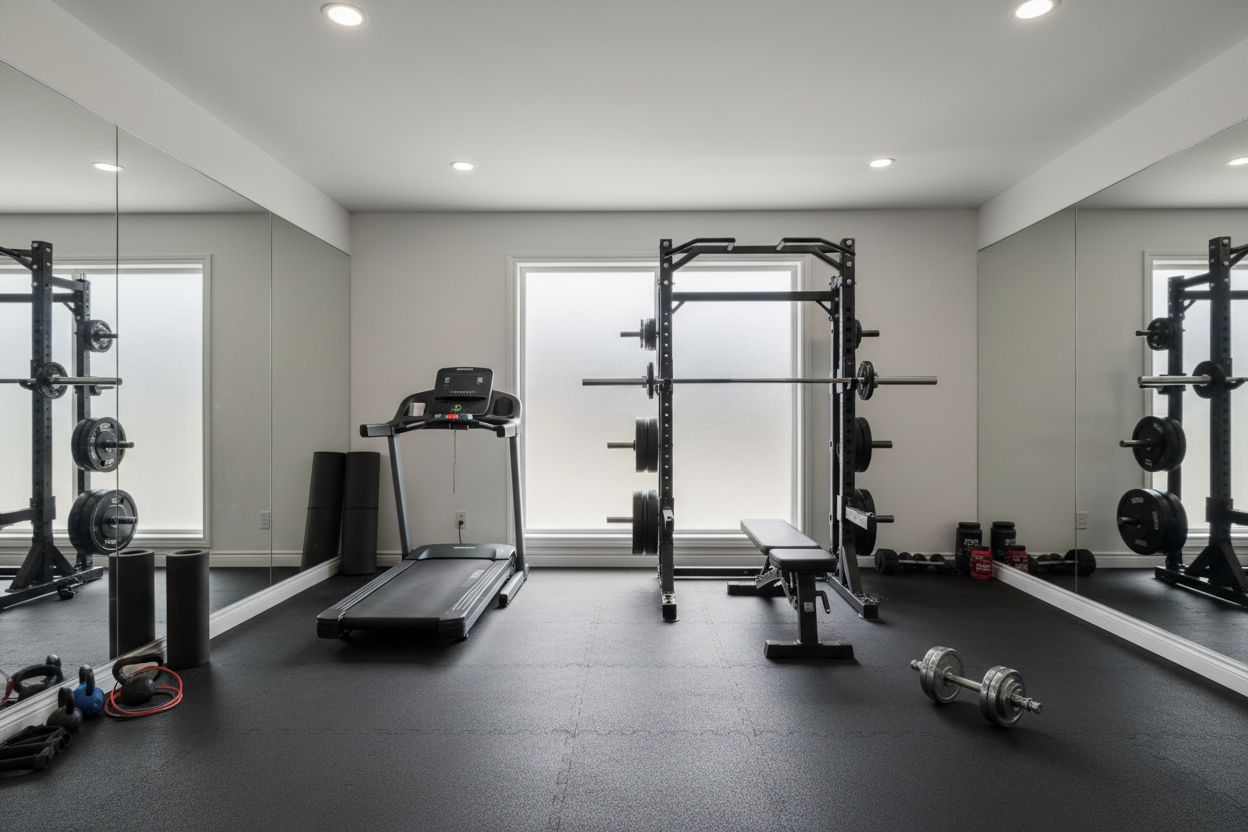
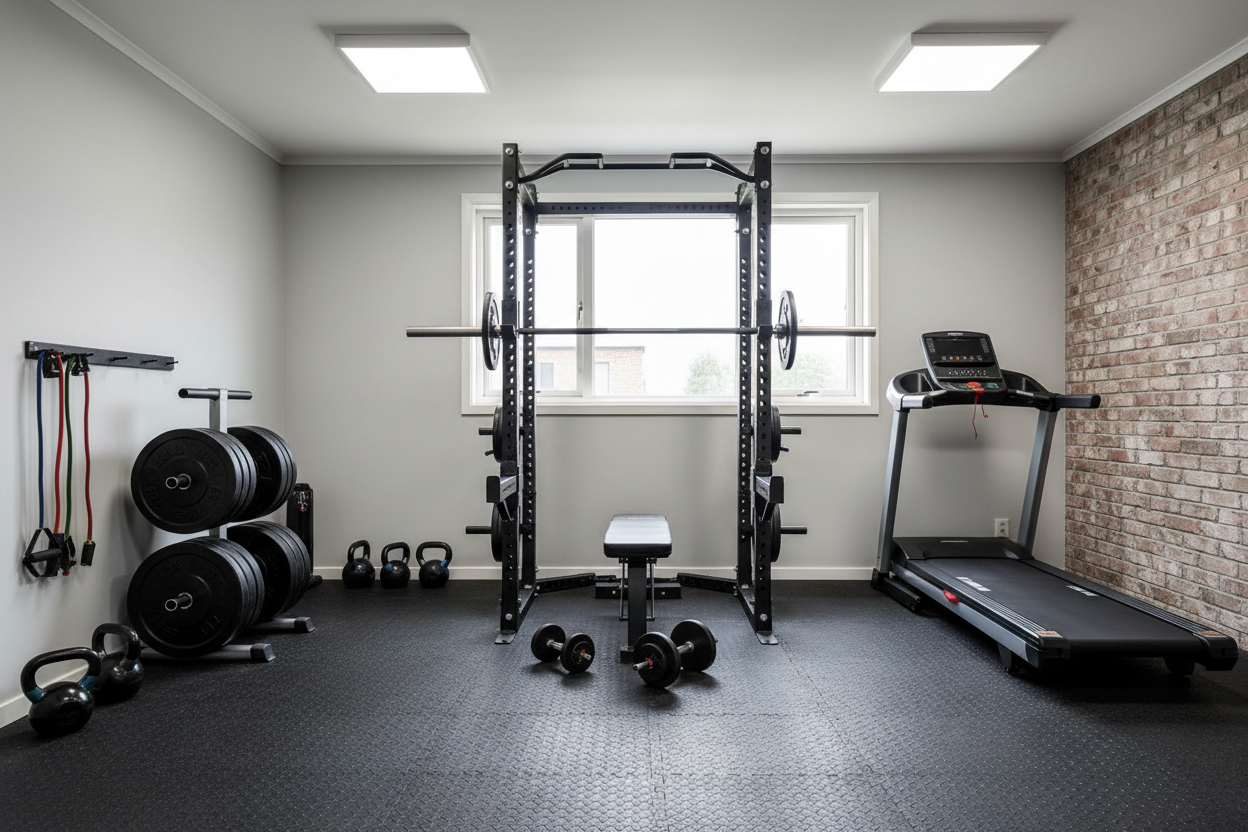
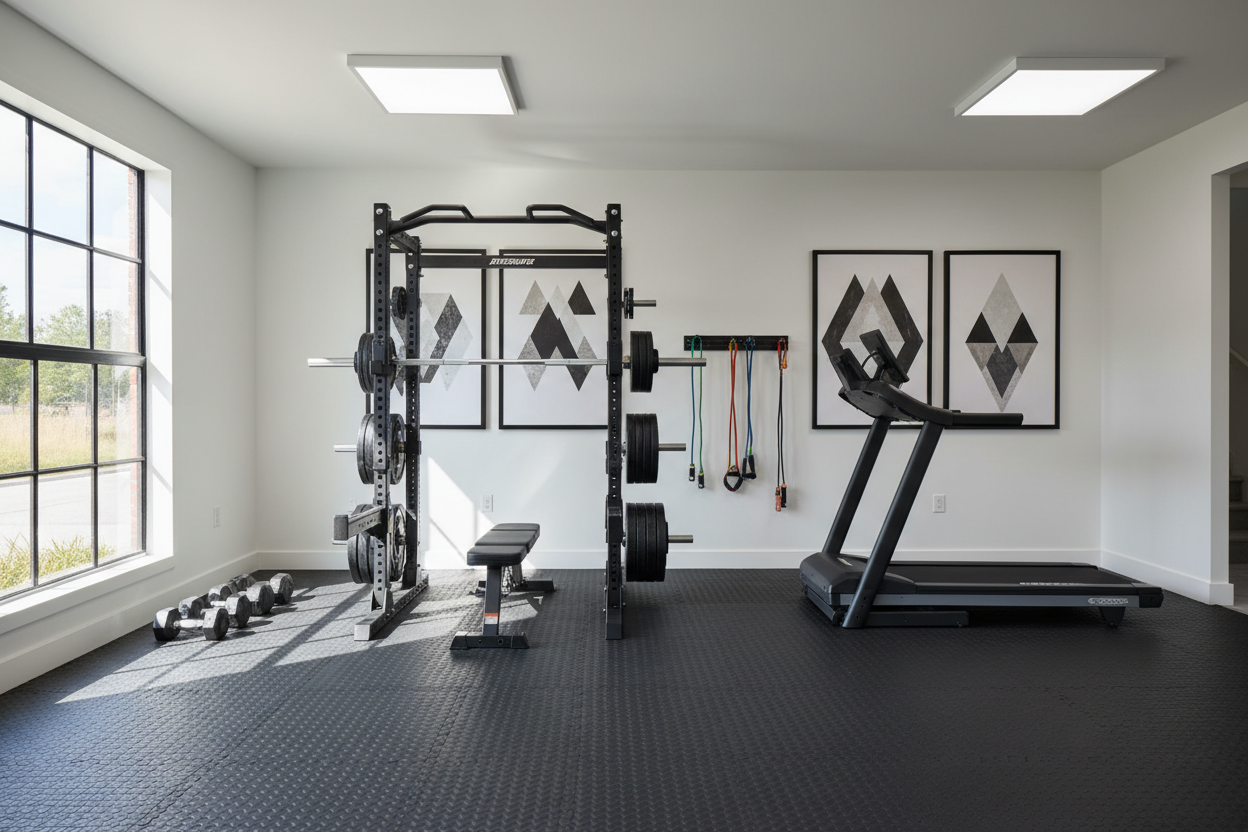
You need a dense, high-traction surface that doesn't budge. I usually recommend a 6x8ft exercise mat gym flooring setup. This size is the sweet spot—it’s large enough to fit a standard power rack and a bench with plenty of room for your 'footprint' during deadlifts. It’s thick enough to protect the subfloor but dense enough that you won't feel like you're standing on a marshmallow.
How to Progress When Your Garage Gym Maxes Out
Once you fix the floor, you'll likely hit a new problem: the plateau. Most home gym owners have 45s, 25s, 10s, 5s, and 2.5s. This means the smallest jump you can make on any lift is 5 lbs. For a 300-lb squat, 5 lbs is nothing. For a 135-lb overhead press, a 5-lb jump is nearly a 4% increase in one week. That is a recipe for a stall.
This is where most people quit their workout program for muscle gain. They hit a wall because they can't make the jump to the next 'standard' weight. I learned the hard way that fractional plates saved my exercise program by allowing me to add 1 lb or even 0.5 lbs to the bar. It sounds small, but adding 1 lb every week for a year is a 52-lb increase. That’s how real, sustainable muscle is built in a garage, not by trying to 'beast' a 10-lb jump you aren't ready for.
What if You Don't Want to Use Free Weights at Home?
Not everyone wants a barbell clanging in their garage at 6:00 AM, and that’s fine. You can absolutely build a world-class physique without ever touching a squat rack. The key is still mechanical tension and progressive overload, just delivered through different tools. If you’re worried about injury or just prefer the feel of constant tension, a machine only workout program for beginners can be incredibly effective.
Machines allow you to push closer to failure because you don't have to worry about the weight crushing you. This is a huge advantage for hypertrophy. Just remember: even with machines, that floor needs to be level and stable. If your functional trainer or cable machine is rocking because it’s sitting on uneven concrete, your mind-muscle connection is going to suffer.
The Ground-Up Checklist for Home Hypertrophy
If you're serious about your gains, stop looking at new supplements and start looking at your environment. Here is the bare-minimum checklist for a garage gym that actually produces results:
- High-density rubber flooring (avoid the 'soft' stuff).
- A level surface (use shims for your rack if your garage floor slopes).
- Fractional plates for micro-loading.
- Adequate lighting (if you can't see your form, you can't fix it).
If you're starting from scratch or finally ready to rip up that old carpet, a large exercise mat for home gym use is the single best investment you can make. It transforms a cold, slippery storage space into a dedicated training cell.
Personal Experience: The Day I Almost Ate My Barbell
I used to lift on those interlocking foam tiles. I thought I was being smart and saving money. One humid July morning, I was doing heavy pendlay rows. My sweat dripped onto the foam, making it slick. As I pulled the weight, my lead foot slipped, my lower back twinged, and I spent the next three days on a heating pad. I ordered real rubber mats that afternoon. The difference in my 'tightness' during lifts was immediate. I added 20 lbs to my row in a month just because I wasn't afraid of falling over.
FAQ
Do I really need a special mat for a home gym?
If you're lifting anything heavier than a soup can, yes. Concrete is slippery and unforgiving. Proper rubber flooring provides the friction needed for leg drive and protects your equipment from shattering on impact.
Can I just use a piece of plywood?
Plywood is great for a lifting platform base, but it’s slick. You still need a rubber top layer for grip. A 3/4-inch rubber mat over plywood is the gold standard for home setups.
How do I stop my bench from sliding?
If your floor is good but your bench feet are plastic/cheap, try adding some grip tape to the bottom of the bench feet. But usually, a high-quality rubber mat solves this problem instantly.