Your Backrest Is Ruining Your Seated Shoulder Dumbbell Exercises
I spent years chasing a 100-pound overhead press while glued to a vertical backrest. I thought I was a beast until I tried to do the same lift on a flat bench with zero support. I couldn't even stabilize the 70s. It turns out, that expensive adjustable bench wasn't helping me build muscle; it was helping me cheat. If you are struggling to see growth in your delts despite heavy seated shoulder dumbbell exercises, your equipment setup is likely the culprit.
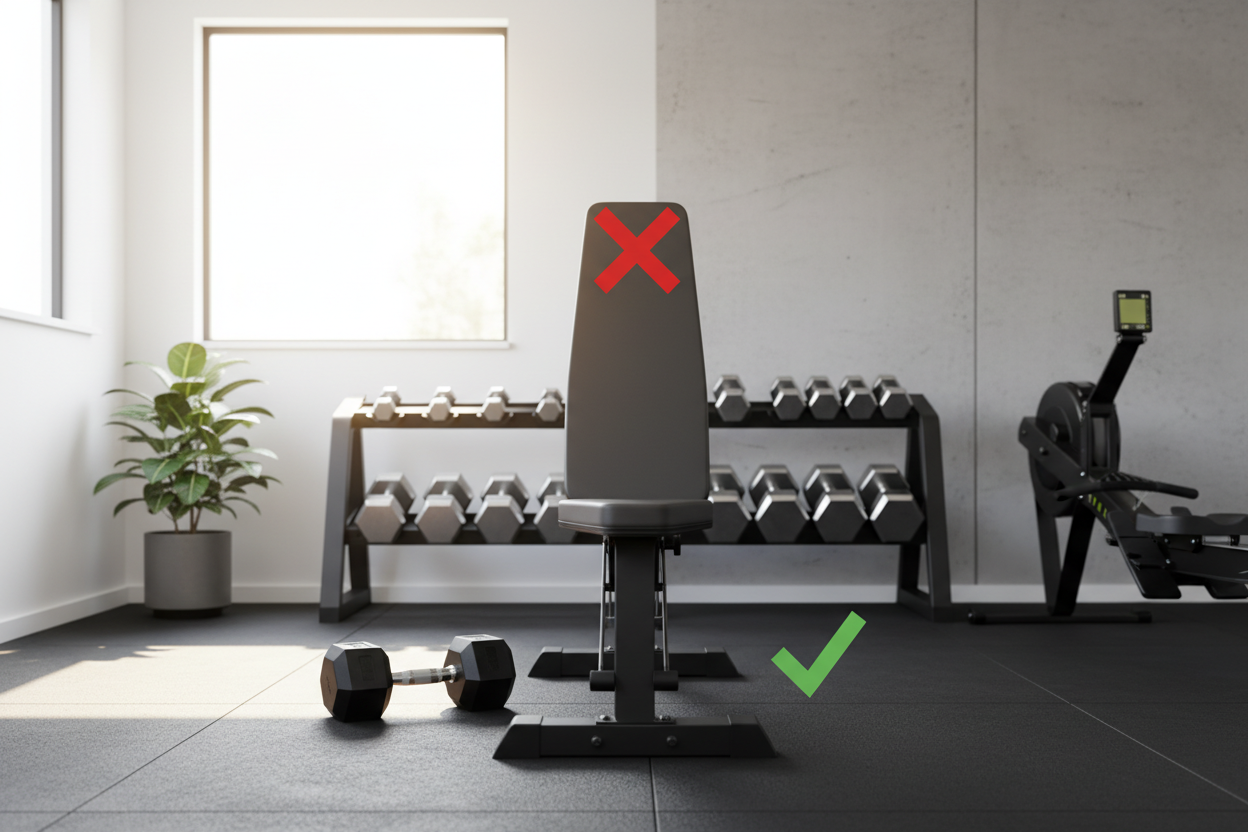
Most home gym lifters default to the 90-degree position because it feels safe. In reality, it creates a mechanical loophole that allows you to bypass your shoulders entirely. You end up arching your spine like a bridge, turning a vertical press into a high-incline chest press. It is time to get off the pad and learn how to sit up straight.
- Vertical backrests encourage excessive lumbar arching and 'chest-cheating.'
- Unsupported seating forces the core to act as a natural weight belt.
- Pressing without a backrest requires lower weight but produces higher muscular tension.
- Ditching the support usually fixes the nagging 'pinch' many lifters feel in their lower back during heavy sets.
The 90-Degree Bench Trap
When you jam your back against a vertical pad, your body instinctively looks for the path of least resistance. As the weights get heavy, you start to slide your butt forward. This creates a massive gap between your lower back and the bench. Suddenly, your ribcage is flared toward the ceiling, and you are essentially performing an incline bench press. You might be moving more weight, but you are hitting your upper pecs, not your medial delts.
Beyond the lack of isolation, this position is a nightmare for your spine. You are compressing your vertebrae while they are in an over-extended position. I have seen guys at the local powerhouse gym load up 90-pounders, arch their backs until they look like a gymnast, and wonder why their lower back hurts for three days after 'shoulder day.' The backrest provides a false sense of security that allows you to ignore poor bracing and terrible vertical alignment.
Why I Swapped to the Flat Bench for Overhead Work
I eventually got tired of the lower back tweaks and switched to a standard flat bench for all my seated shoulder workouts with dumbbells. When you sit on a flat bench with nothing behind you, there is nowhere to hide. If you lean back, you fall over. This forced me to drop my ego and my working weight by about 20 percent, but the results were almost immediate. My shoulders actually started to cap because they were finally doing 100 percent of the work.
Performing an unsupported seated press turns the movement into a full-body stabilizer challenge. Your rectus abdominis, obliques, and erectors have to fire constantly to keep you from toppling. It turns a simple isolation move into a functional powerhouse. Plus, from an equipment standpoint, a high-quality flat bench like the Rogue Utility Bench is way more stable and has a smaller footprint than most clunky, wobbly adjustable benches that take up a 4x2 foot chunk of your floor space.
How to Brace Without a Pad Behind You
To succeed without a backrest, you have to become your own support system. Start by planting your feet wide—wider than your hips—and digging your heels into the floor. This creates a tripod base. Squeeze your glutes hard; this stabilizes your pelvis and prevents that nasty anterior tilt that leads to back pain.
The biggest cue is 'ribs to hips.' Imagine there is a string connecting your bottom rib to your hip bone. Keep that string short. This forces your spine into a neutral position and ensures the dumbbells stay stacked directly over your center of gravity. If you feel your chest pointing at the ceiling, you have already lost the brace.
Stop Flaring: The Golden Rule for Unsupported Lifts
When you don't have a bench to push against, your joint mechanics become much more obvious. Most people try to press with their elbows flared out 90 degrees to the side. This is a fast track to an impingement. Without a backrest to bail you out, you will quickly realize that pressing in the 'scapular plane'—with your elbows tucked about 30 degrees forward—is the only way to stay stable.
Flaring the elbows wide puts a massive amount of shear force on the AC joint. I learned this the hard way after a month of heavy pressing that left my right shoulder clicking like a ballpoint pen. Why Flared Elbows Ruin Tricep and Shoulder Workouts With Dumbbells is a lesson in biomechanics; keeping the weights slightly in front of your face allows the shoulder blade to move naturally. This not only saves your joints but allows for a much deeper, more effective range of motion.
The 3-Move Unsupported Shoulder Routine
If you want to build thick delts without the joint baggage, try this three-move circuit on a flat bench. It focuses on longevity and strict tension. I recommend using a set of high-quality adjustable dumbbells—something like the Ironmasters or PowerBlocks—so you can make small 2.5-lb jumps as your stabilizers get stronger.
1. Strict Unsupported Overhead Press: 3 sets of 8-10 reps. Focus on the 'ribs to hips' cue. If you feel yourself leaning back, the set is over. 2. Seated Strict Lateral Raises: 3 sets of 15 reps. Sitting down removes the 'hip hinge' cheat that most people use on standing raises. 3. Bent-Over Rear Delt Flyes: 3 sets of 20 reps. Lean forward until your chest is near your knees. These are essential safe dumbbell shoulder exercises that balance out the front-heavy nature of pressing. Keep the reps high and the rest periods short—about 60 seconds.
Personal Experience: The Day I Damped My Ego
I used to pride myself on being the guy who could press the 100s for reps on the vertical bench. Then I moved into a smaller garage gym and only had a flat bench. The first time I tried to press the 80s unsupported, I almost tipped over backward. It was a wake-up call. I realized my 'strength' was just me leveraging my weight against a piece of steel. Once I spent six months mastering the unsupported press, my standing overhead press numbers skyrocketed, and my persistent lower back 'tightness' disappeared. Don't let a $50 foam pad dictate your progress.
FAQ
Is it dangerous to press without a backrest?
Only if you use weight you can't control. Start light, focus on your core brace, and keep your feet wide. It is actually safer for your spine in the long run because it prevents the 'arch' that causes disc compression.
Can I do this on a weight bench with a 300-lb capacity?
Most basic flat benches have a 300-500 lb capacity. If you weigh 200 lbs and are pressing 50s, you are only at 300 lbs total. Just make sure the bench has a wide enough base so it doesn't tip when you are getting the weights into position.
Should I still go to failure?
I wouldn't recommend 'absolute' failure on unsupported presses. When your core fatigues, your form breaks, and that is when injuries happen. Stop one or two reps short of technical failure—when you can no longer keep your torso perfectly vertical.