You Lift Heavy, But Can You Do a Bodyweight Shoulder Press?
I’ve spent years chasing a heavy overhead press. My rack is scarred from 45-pound plates, and my ego is usually tied to how many wheels I can move. But a few months ago, I tried a strict pike press and realized I couldn’t even do five reps without my shoulders shaking like a leaf. It turns out, I was strong in a very specific, very stable way, and I was neglecting the foundation.
The bodyweight shoulder press is a different beast entirely. It’s a closed-chain movement, meaning your hands stay fixed while your body moves through space. This forces your serratus anterior and your core to work overtime just to keep you from face-planting on your rubber mats. If you think your 225-lb barbell press makes you immune to this, you’re in for a reality check.
Quick Takeaways
- Barbell strength doesn't always translate to bodyweight stability.
- Closed-chain movements recruit more stabilizing muscles like the serratus.
- Progressions are mandatory; jumping straight to handstands is a recipe for a neck injury.
- Machines can actually help build the raw delt volume needed to bridge the gap.
The Day I Got Humbled by My Own Body Weight
I remember the session vividly. I’d just finished a heavy set of 185-lb overhead presses. Feeling invincible, I decided to mess around with some calisthenics. I tucked my feet, hiked my hips into a pike position, and tried to lower my head to the floor. Halfway down, my shoulders started screaming. I didn't have the stability to control the eccentric phase, let alone push back up.
It was a wake-up call. I had plenty of 'push' power, but zero 'control' power. My traps and delts were used to having a solid floor and a predictable barbell path. When I asked them to stabilize my entire torso in a vertical plane without the help of a rack, they clocked out. It’s a humbling experience to realize you can’t move your own frame after bragging about your PRs.
Why Pressing Your Body is Harder Than Pressing Iron
When you use a barbell, the weight moves around you. In a bodyweight press, you move around the weight (yourself). This shift from open-chain to closed-chain changes the neural demand. Your serratus anterior—those finger-like muscles on your ribs—has to fire like crazy to keep your shoulder blades from winging. If those aren't engaged, your power leaks out like a flat tire.
You also can't cheat as easily. On a bench or in a rack, you can arch your back or use leg drive to grind out a rep. In a pike press or handstand push-up, if your core goes soft, you lose your balance and the rep is over. It’s a total-body integration that a seated dumbbell press just can't replicate. You're not just training shoulders; you're training the ability to hold your structure under tension.
How to Actually Progress Without Face-Planting
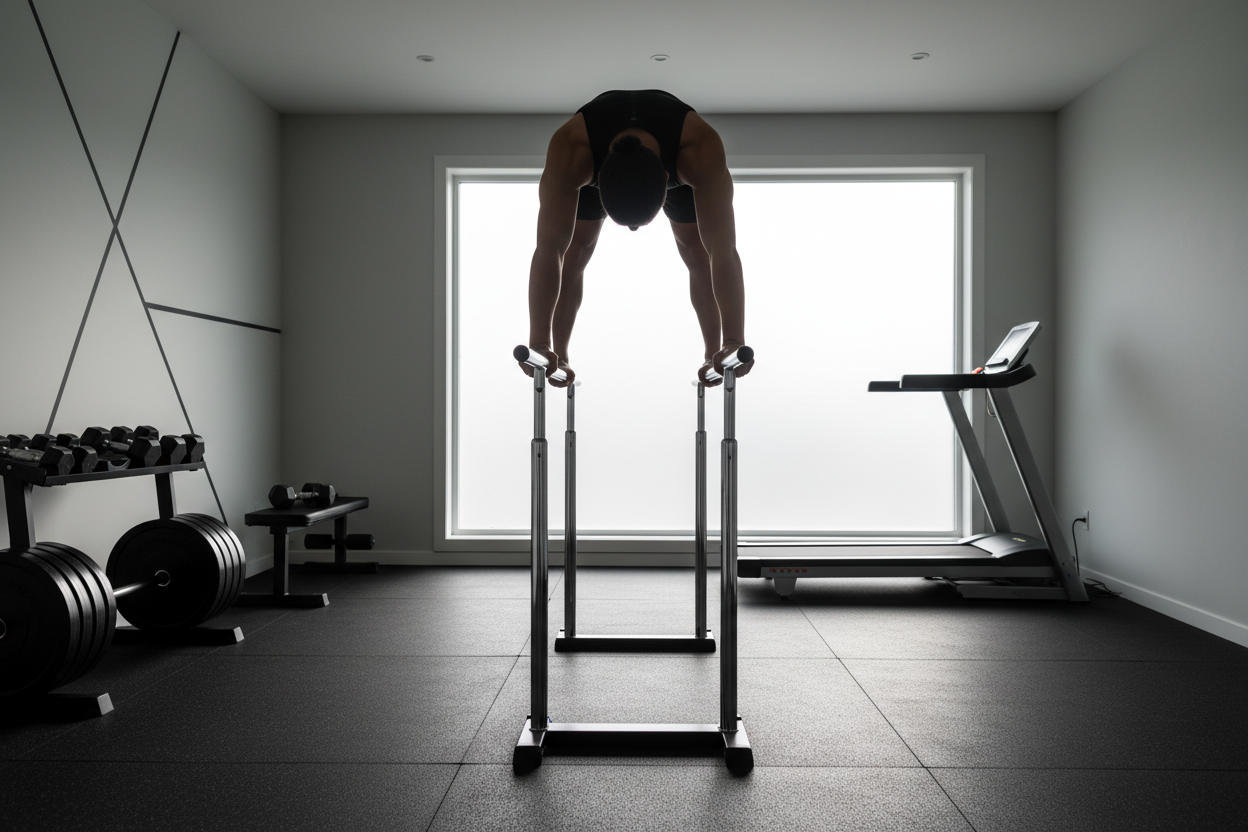
Don't be the guy who tries a handstand push-up on day one. Start with a deep downward dog hold. Focus on pushing the floor away and 'shrugging' your shoulders toward your ears at the top. Once you can hold that for 60 seconds with total control, move to the pike press. Keep your feet on the ground, but walk them toward your hands until your torso is as vertical as possible.
As that gets easier, elevate your feet on a 20-inch plyo box or your weight bench. This shifts more of your body weight onto your shoulders. Eventually, you’ll be ready for wall-facing handstand holds. I prefer wall-facing over back-to-wall because it forces better ribcage positioning and prevents that 'banana back' posture that ruins your mechanics. It takes time, but your joints will thank you for the slow build.
Can Fixed-Path Machines Actually Help Your Bodyweight Skill?
It sounds backwards, but machines have a place here. One of the biggest hurdles in bodyweight pressing is that you reach muscular failure because of balance, not because your delts are tired. By using a machine, you can hammer your anterior delts with high volume without worrying about falling over. This builds the raw muscle mass you need for the later progressions.
I’ve been asked if is the Smith machine shoulder press effective for this, and the answer is a surprising yes. It allows you to isolate the raw pressing strength. You can build the 'engine' on the machine, then use your pike work to learn how to 'drive' that engine in an unstable environment. It’s about separating the strength building from the skill training.
Bridging the Gap with Hybrid Training
My current routine starts with the high-skill stuff. I do my handstand progressions or weighted pike presses first when my nervous system is fresh and I'm not shaking yet. Once my balance starts to fade and I can no longer maintain a vertical line, I move to the iron to finish the job.
After the skill work, I’ll jump on a Smith machine shoulder press to finish off the delts. I usually aim for 3 sets of 10-12 reps here. This ensures my muscles are actually getting enough hypertrophy stimulus even if my balance-limited bodyweight sets were low-rep. It’s the best of both worlds: the functional stability of calisthenics and the raw mass of bodybuilding.
Programming the Press: Where Does This Fit in a Garage Gym Routine?
If you're a garage gym owner like me, space is a premium. You don't need a fancy rig for this—just some floor space and maybe a bench. I treat the bodyweight press as my primary 'vertical push' on one of my two upper-body days. It’s my main strength movement for that session, and I track it just as religiously as I track my deadlift.
On the other day, I stick to the barbell. This keeps my raw strength high while the bodyweight work fixes the holes in my armor. If you’re just starting, use pike presses as a warm-up for your bench press. It’ll wake up your serratus and make your shoulders feel much more stable under the bar. Just don't be surprised when your 'warm-up' turns out to be the hardest part of your workout.
FAQ
Do I need a wall for pike presses?
No, pike presses are done with your feet on the floor or a box. You only need a wall once you transition to handstand holds and handstand push-ups. A sturdy garage wall or a power rack upright works fine.
Will this hurt my wrists?
It can if you have poor mobility. Use parallettes or a pair of hex dumbbells as handles to keep your wrists in a neutral position if the floor feels too aggressive. Most people find the neutral grip much more comfortable for their joints.
How often should I train this?
Treat it like any other heavy lift. Twice a week is plenty. Your shoulders are small muscles and the connective tissue needs time to adapt to the closed-chain pressure. Don't overdo it or you'll be dealing with impingement issues.