Workout Regimen at Home: The Athletic Sequencing Method
I remember standing in my 10x10 foot spare bedroom during the gym closures of 2020, staring at a pair of 25-pound dumbbells and a resistance band. I was a certified personal trainer, yet I felt completely lost without my squat racks and cable machines. I quickly realized that doing endless push-ups and air squats wasn't going to maintain my strength. What I needed was a structured workout regimen at home.
Instead of randomly picking exercises until I was sweaty, I adapted the same programming I used for my elite athletes. By sequencing exercises based on central nervous system (CNS) fatigue, I transformed a cramped space into a high-performance training zone. You don't need a massive garage gym to build muscle and power; you just need to understand energy systems.
Quick Takeaways
- Sequence matters more than the specific exercises you choose.
- Always perform explosive, high-power movements first when your nervous system is fresh.
- Shift to heavy, slow tension exercises (hypertrophy) in the middle of your session.
- Save high-rep, low-resistance cardio burners for the very end.
- Protect your joints with proper flooring during plyometric phases.
Stop Randomizing Your Workout Regimen at Home
Most people approach their workout routine for at home like a buffet. They grab a little bit of core work, throw in some lunges, do a few curls, and call it a day. This random approach is exactly why you hit a plateau after three weeks. Sweating is not the same as training.
When you randomize your movements, you confuse your body's adaptation process. If you exhaust your legs with 100 air squats before trying to do explosive jump lunges, you are actively working against your physiology. You lose power output and vastly increase your risk of injury.
To fix this, I teach my clients the athletic energy-system sequencing method. This structure mimics elite athletic programming without requiring a commercial gym. It turns basic workout routines in home into a calculated system of power development, muscle building, and fat loss.
The Science of Energy System Sequencing
When you start an exercise program home, your central nervous system is a fully charged battery. Every movement you make drains that battery, but not all movements drain it at the same rate.
High-velocity, explosive exercises require massive neural drive. Your brain has to send rapid-fire signals to your fast-twitch muscle fibers. If you do these exercises when you are already tired, your brain literally cannot recruit those fibers fast enough.
That is why exercise order is the secret weapon of any effective exercise routine for at home. We divide the session into three distinct phases: Power, Tension, and Conditioning. You start fast and explosive, transition into slow and heavy, and finish with light and breathless. This prevents your energy systems from competing against each other.
Phase 1: Central Nervous System (Power & Plyometrics)
The first 10 to 15 minutes of your exercise workout routines at home belong to the CNS. Your muscles are fresh, your joints are warmed up, and your brain is ready to fire.
This phase is all about speed, not fatigue. You want to execute movements like broad jumps, plyo push-ups, or kettlebell swings. Keep the rep ranges low—usually between 3 to 5 reps per set. The goal is maximum explosiveness, taking 60 to 90 seconds of rest between sets to let your nervous system recover.
If you are doing a workout home routine and feel a massive burn in your muscles during Phase 1, you are doing too many reps. Stop before fatigue sets in. We are priming the nervous system to recruit more muscle fibers for the heavy lifting that comes next.
Phase 2: Hypertrophy & Tension (Core Strength)
Now that your nervous system is wide awake, it is time to build muscle. Phase 2 is the meat and potatoes of your workout routine in home. We shift from fast and explosive to slow and heavy.
Here, you want to focus on time under tension. Think goblet squats, Romanian deadlifts, heavy dumbbell rows, and strict overhead presses. Since you might not have 300 pounds of weight plates lying around, you have to manipulate the tempo. Lower the weight over 3 to 4 seconds, pause at the bottom, and drive up.
Aim for 3 to 4 sets of 8 to 12 reps. This is where you actually want to feel the muscle burn and approach technical failure. By recruiting the fast-twitch fibers in Phase 1, you will be able to lift heavier or push closer to failure in Phase 2.
Phase 3: Metabolic Conditioning (The Burnout)
The final phase of your at-home workout routines is where you empty the tank. Your CNS is fried, and your muscles are fatigued from the heavy tension work. Now, we target the cardiovascular system.
You want high-rep, low-resistance movements. Think mountain climbers, battle ropes, light kettlebell carries, or jumping jacks. Because the resistance is low, you don't need a fresh nervous system to perform these safely.
Keep this phase short and brutal—usually 5 to 10 minutes of interval work, like 30 seconds of work followed by 30 seconds of rest. This maximizes calorie burn and metabolic stress without compromising the strength gains you just worked so hard for.
Designing Your Exercise Routine For At Home
You don't need a 500-square-foot garage to execute these good workout routines at home. I regularly train clients in tiny studio apartments where their only floor space is the gap between the couch and the TV stand.
The trick is selecting movements that fit your footprint. If you lack the ceiling height for box jumps, swap them for seated explosive jumps. If you don't have space for walking lunges, do Bulgarian split squats with your back foot resting on your sofa.
Integrating Equipment Strategically
While bodyweight and dumbbells are great, eventually you might want to add heavier resistance for the hypertrophy phase. This is where selective equipment purchases make sense. If you have the budget and space, integrating at home exercise machines like a compact functional trainer or an adjustable leg extension unit can push your Phase 2 tension to the next level. Use these machines strictly for the slow, heavy muscle-building portion of your session, keeping the power and conditioning phases strictly free-weight or bodyweight.
Protecting Your Joints During High-Impact Phases
One of the biggest mistakes I see with workout routines in home is ignoring the training surface. Doing plyometric bounding or heavy dumbbell snatches on a hardwood floor or thin apartment carpet is a recipe for shin splints and knee pain.
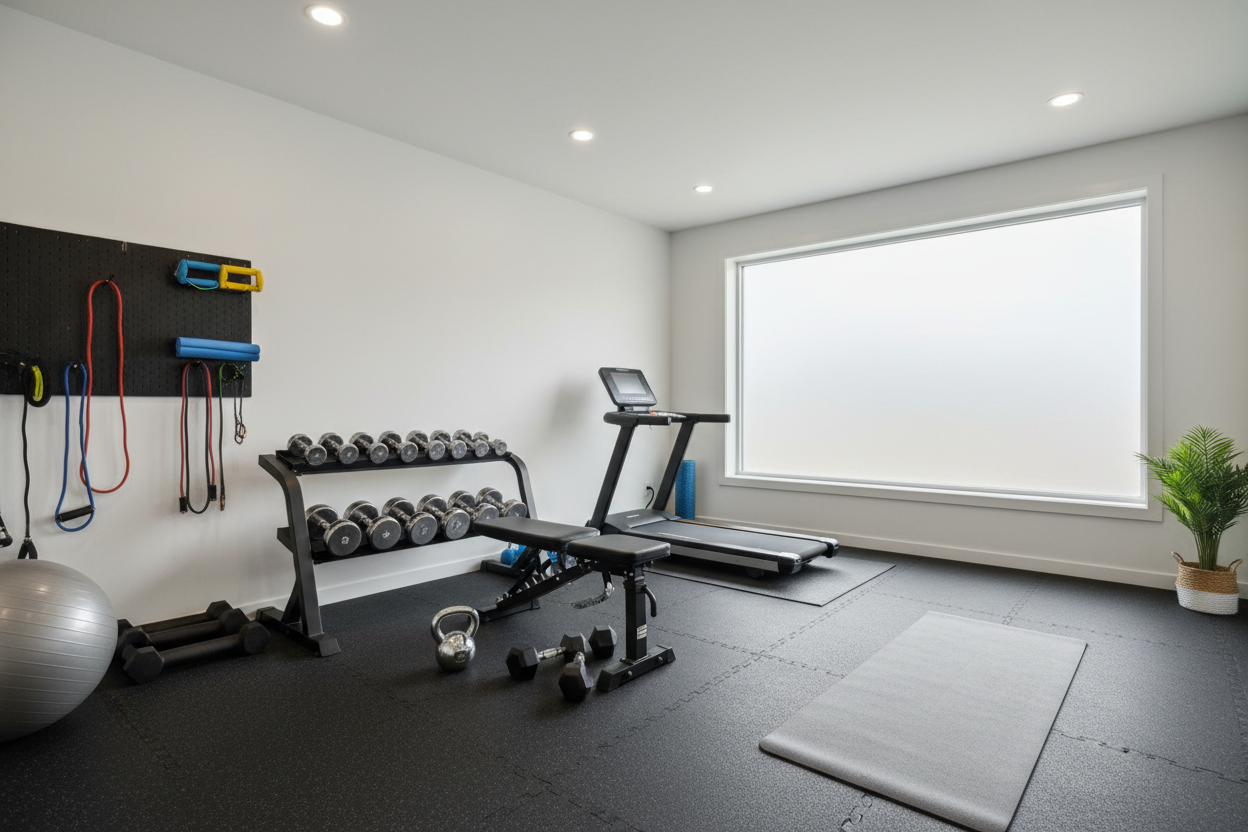
During Phase 1, your joints absorb massive force. You need a dedicated, spacious surface for explosive lateral movements. I highly recommend laying down a large exercise mat for home gym use. It absorbs the shock, protects your subfloor from dropped weights, and gives you the traction needed to push off violently without slipping.
For my own setup, I tested several options and found that a 6x8ft exercise mat is the absolute sweet spot. It provides enough runway for broad jumps and lateral bounds while easily rolling up if you need the room back. The only honest downside I found is that high-density mats of this size can be quite heavy to move around daily, so it is best left unrolled if you have a dedicated corner.
Example At-Home Workout Routines Using Energy Systems
Let's put this theory into practice. Here are two exercise workout routines at home mapped to the three-phase model.
Lower Body Day:
- Phase 1 (Power): Broad Jumps - 4 sets of 3 reps. Rest 90 seconds.
- Phase 2 (Tension): Dumbbell Goblet Squats (3-second negative) - 4 sets of 10 reps. Rest 60 seconds.
- Phase 3 (Conditioning): Kettlebell Swings - 8 rounds of 20 seconds work, 10 seconds rest (Tabata).
Upper Body Day:
- Phase 1 (Power): Plyometric Clap Push-ups - 4 sets of 4 reps. Rest 90 seconds.
- Phase 2 (Tension): You can pull from various at home chest workout routines here. Try a heavy floor press or weighted dips for 4 sets of 8-12 reps.
- Phase 3 (Conditioning): Battle ropes or rapid shadow boxing for 5 minutes straight.
How many days a week should I do this workout regimen at home?
For most people, 3 to 4 days of structured energy-system training is optimal. This allows for adequate CNS recovery between sessions. You can fill the rest days with light mobility work or walking.
Can I build muscle without heavy barbells?
Absolutely. Muscle fibers respond to mechanical tension and metabolic stress, not the specific tool you use. By manipulating tempo, decreasing rest periods, and increasing range of motion, a 50-pound dumbbell can feel like 100 pounds.
What if I don't have any equipment?
You can still use this sequencing method. Phase 1 becomes explosive jump squats. Phase 2 becomes slow-tempo pistol squats or decline push-ups. Phase 3 becomes burpees or mountain climbers.