Workout Plans for At Home: The Movement Pattern Guide
I've watched countless clients try to replicate their local commercial gym's chest day in their living room, only to get frustrated by a lack of cable crossovers and heavy dumbbells. It usually ends with them doing 500 push-ups, burning out, and eventually tweaking a shoulder. If you want effective workout plans for at home, you have to stop thinking about isolating body parts and start thinking about training movement patterns.
When the pandemic hit and everyone was locked out of their gyms, I had to completely redesign how my clients trained in cramped apartments and 10x10 spare bedrooms. The ones who succeeded weren't the ones who bought the most expensive gear. They were the ones who shifted their mindset to the movement pattern matrix.
Quick Takeaways
- Abandon traditional body-part splits; focus instead on five fundamental movements: Squat, Hinge, Push, Pull, and Core.
- Minimal gear is required: a pair of adjustable dumbbells (like a 5-52.5 lb set) and resistance bands cover 90% of your needs.
- Progressive overload at home relies heavily on tempo manipulation and paused reps, rather than just stacking plates.
- Protect your joints and floors with high-quality, dense gym flooring to ensure safe, stable movements during heavy lifts.
Why Traditional Body-Part Splits Fail in Living Rooms
When you walk into a commercial facility, dedicating an entire Tuesday to just your back and biceps makes sense. You have access to lat pulldowns, seated cable rows, and racks of dumbbells scaling up to 120 pounds. But try running that same routine in a spare bedroom with a single pair of 20-pound hex weights. You hit a wall incredibly fast.
This is the biggest mistake I see when designing a training program for home gym setups. People try to force a square peg into a round hole. When you lack endless heavy iron, isolating a single muscle group quickly leads to a plateau. You simply run out of resistance, and doing sets of 60 bicep curls becomes an exercise in cardio, not strength training.
Instead, the most successful home trainees use a movement pattern matrix. Rather than asking, 'How do I hit my chest?' you ask, 'What horizontal pushing movement can I perform with the gear I have?' This mindset shift frees you from needing 15 different machines. It allows you to build a highly effective routine using only your body weight, some bands, and a pair of adjustable dumbbells. It's about training movements, not muscles.
The Core of Effective Workout Plans for At Home
The human body doesn't actually know what a bicep curl is. It only understands tension, load, and movement. To build a balanced physique and functional strength, your routine needs to hit five primary movement patterns: the squat, the hinge, the push, the pull, and the core/carry.
When I build a home gym training program for a client, I ensure these five pillars are present every single week. This guarantees no muscle group is left behind, even if we never do a single isolation exercise. If you hit these patterns hard, your biceps, triceps, and calves will get plenty of secondary stimulation.
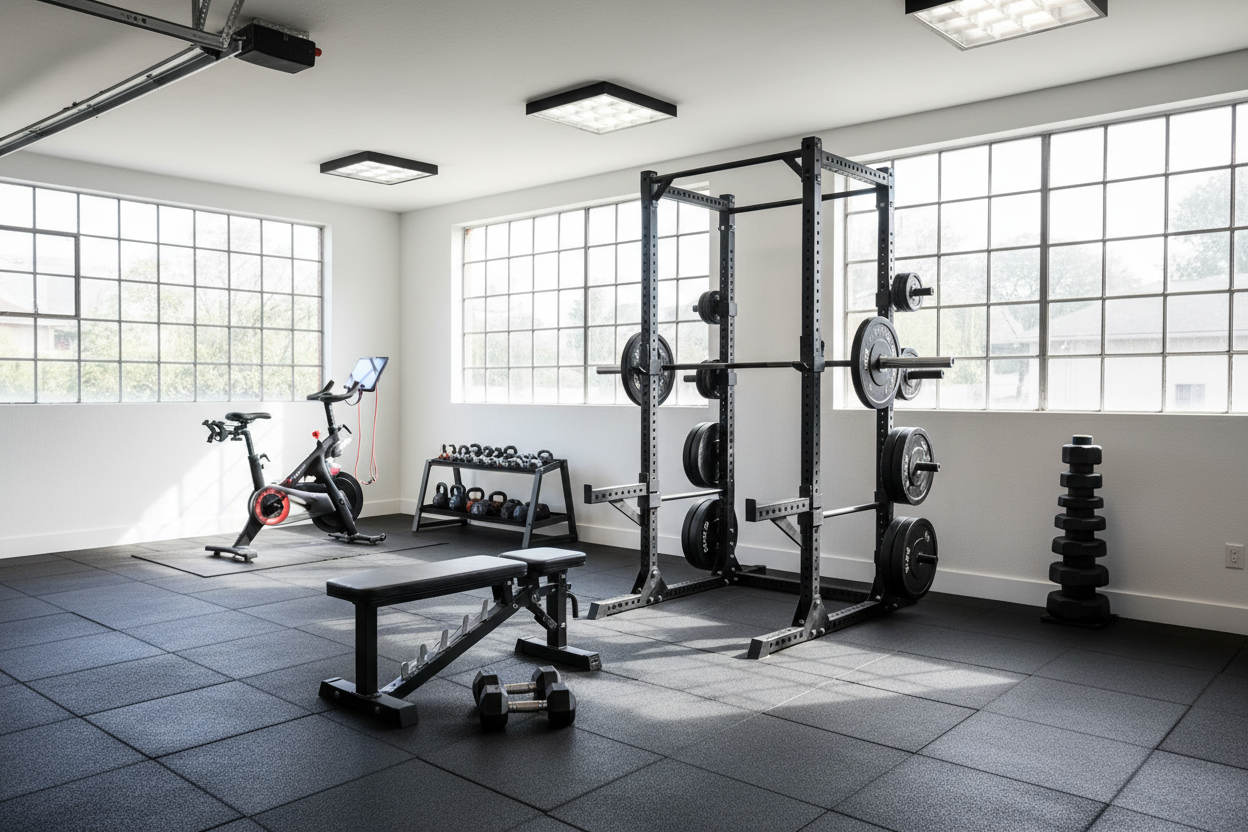
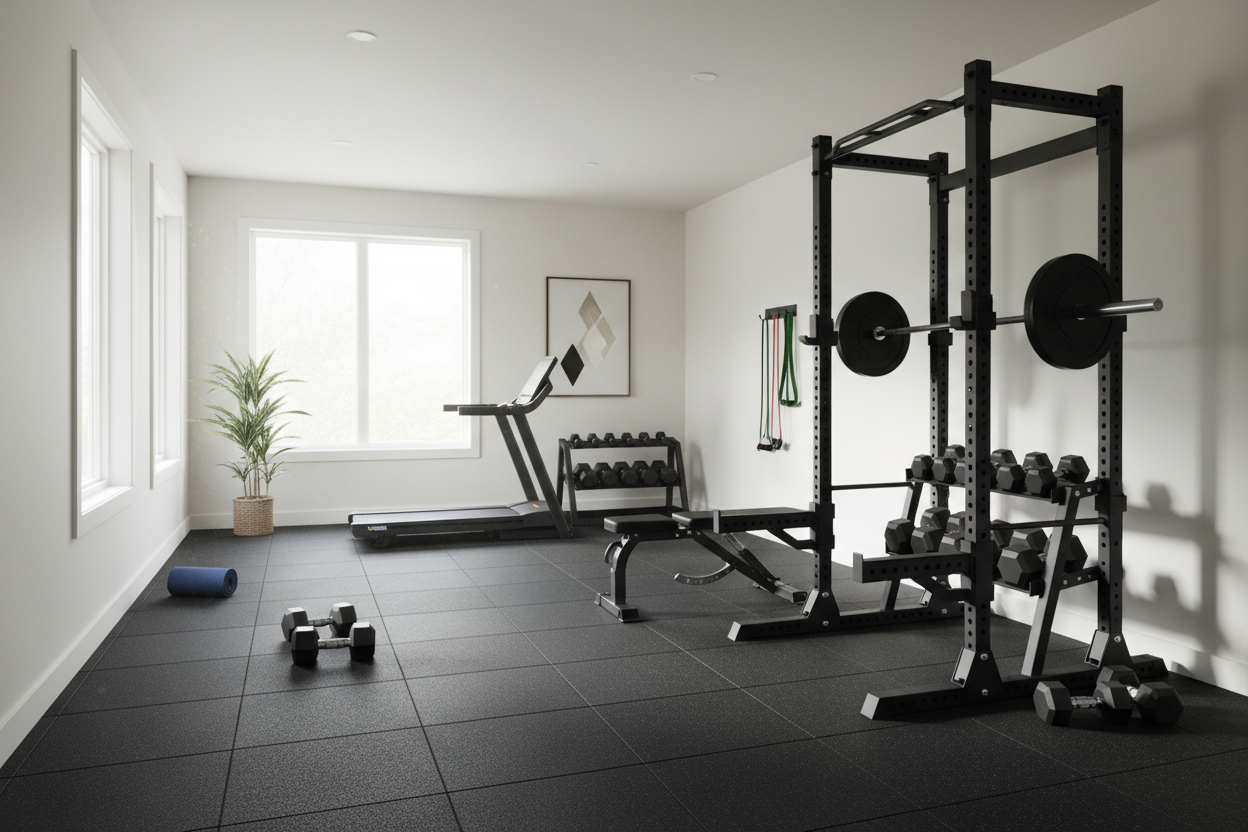
Before you start loading up these movements, you need a safe foundation. Doing heavy goblet squats or dynamic lunges on slippery hardwood or plush carpet is asking for a rolled ankle. I always have my clients lay down a large exercise mat for home gym use. It provides the necessary grip for ground-based movement patterns and absorbs the impact of dropped weights, which keeps both your joints and your downstairs neighbors happy.
Once your space is prepped, you can start plugging exercises into the matrix. The beauty of this system is its sheer flexibility. If you don't have a barbell for traditional back squats, you simply swap in a dumbbell goblet squat or a bodyweight Bulgarian split squat. The fundamental movement pattern remains intact, and your legs still get a massive growth stimulus.
Horizontal vs. Vertical Pushing and Pulling
Upper body training comes down to pushing things away from you and pulling things toward you. To avoid shoulder imbalances and posture issues, you need to split these into horizontal and vertical planes.
For horizontal pushing, think standard push-ups, dumbbell floor presses, or banded chest presses. Vertical pushing involves overhead movements like seated dumbbell presses, half-kneeling landmine presses, or bodyweight pike push-ups.
Pulling is notoriously tricky at home. For vertical pulls, a doorway pull-up bar is ideal, but heavy resistance bands anchored to the top of a door work remarkably well for kneeling lat pulldowns. Horizontal pulling can easily be covered by bent-over dumbbell rows or inverted rows underneath a sturdy dining table. By checking off one exercise from each of these four upper-body categories twice a week, you've built a complete, bulletproof upper-body routine.
Mastering the Squat and Hinge with Limited Weight
Lower body training requires distinguishing between knee-dominant (squat) and hip-dominant (hinge) movements.
Squat patterns primarily target the quads. At home, you will max out your dumbbell weight quickly on two-legged squats. The fix? Shift to unilateral, single-leg work. A Bulgarian split squat holding a single 30-pound dumbbell will humble even advanced lifters and requires half the weight.
The hinge pattern targets the glutes and hamstrings. Romanian deadlifts (RDLs) with dumbbells or heavy resistance bands are fantastic. If you run out of weight for two-legged RDLs, switch to single-leg RDLs or sliding leg curls on a hard floor using socks. The goal is to create maximum tension in the muscle, not just move a heavy object from point A to point B.
Structuring Your At Home Gym Workout Program
Now that we have the pieces, how do we put this at home gym workout program together? For most people training in their living room or garage, I recommend one of two schedules: a 3-day full-body split or a 4-day upper/lower split.
A 3-day full-body routine (for example, Monday, Wednesday, Friday) is incredibly efficient. Each workout includes one squat, one hinge, one push, one pull, and one core exercise. You hit every muscle group three times a week, which is optimal for natural lifters trying to grow muscle without spending hours in a gym.
If you prefer shorter, slightly more focused sessions, the 4-day upper/lower split works beautifully. Monday and Thursday are dedicated to pushing and pulling. Tuesday and Friday are reserved for squats, hinges, and core work. This allows for slightly more volume per session.
This structure is highly adaptable. If you are sharing your workout space and equipment with a partner or roommate, you can easily tweak a training program for a multi-user home gym by having one person do their upper body day while the other tackles legs. Because the movement matrix relies on minimal, versatile gear, you rarely end up fighting over the exact same pair of dumbbells at the exact same time.
Progressing Your Home Gym Training Program
The biggest complaint I hear about training at home is, 'I can't get stronger because I don't have enough weight.' This is a fundamental misunderstanding of how muscle growth works. Your muscles don't know the physical number stamped on the side of the dumbbell; they only know mechanical tension and metabolic stress.
In a commercial facility, you might rely on weight training machines where progressing is as simple as moving a pin down one slot. Home lifters have to be much more creative with how they apply tension.
If your 50-pound dumbbells feel too light for goblet squats, don't rush out to buy 70-pounders. Instead, change the tempo. Take four full seconds to lower into the squat, pause for two agonizing seconds at the absolute bottom, and explode up. I guarantee those 50s will suddenly feel like 100s.
You can also extend the range of motion. Elevate your front foot on a thick book during split squats to stretch the quad further. Add a resistance band to your dumbbell exercises to create accommodating resistance, where the movement gets harder at the top of the rep. These intensity techniques force your body to adapt and grow without requiring a massive financial investment in heavier iron plates.
Essential Gear to Support the Movement Matrix
I've tested dozens of home gym setups, from extravagant garage monoliths to minimalist studio apartment corners. The truth is, you only need three things to execute this movement matrix effectively.
First, a pair of adjustable dumbbells. A set that scales from 5 to 52.5 pounds is the gold standard for home use. They take up the footprint of a single shoebox but replace 15 pairs of traditional hex weights, giving you the micro-adjustments needed for both heavy rows and light lateral raises.
Second, a set of loop resistance bands. They cost less than a few cups of coffee, provide up to 100 pounds of tension, and are absolutely essential for replicating cable machine pulling movements at home.
Third, high-quality flooring. I cannot stress this enough. I once tried running a high-intensity circuit on a cheap, 1/4-inch yoga mat over concrete. My knees ached for a week, and the mat literally shredded after 500 reps of burpees and lunges. For performing dynamic lunges and wide-stance hinges without damaging floors or your joints, a 6x8ft exercise mat is the ideal surface area. It gives you enough room to move laterally without stepping off the edge, and the dense foam absorbs the shock of heavy dumbbell drops. Keep your setup simple, focus on the fundamental movements, and watch your strength skyrocket.
FAQ
Can I build muscle at home without a barbell?
Absolutely. Muscle growth requires mechanical tension, progressive overload, and adequate protein recovery. By using adjustable dumbbells, resistance bands, and tempo manipulation, you can create more than enough tension to stimulate hypertrophy without ever touching a standard 45-pound barbell.
How long should an at-home workout take?
If you follow a movement pattern matrix, a highly effective session takes 35 to 45 minutes. Because you aren't waiting for machines to open up or chatting at the water cooler, your rest periods are strictly tracked, keeping the workout dense, focused, and efficient.
What if I can't do a pull-up at home?
Pull-ups are tough, especially if you don't have a sturdy doorframe or wall space for a bar. You can substitute vertical pulling with heavy resistance band pulldowns anchored to a door top, or perform horizontal pulling like inverted rows using a strong table or a suspension trainer.