
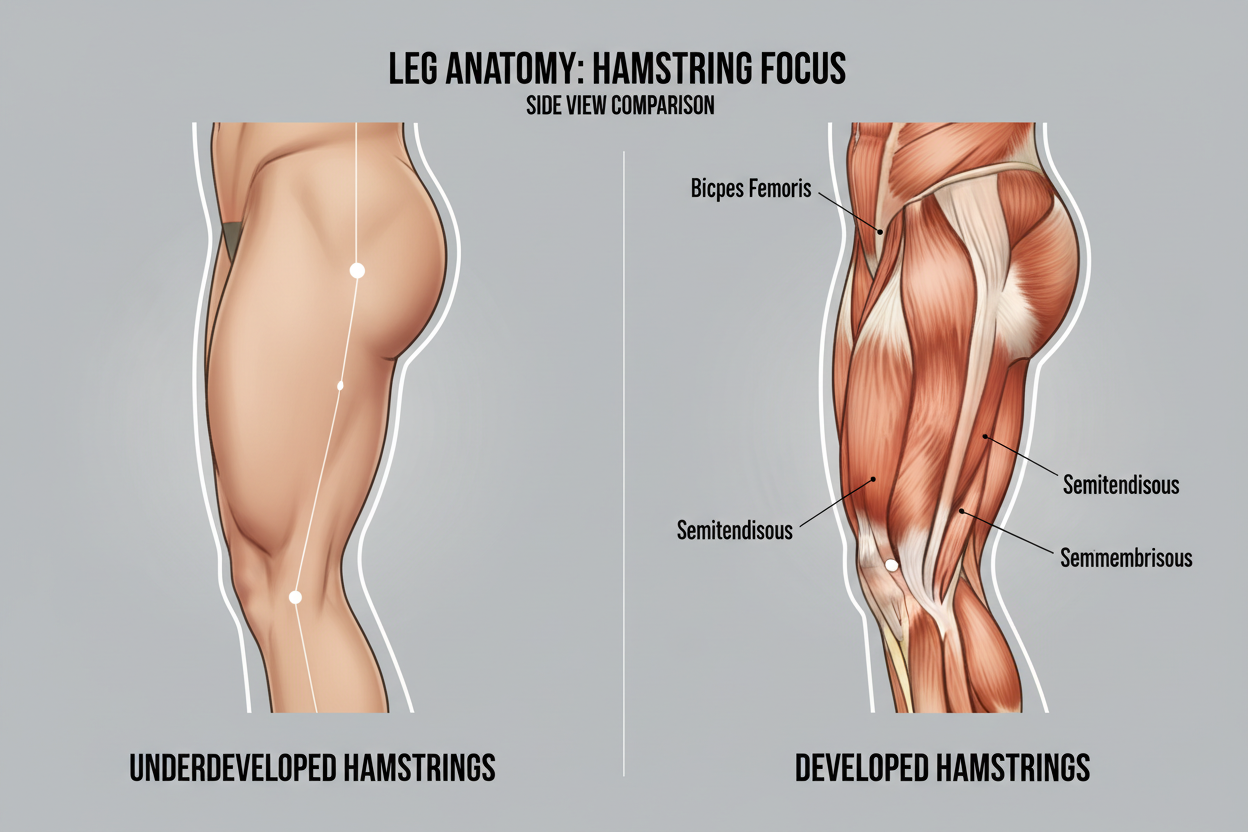
Why Your Legs Look Flat From the Side: The Ultimate Guide to Hamstring Mass
You check yourself out in the mirror after a heavy squat session. From the front, your quads are popping, looking thick and developed. But then you turn to the side, and the illusion vanishes. The back of your legs looks flat, almost nonexistent compared to the front. This is a common imbalance that plagues gym-goers who prioritize pushing movements over pulling ones. If you want legs that look powerful from every angle, you have to stop treating your hamstrings as an afterthought.
Building significant size on the back of your legs requires a two-pronged approach: heavy hip hinging movements to overload the muscles in a lengthened position, and high-tension knee flexion exercises to isolate the muscle belly. You cannot rely on squats alone. A dedicated hamstring workout for mass must prioritize the Romanian Deadlift (RDL) for hip extension and the seated or lying leg curl for knee flexion. By focusing on the eccentric (lowering) phase of these movements and progressively increasing the load, you force the muscle fibers to adapt and grow.
My Struggle with Quad-Dominant Training
I spent the first few years of my lifting career obsessed with my squat numbers. I thought if I could just squat four plates, my entire lower body would naturally become massive. I was wrong. While my quads grew, my hamstrings lagged severely. It wasn't until I suffered a minor knee strain that a physical therapist pointed out the glaring weakness in my posterior chain. My quads were overpowering my hamstrings, creating instability at the knee joint.
That was my wake-up call. I stopped throwing in a few lazy sets of leg curls at the end of my workout and started prioritizing hamstring workouts for mass at the beginning of the session. I had to leave my ego at the door, strip the weight back, and learn how to properly hinge at the hips without using my lower back. The difference in physique balance and knee stability within six months was night and day. It wasn't just about aesthetics; my squat actually improved because I finally had a stable base to push from.
The Anatomy of a Mass-Building Routine
To construct the best hamstring workout for mass, you need to understand what you are training. The hamstrings are a group of three muscles: the semitendinosus, semimembranosus, and the biceps femoris (long and short heads). Crucially, the short head of the biceps femoris only crosses the knee joint, meaning it only activates during leg curls. The other muscles cross both the hip and the knee.
This bi-articular nature means a complete routine cannot consist of just one type of movement. If you only do deadlifts, you neglect the short head. If you only do curls, you miss out on the massive mechanical tension generated by heavy hip extension. A balanced approach ensures every fiber is recruited.
The King of Mass: The Romanian Deadlift (RDL)
If you have limited time and need the most bang for your buck, the Romanian Deadlift is non-negotiable. Unlike a conventional deadlift where the weight starts on the floor, the RDL starts from the top down, keeping constant tension on the posterior chain. This exercise places the hamstrings under extreme stretch while supporting a load, which is a primary driver of hypertrophy.
Form is everything here. Keep your knees slightly bent but fixed—they shouldn't travel forward. Push your hips back as if you are trying to close a car door with your glutes. Lower the bar only as far as your hamstring flexibility allows without your lower back rounding. You should feel a deep, uncomfortable stretch in the belly of the muscle. Explosively drive the hips forward to return to the start, squeezing the glutes hard. Aim for the 6 to 10 rep range with heavy loads to maximize growth.
Isolation Mastery: The Seated Leg Curl
For years, the lying leg curl was the standard, but recent biomechanical evidence suggests the seated leg curl might be superior for mass. When you are seated with your hips flexed, the hamstrings are more lengthened at the hip origin. Training a muscle at longer lengths often results in greater hypertrophy.
When performing these, avoid the temptation to use momentum. Lock yourself into the machine so your hips don't lift off the pad. Execute the curl with a controlled tempo, pausing for a split second at the point of peak contraction. The eccentric phase—letting the weight back up—should take two to three seconds. This controlled release causes micro-tears in the muscle tissue that repair bigger and stronger.
The Nordic Hamstring Curl
If you want to bulletproof your hamstrings while adding size, the Nordic curl is an eccentric-focused powerhouse. You can do these on a specific machine or by having a partner hold your ankles while you kneel on a pad. The goal is to lower your torso toward the floor as slowly as possible using only your hamstrings to control the descent.
Most people cannot perform the concentric (lifting) portion without assistance, and that is fine. Focus entirely on the lowering phase. Fight gravity all the way down. Once your chest touches the floor, push yourself back up with your hands to the starting position and repeat. This exercise recruits high-threshold motor units that are difficult to tap into with standard weights.
Programming Your Posterior Chain Training
Integrating these moves requires smart programming. If your hamstrings are a weak point, consider training them twice a week. One session can be heavy, focusing on RDLs and lower rep ranges. The second session can focus on metabolic stress using higher reps on leg curls and glute-ham raises.
A sample heavy rotation might look like this:
- Romanian Deadlifts: 3 sets of 8-10 reps (Focus on the stretch)
- Seated Leg Curls: 4 sets of 12-15 reps (Focus on the squeeze and slow eccentric)
- Bulgarian Split Squats (Glute/Ham focus): 3 sets of 10 reps per leg (Lean torso forward to engage the posterior chain)
Remember that recovery is just as vital as the lifting. Hamstring workouts for mass can be incredibly taxing on the central nervous system, especially when heavy hinging is involved. Ensure you are eating enough protein to support repair and getting adequate sleep. If your lower back feels fried, check your RDL form or swap them for 45-degree back extensions until your core strength catches up.
Leg development takes patience. You won't fix years of neglect in four weeks. However, by consistently applying progressive overload to these key movements, you will transform the back of your legs from flat to full, completing the look of a truly powerful physique.
Frequently Asked Questions
Can I train hamstrings and quads on the same day?
Yes, you can, but it depends on your energy levels. If you do heavy squats first, your hamstring intensity might suffer later in the workout. If hamstrings are your priority, try starting your leg day with leg curls to pre-exhaust them, or split your leg training into a dedicated quad day and a dedicated posterior chain day.
Why do I feel RDLs in my lower back instead of my hamstrings?
This usually happens because you are bending at the waist rather than hinging at the hips, or you are lowering the weight too far past your flexibility limit. Keep the bar close to your legs, brace your core tight, and stop the descent as soon as your hips stop moving backward.
Are squats enough to build big hamstrings?
Generally, no. While squats do activate the hamstrings to stabilize the knee, the muscle length doesn't change enough during the movement to stimulate maximal hypertrophy. You need direct hip extension (like deadlifts) and knee flexion (like curls) to fully develop the muscle group.


