Why Your Home Gym Is Failing (And How to Fix It With Proper Storage)
You walk into your garage or spare room, ready to crush a leg day, but immediately stop. There is a pile of iron plates scattered near the door, the barbell is wedged behind a treadmill, and you have to move a stack of 45s just to get to your 10s. By the time you actually start your warm-up, ten minutes have passed, and your motivation has taken a nosedive. This scenario is the silent killer of workout consistency.
Most people obsess over which barbell to buy or which program to follow, yet they completely neglect the logistics of their training environment. A chaotic gym leads to chaotic training. If you have to fight your equipment before you even lift it, you are less likely to train. The foundation of a long-term, successful lifting habit isn't just willpower; it is having a space that invites you to work out rather than repelling you.
The Psychology of a Clean Lifting Space
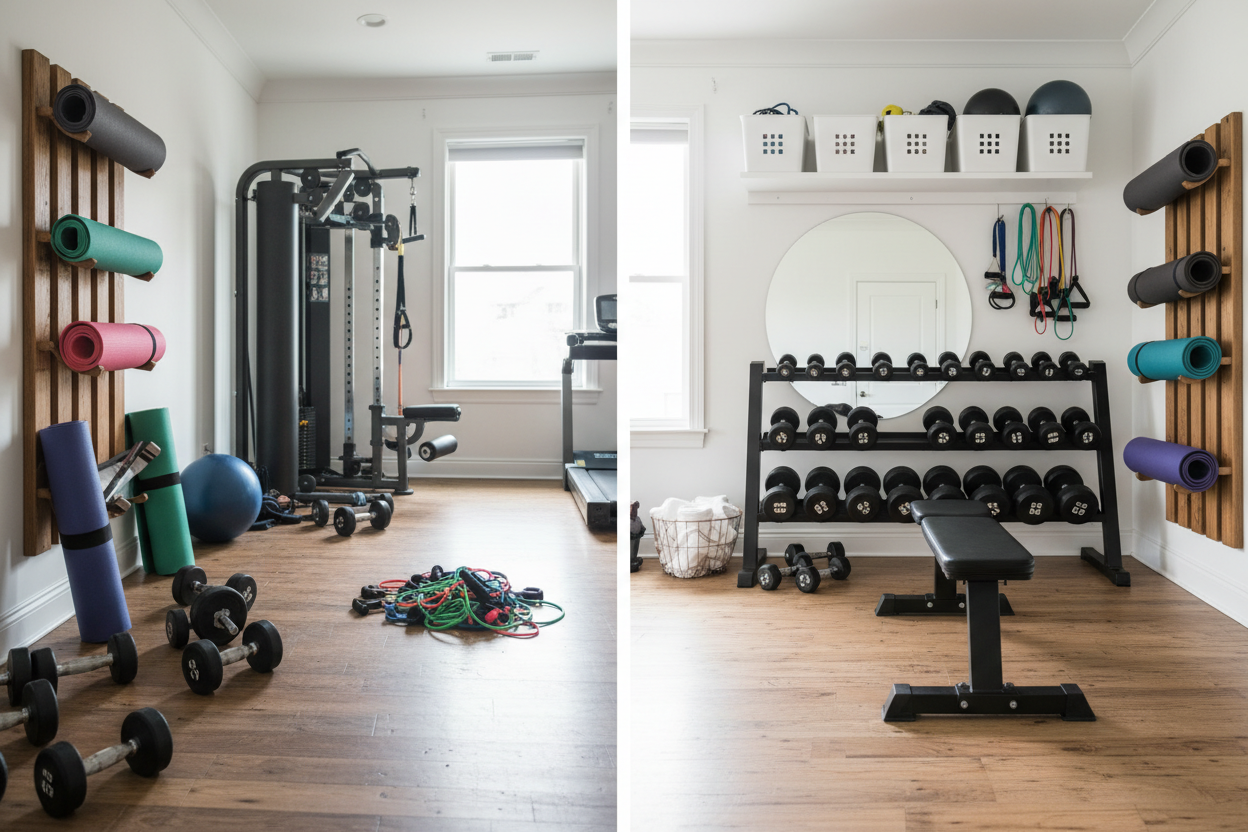
Environmental friction is a real psychological barrier. Every extra step required to start a behavior reduces the likelihood of that behavior occurring. In a commercial gym, the staff (hopefully) puts weights away, keeping the flow efficient. At home, you are the staff. If your plates are lying in a heap, loading the bar becomes a chore rather than a ritual. This is where dedicated storage infrastructure transforms a room full of heavy metal into a functional gym.
I learned this the hard way a few years ago. I was training in a tight single-car garage with zero organization. I kept my bumper plates stacked in a single vertical tower in the corner. Every time I needed the 25lb plates, they were inevitably at the bottom of the stack, crushed under the 45s and 35s. I found myself skipping progressive warm-up sets just to avoid the "plate shuffle." It was lazy, dangerous, and stalled my progress. The day I finally bought a dedicated tree was the day my training volume actually increased. I wasn't stronger; I just wasn't wasting energy wrestling with gravity before the set even started.
Choosing the Right Storage for Your Setup
Organizing your weights requires understanding your space and your equipment. Not all storage solutions are built the same, and buying the wrong one can be just as frustrating as having none at all. You generally have three options: vertical trees, horizontal racks, and wall-mounted storage.
Vertical Weight Trees
For most home setups, the vertical tree is the gold standard. It minimizes the footprint, allowing you to store hundreds of pounds of plates in roughly four square feet of floor space. When selecting a tree, pay close attention to the spacing between the posts. If you use bumper plates, which are significantly thicker than cast iron, a standard tree might not have enough gap between the pegs to hold full-sized 45lb bumpers on both the top and bottom rungs.
Horizontal Racks
If you have a bit more floor space, a horizontal barbell weights rack is often superior for bumper plates. These low-profile units usually come on wheels, allowing you to roll the weights right up to your lifting platform. This mimics the feel of a high-end weightlifting club. The advantage here is the "toaster rack" style slots, which let you pull any plate size without removing others first. It eliminates the stacking order issue entirely.
Safety and Equipment Longevity
Leaving weights on the floor does more than look messy; it damages your investment. Concrete floors draw moisture, and if cast iron plates sit directly on concrete for extended periods, they will rust. Even rubber bumper plates can degrade or warp if stored improperly under uneven pressure. Getting your weights off the ground extends their lifespan significantly.
Furthermore, tripping hazards are no joke when you are fatigued. Stumbling over a stray 5lb change plate while carrying a heavy dumbbell is a recipe for an ankle sprain or worse. A designated spot for every piece of gear ensures your floor remains a safe zone for movement.
Integrating the Barbell
Plates are only half the equation. Your bars need a home too. Leaning a barbell in a corner places stress on the bearings and bushings within the sleeve, potentially causing them to seize up over time. It also risks the bar sliding down and marking up your walls or smashing a window.
Many lifters look for a combination unit—a barbell rack and weights storage system in one. these are excellent for compact spaces. These units typically feature weight pegs on the frame and vertical tubes to hold two or more barbells upright. However, be cautious with ceiling height. If you have low ceilings (common in basements), extracting a 7-foot barbell from a vertical holder might be impossible. In those cases, horizontal gun-rack style wall mounts are the only viable option.
The Workflow Factor
Think about your workout flow when positioning your storage. If your squat rack is on the left side of the room, do not put your weight storage on the far right. You will spend half your workout walking back and forth carrying heavy discs. This fatigues your grip and lower back unnecessarily.
Ideally, your storage should sit within one step of where you load the bar. If you have a power rack, consider buying weight storage horns that attach directly to the rack uprights. This adds stability to the rack (weighing it down so it doesn't tip during kipping movements or heavy racking) and puts the plates exactly where you need them. This is the most efficient setup for solo training.
Making the Investment
It is easy to justify spending money on a new barbell or a heavier set of dumbbells because you can "feel" the utility. Spending money on a rack feels boring. But you have to view it as buying time and focus. A disorganized gym is a distraction. A clean, organized gym is a sanctuary.
When you are ready to upgrade, look for welded steel construction. Bolt-together units are fine, but they require maintenance to keep the bolts tight. Check the weight capacity rating—cheap generic racks might buckle under a full set of calibrated powerlifting discs. Treat your storage with the same seriousness as your lifting gear, and your home gym will serve you for decades.
Frequently Asked Questions
Does it matter if I store my barbell vertically or horizontally?
Generally, high-quality barbells can be stored either way without damage. However, cheap barbells with poor lubrication might leak oil if stored vertically. If you store them vertically, ensure the weight is resting on the sleeve end cap, not the shaft, to protect the bearings.
What is the difference between standard and Olympic weight racks?
The difference lies in the diameter of the posts. Olympic racks have 2-inch diameter posts designed for Olympic plates, while standard racks have 1-inch posts for standard plates. You cannot fit standard plates on an Olympic rack, and Olympic plates will hang loosely and rattle on a standard rack.
Can I keep my bumper plates in a hot garage?
Yes, but try to keep them out of direct sunlight and off the floor. UV rays can break down the rubber over time, causing cracking, and extreme heat fluctuations can loosen the center hubs. A proper rack kept in the shade is the best protection.