Why Your Female Body Training Plan Leaves You Exhausted
I spent years scrolling through Instagram, watching influencers breeze through 1,000-rep 'toning' circuits with 2-lb dumbbells. I tried them all. I’d finish those sessions drenched in sweat, gasping for air, and feeling like I’d put in the work. But six months later? My strength hadn't budged, and I looked exactly the same. I was exhausted, but I wasn't changing. If your female body training feels like a never-ending treadmill of fatigue without the muscle to show for it, you’re likely stuck in the circuit trap.
Quick Takeaways
- High-rep circuits are often just cardio in disguise, not a strength builder.
- Splitting your training days allows for higher intensity and better recovery.
- Lifting heavy (relative to your strength) is the only way to drive actual muscle adaptation.
- A stable floor foundation is non-negotiable for safe, heavy compound lifts.
- Rest days are when the actual 'toning' (muscle repair) happens.
The Trap of the Endless Full-Body Circuit
The fitness industry loves to sell women on 'metabolic conditioning' and 'full-body burns.' The logic sounds great: hit every muscle every day to burn maximum calories. In reality, this approach usually leads to systemic fatigue. When you try to hit your legs, back, and shoulders all in one go, you’re limited by your heart rate rather than your muscle strength. You stop because you're out of breath, not because your glutes are fatigued.
Doing these low-weight, high-volume circuits every single day doesn't give your Central Nervous System (CNS) a break. You end up in a state of chronic under-recovery. Your cortisol spikes, your sleep suffers, and you stay 'soft' because you aren't actually lifting enough weight to trigger muscle protein synthesis. You don't need more sweat; you need more tension.
Why Splitting Your Days Changes Everything
When I finally ditched the daily circuits and moved to an Upper/Lower split, my progress exploded. Splitting your days means you dedicate an entire session to just two or three muscle groups. This allows you to use heavier loads because you aren't saving energy for ten other exercises. Mentally, it’s a relief too. You can focus on mastering the squat without worrying about the burpees coming up in three minutes.
Physiologically, this is where the magic happens. If you crush your legs on Tuesday, they get to rest on Wednesday while you focus on your back and shoulders. This recovery window is when the muscle actually grows. Without it, you're just tearing down tissue that never gets a chance to rebuild. You’ll find you can move 20% to 30% more weight just by giving those specific muscles a dedicated day.
Prioritizing Heavy Lower Body Sessions
If you want a strong female workout body, you have to move past the resistance bands. While bands are great for activation, they won't build a shelf. You need mechanical tension—the kind you get from a barbell or a heavy machine. Transitioning to a dedicated female lower body workout guide will show you that the real results come from the 5-to-10 rep range, not the 50-rep range.
In my home gym, I realized that my adjustable dumbbells eventually weren't enough for my progress. To really load the posterior chain without my grip failing first, I started looking into lower body strength machines like a dedicated leg press or a hack squat. These tools allow you to isolate the quads and glutes with much heavier weights than you can safely hold in your hands, which is the fastest route to changing your body composition.
Setting Up Your Floor for Heavy Lifts
As you transition from light circuits to heavy lifting, your environment has to change. You cannot safely squat or deadlift on a plush carpet or a thin, squishy yoga mat. I learned this the hard way when I tried to max out my deadlift on a cheap foam tile and felt my ankle roll as the foam compressed. It was a stupid mistake that sidelined me for three weeks.
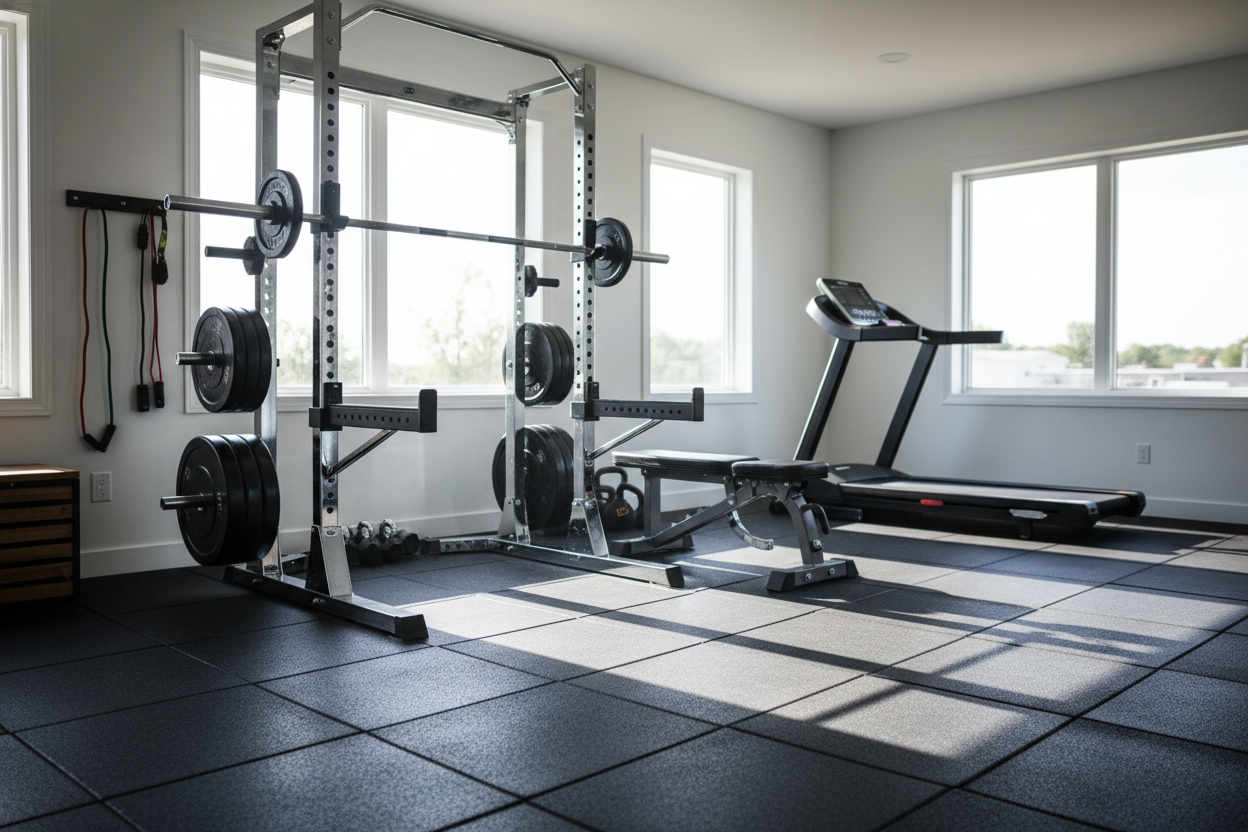
For heavy lower body days, you need a non-slip, high-density surface that offers 'dead' energy return. A heavy-duty exercise mat is essential here. You want something at least 7mm to 10mm thick that won't slide when you're driving through your heels. This stable foundation ensures that 100% of your power goes into the lift rather than being absorbed by a soft floor, and it protects your subfloor when you finally set those heavy plates down.
A Realistic 4-Day Split You Won't Hate
You don't need to live in the gym. A 4-day split is the 'sweet spot' for most women who want to see real muscle without burning out. Try this schedule: Monday (Upper Body), Tuesday (Lower Body), Wednesday (Active Recovery/Walk), Thursday (Upper Body), Friday (Lower Body), Weekend (Rest). This ensures every muscle group is hit twice a week, which is the gold standard for hypertrophy.
On your lower body days, don't overcomplicate it. Pick four or five movements and do them well. You can plug this ultimate lower body workout template into your schedule to ensure you're hitting the right angles. Focus on progressive overload—adding just 2.5 lbs or one extra rep every week. That slow, boring progression is what actually builds the physique that 1,000 burpees never could.
FAQ
Will lifting heavy make me look 'bulky'?
No. Women don't have the testosterone levels to accidentally turn into a bodybuilder. Lifting heavy will give you the 'toned' look you're actually after by building the muscle that sits under your skin.
Can I still do my favorite HIIT class?
Sure, but keep it to once or twice a week. If you're doing HIIT five days a week, you won't have the energy to lift heavy enough to change your muscle shape. Treat cardio as a supplement, not the main course.
What if I don't have a barbell?
You can go very far with heavy dumbbells and machines. The key isn't the specific tool, but the intensity. If you can easily finish your set, the weight is too light.