Why Your Core Routine Needs Angles: The Secret to Lower Ab Definition
Most people spend years chasing lower abdominal definition only to find that endless crunches and planks aren't getting the job done. The problem usually isn't effort; it's physics. Your abdominal muscles, specifically the lower region and the deep transverse abdominis, respond best to leverage and tension rather than simple flexion. This is where the concept of the leg angle exercise comes into play. By manipulating the angle of your legs relative to your torso, you create a longer lever arm, forcing your core to stabilize against gravity in a way that standard sit-ups simply cannot replicate.
Integrating specific angle-based movements changes the stimulus entirely. Instead of curling your spine, you are fighting to keep your spine neutral while heavy limbs move away from your center of gravity. This approach targets the stubborn lower abdominal pouch and strengthens the hip flexors, which are often the weak link in functional movement. If you are looking to fix your posture, alleviate lower back pain, or finally see muscle separation, you have to stop thinking about reps and start thinking about degrees and angles.
The Mechanics of the Leg Angle Exercise
A leg angle exercise is fundamentally an isometric or dynamic hold where the legs are positioned at a specific degree—usually between 30 and 45 degrees—off the floor. At this specific range, the tension on the rectus abdominis is at its peak. If the legs are too high (90 degrees), the skeletal structure of the hips takes the weight, and the abs relax. If they are too low, the lower back often arches, transferring the load to the lumbar spine. Finding that sweet spot in the middle is where the magic happens.
To perform a basic variation, lie flat on your back with your hands under your glutes for pelvic support. Press your lower back firmly into the mat—this is non-negotiable. Lift both legs straight up, then slowly lower them until you feel your core trembling but your back remains flat. This is your working angle. Holding this position builds immense static strength.
I remember when I first transitioned from a standard bodybuilding split to more calisthenics-based training. I thought I had a strong core because I could rattle off 50 sit-ups. My coach had me lie on the floor and hold my legs six inches off the ground. I couldn't last 15 seconds. My lower back took over immediately, and my hip flexors cramped. It was a humbling realization that I had surface-level abs but zero deep core stability. Incorporating these angle holds three times a week corrected my anterior pelvic tilt and actually improved my squat depth significantly within a month.
Fixing Imbalances with Unilateral Training
We rarely move symmetrically in real life. We walk, run, and climb one leg at a time. Training both legs together constantly can mask a dominant side, leading to torque on the hips and eventual injury. You need to isolate each side to ensure your pelvis remains stable during movement.
This is where the right leg angle exercise becomes vital. By keeping the left leg planted firmly on the ground (knee bent or straight) and performing lifts or holds only with the right leg, you force the right side of your core (obliques and rectus abdominis) to stabilize the pelvis without help. You might find that your left leg can hold a 30-degree angle easily, while your right leg shakes or your hip pops at that same depth. Identifying this discrepancy allows you to train the weaker side with more volume.
Try performing single-leg lowers. Start with both legs up. Keep the left leg vertical while you lower the right leg to a 45-degree angle. Pause, hold, and return. This dissociates the hips, teaching you to control one limb while stabilizing the rest of the body.
Dynamic Compression: The Leg In Leg Out
Static holds build stability, but dynamic movement builds endurance and definition. Once you have mastered the static hold, you need to add compression. The leg in leg out movement, often referred to as seated knee tucks or lemon squeezers, is the perfect follow-up to static holds.
Sit on the floor, balancing on your tailbone with your hands placed lightly behind you for balance (or lifted for an advanced version). Extend your legs straight out so your body forms a wide V shape. Explosively tuck your knees in toward your chest while simultaneously bringing your torso slightly forward to meet them. Extend back out to the starting position without letting your heels touch the ground.
The rhythm here is crucial. The leg in leg out motion creates a pump effect in the abdominals. Unlike the slow grind of the angle holds, this should be rhythmic. It flushes blood into the muscle and forces the core to rapidly switch between eccentric (lengthening) and concentric (shortening) contractions. This exercise is particularly effective for runners or athletes who need hip flexor speed combined with core rigidity.
Rotational Strength: The Up and Over Leg Exercise
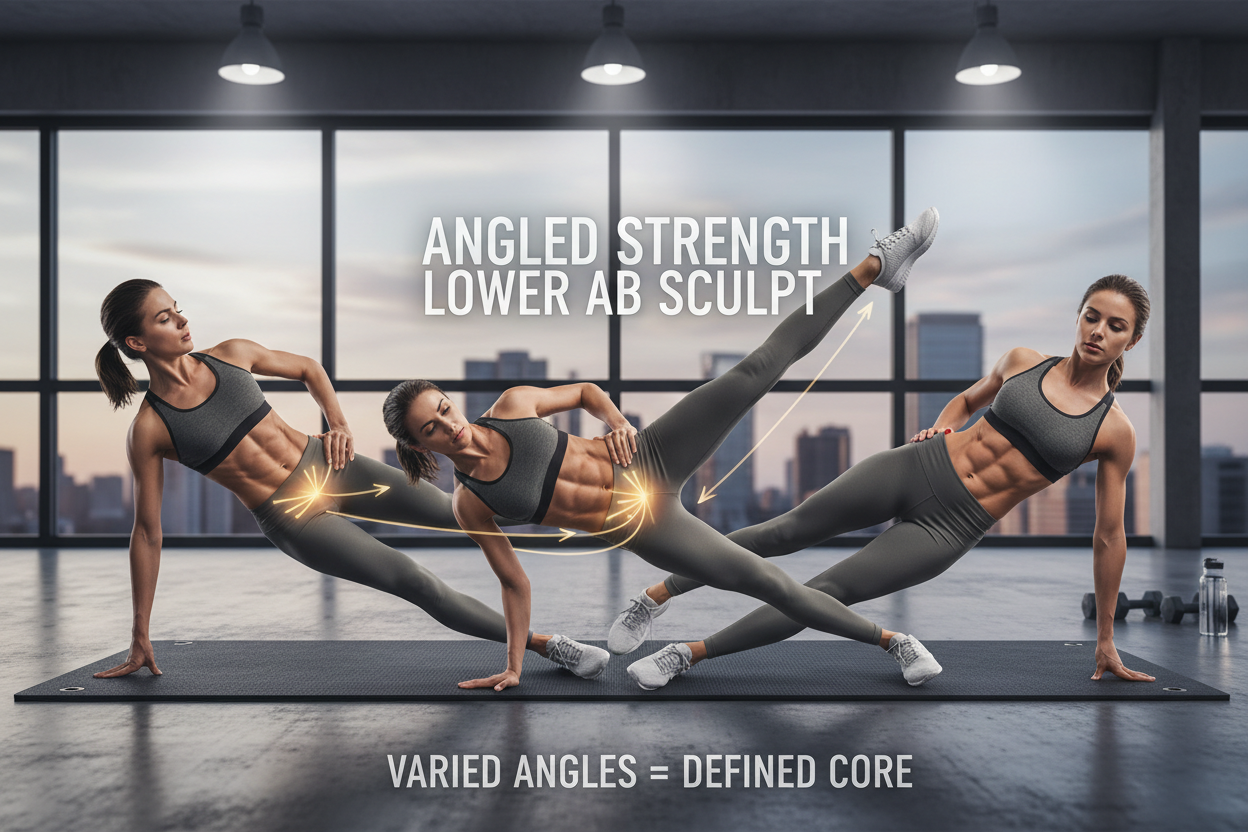
The abdominal wall is not just a flat sheet; it wraps around your torso. To target the obliques and improve hip mobility, you must move laterally, not just vertically. The up and over leg exercise, sometimes called "rainbows," challenges the core to control the weight of the legs through a rotational arc.
Place a visual target on the floor at the center of your mat—a yoga block, a kettlebell, or a water bottle works well. Sit on the floor with your hands behind you for support. extend your legs fully to the left side of the object. Keeping your legs glued together and straight, lift them up high, arcing over the object, and tap your heels gently on the floor on the right side. Immediately lift them back up and over to the left.
This movement is deceptive. The height of the arc forces the lower abs to work hard to lift the heavy leg weight, while the lateral movement engages the obliques and the quadratus lumborum (lower back stabilizer). The key is to not use momentum. If you swing your legs, you use your back. If you lift them with control, you use your core. This exercise creates that desirable "V-taper" look where the obliques meet the hip bone.
Structuring the Routine
You do not need to dedicate an entire hour to these movements. They work best as a high-intensity finisher after your main workout or as a standalone 15-minute circuit. Because these exercises rely on leverage, form breakdown happens quickly. It is better to do fewer reps with perfect spinal alignment than high reps with an arched back.
Try this circuit structure:
- Static Hold (Leg Angle): 30 seconds work, 15 seconds rest.
- Seated Compression (Leg In Leg Out): 45 seconds work, 15 seconds rest.
- Rotational Arc (Up and Over): 45 seconds work, 15 seconds rest.
- Unilateral Hold (Right/Left isolated): 30 seconds per side.
Repeat this circuit three times. Pay attention to your breathing. Exhale sharply as you exert force (lifting the legs or tucking in) and inhale as you extend or lower. Holding your breath increases intra-abdominal pressure but can cause dizziness during high-tension holds. Proper breathing engages the diaphragm, which stabilizes the core from the inside out.
Consistency with these angles will do more for your core strength than hundreds of crunches ever could. By respecting the physics of leverage and gravity, you turn your own legs into the most effective gym equipment you own.
Frequently Asked Questions
Can I do leg angle exercises if I have lower back pain?
You should approach these with caution. If you feel pain, modify the movement by placing your hands under your hips to tilt the pelvis or by bending your knees slightly to shorten the lever arm. This reduces the strain on the lumbar spine while still engaging the core.
How often should I train my lower abs with these exercises?
The core muscles recover relatively quickly, but these leverage-based movements are intense. Aim for 3 to 4 times per week, allowing a day of rest in between sessions to prevent hip flexor overuse and ensure maximum performance.
Do I need ankle weights for these exercises?
For most people, the weight of their legs is sufficient resistance, especially when maintaining perfect form. Master the movements with slow, controlled tempos first; only add ankle weights once you can perform the exercises for 60 seconds without your lower back arching.