Why Your Cheap Exercise Equipment Bar Is Ruining Your Lifts
I remember the night I decided to quit my $150-a-month commercial gym and start a garage setup. I spent hours scrolling through Amazon at 2:00 AM, trying to convince myself that a $60 exercise equipment bar would be 'good enough' for my modest goals. I was wrong. That cheap piece of pipe ended up costing me more in the long run than if I had just bought a professional-grade barbell from the jump.
Quick Takeaways
- Standard 1-inch bars are basically toys; always go for a 2-inch Olympic bar.
- Cheap steel has low tensile strength, meaning it will permanently bend under 300+ lbs.
- The knurling (grip texture) on budget bars is either non-existent or painfully sharp.
- Sleeve rotation is non-negotiable to prevent wrist and elbow injuries.
The Day My First Barbell Bent (And Why It Happened)
I bought a generic workout equipment bar from a big box store because it came in a '300-lb weight set' for a price that seemed like a steal. Three months later, I was loading 225 lbs for a set of squats. As I walked the weight out, I felt a rhythmic oscillation that didn't feel right. When I finished the set and looked at the bar on the rack, it had a permanent 'smile.' It was bowed right in the center.
Cheap bars are made from low-grade carbon steel with a tensile strength often below 130,000 PSI. In the world of heavy lifting, that is a disaster waiting to happen. Once a bar takes a permanent set (a bend), it becomes dangerous because it will want to roll in your hands to find its lowest center of gravity. My mistake was thinking steel is just steel. It isn't. High-quality bars are heat-treated to ensure they can flex and then snap back to perfectly straight every time.
Standard vs. Olympic: The Only Rule That Matters
If you are serious about getting strong, stop looking at 1-inch 'standard' bars. These are the thin bars you see in dusty basements with the screw-on collars. They are rated for very low weights, and the plates you buy for them won't fit on any professional equipment. You are essentially buying into a dead-end ecosystem.
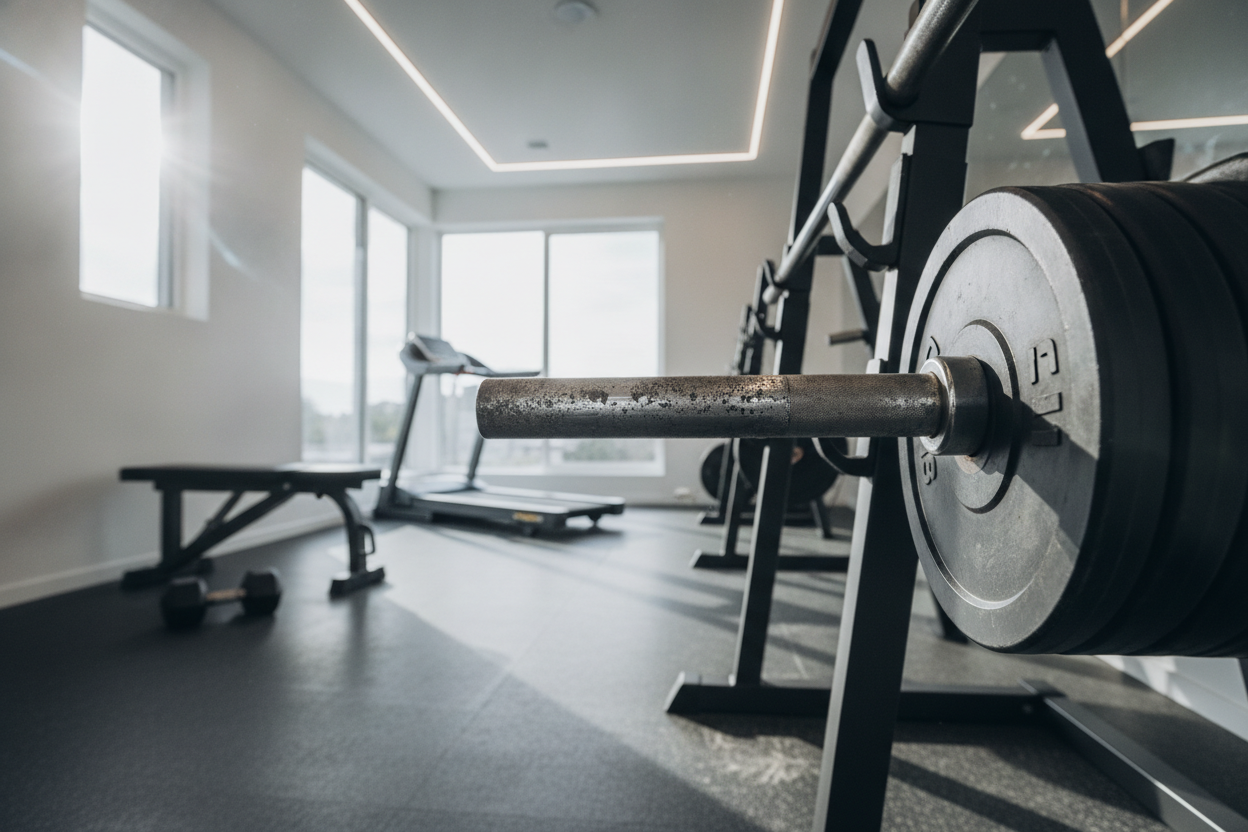
You should be investing in a high-quality Olympic bar from the start. These have 2-inch diameter sleeves and are built to withstand hundreds of thousands of pounds of cumulative stress. The sleeves on an Olympic bar also feature bearings or bushings that allow the weights to spin independently of the shaft. This might sound like a luxury, but when you are cleaning a bar or even just curling, that spin prevents the momentum of the plates from wrecking your wrists.
Knurling, Whip, and Spin (Translated for Normal People)
When you start shopping, you'll see specs like 'knurling' and 'whip.' Knurling is the cross-hatched pattern etched into the steel. On a cheap bar, it's often pressed on, resulting in a slippery feel. On a real bar, it's cut with a CNC machine. I prefer a medium 'volcano' knurl—it's grippy enough for heavy deadlifts but won't leave your palms bleeding after a high-rep set.
Whip refers to how much the bar bends and bounces. For most garage gym owners, you want a stiff bar for squats and presses, but a little whip is nice for deadlifts. Before upgrading your core strength equipment, check the sleeve construction. If the sleeves are pinned or bolted on, stay away. You want a snap-ring construction that can handle being dropped without the ends flying off and denting your floor.
Do You Actually Need Plates Right Away?
One of the biggest hurdles for beginners is the cost of iron. But here is a secret: a standard 20kg or 45lb bar is a significant amount of weight. Most people struggle to strict press a 45lb bar with perfect form on day one. You can get a good bar workout for beginners by focusing entirely on technique—think overhead squats, lunges, and Romanian deadlifts—before you ever buy your first pair of 45lb plates.
I spent my first month just mastering the 'empty' bar. It taught me more about balance and bar path than any machine ever did. Don't let the lack of a full plate tree stop you from getting a quality bar. Buy the bar first, then add plates as your strength (and budget) allows.
The Truth About Fixed and Guided Bars
Some people prefer Smith machines or fixed-weight bars because they feel 'safer.' While these have their place for bodybuilding isolation, they don't teach you how to stabilize a load. If you find yourself figuring out the Smith machine bar weight, keep in mind that most are counterbalanced to feel like 15 or 25 lbs, rather than the standard 45 lbs of a free barbell.
Fixed bars (the ones you see on a rack in 10lb increments) are great for convenience, but they are a nightmare for a home gym because they take up massive amounts of space. A single high-quality barbell and a few plates replace an entire rack of fixed bars and give you a much more natural range of motion.
My Final Verdict on Building Your First Setup
Your barbell is the most important interface in your gym. It is the only thing you touch on every single rep. You can survive with a cheap rack or a DIY bench, but a bad bar will actively fight against your progress. If you want to avoid the 'buy it twice' trap, look for a complete power rack and barbell package that includes a bar with at least 190,000 PSI tensile strength.
I've owned six different bars over the last decade. The ones I tried to save $50 on are all in the scrap heap. The one I spent a little extra on is still straight as an arrow and sits in my rack today. Buy once, cry once.
FAQ
Is a 7-foot bar too long for a garage?
Not usually. A standard Olympic bar is about 86 inches. You need about 9 feet of width to comfortably load plates without hitting your car or the wall. If you're really cramped, look for a 'shorty' bar with shorter sleeves.
How do I stop my bar from rusting?
If you live in a humid area, avoid 'decorative' chrome. Go for stainless steel or Cerakote. At the very least, wipe your bar down with a light coat of 3-in-1 oil once a month to keep the sweat from eating the steel.
Why does the bar thickness matter?
Most multi-purpose bars are 28.5mm. Powerlifting bars are 29mm (stiffer), and women’s Olympic bars are 25mm (easier to grip with smaller hands). For a general home gym, 28.5mm is the sweet spot for everything from cleans to bench press.