Why the Best Workout for Muscle Growth Uses One Arm at a Time
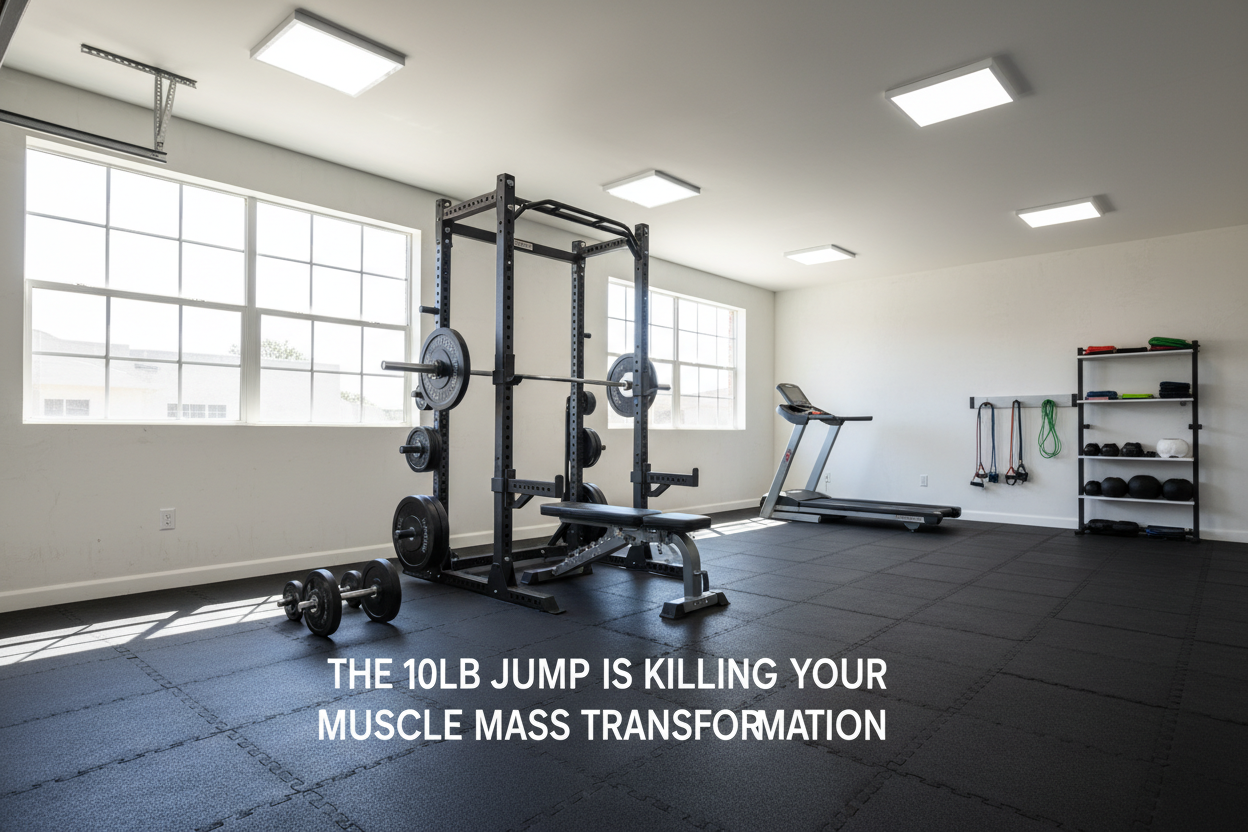
I remember staring at my 300-lb barbell set during a late-night session in my damp garage, wondering why my left pec looked like a deflated balloon compared to my right. It is the classic home gym trap: we think the big iron and the heavy racks are the only way to pack on size. But after a decade of loading and dropping plates, I have realized the best workout for muscle growth usually involves putting down the barbell and picking up one dumbbell at a time.
Quick Takeaways
- Fixes 'bilateral deficit' where your strong side hides your weak links.
- Increases core engagement and stabilizer recruitment without extra equipment.
- Reduces spinal load, making it safer to train to failure alone.
- Requires half the weight, saving you money on plates and floor repairs.
The Hidden Trap of Two-Handed Barbell Lifts
Most of us chase the big numbers on the bench press or the squat rack because that is what the internet tells us to do. But your body is a master at cheating. If your right side is even 5% stronger, it is going to hog the load during a heavy set. This is the 'bilateral deficit' in action. You think you are hitting both sides equally, but you are actually capping your total growth because your weak side never truly has to step up and work.
When you use a barbell, your dominant side compensates for the laggard. Over months of training, this creates a physique that looks lopsided and a nervous system that is fundamentally inefficient. By forcing each limb to move the weight independently, you strip away the help. There is nowhere for the weakness to hide. If your left leg cannot move that 50-lb dumbbell, it is going to stay small until it can. That is how you unlock real, symmetrical size.
Why Single-Limb Training Forces Faster Hypertrophy
Switching to unilateral work changes the physics of the lift. When you perform a single-arm dumbbell press, your entire core has to fire to prevent you from sliding off the bench. It is a chest workout that engages every muscle from your obliques to your serratus. You get a deeper stretch at the bottom of the movement and a harder, more focused contraction at the top because you are not restricted by the rigid path of a barbell.
The mind-muscle connection is not just some bro-science term; it is a measurable increase in motor unit recruitment. When you focus on one limb, your brain can send a clearer signal to those fibers. I have found that my clients get more out of a 60-lb single-arm row than they do a 135-lb barbell row because they can actually feel the lat doing the work instead of just heaving weight with their momentum and lower back.
Structuring the Best Routine for Muscle Growth at Home
To build the best routine for muscle growth, you have to be willing to do the stuff that sucks. Swap your back squats for Bulgarian split squats. I know, they are miserable. But they hit the quads and glutes with surgical precision. For your upper body, pay attention to the muscle groups to pair with shoulders. If you are doing single-arm overhead presses, don't follow them up immediately with heavy triceps work, or your stability will tank before your delts actually fatigue.
A solid framework looks like this: start with your heaviest unilateral movement (like a split squat), move to a single-arm press, and then finish with high-rep isolation. Since you are working one side at a time, your rest periods are built-in. While your right side works, your left side rests. This keeps your heart rate up and the metabolic stress high—two key drivers for hypertrophy that most people ignore in favor of just lifting heavy stuff.
Saving Your Spine (And Your Garage Floor)
Training alone in a garage means you don't have a spotter to bail you out. Dropping a 70-lb dumbbell is a lot less dramatic than getting pinned under a 225-lb barbell. Unilateral training requires exactly half the total weight to achieve the same muscular stimulus. This drastically reduces spinal compression, which is a massive win if you are over 30 and want to keep lifting for the next few decades.
Logistically, it is also easier on your house. Dropping heavy weights can crack concrete even through thin rubber. When you are doing heavy single-arm rows or lunges, having a large exercise mat for home gym use is enough to protect your foundation. You don't need a $2,000 platform to train like an animal if you are smart about your exercise selection.
A 4-Week Unilateral Blueprint to Try This Month
If you want to try this, commit to it for four weeks. The first week will feel awkward. Your balance will be shaky, and you will realize your 'strong' side is actually doing 70% of the work on your old lifts. Stick with it. Aim for 3 sets of 8-12 reps per side. Start with your weaker side first, then match those reps with your stronger side. This ensures you are not widening the gap between them.
My personal mistake when I started this? I tried to rush the sets. You have to be patient. A unilateral workout takes about 30% longer than a standard one. But the soreness I felt in my 'weak' side after that first week told me everything I needed to know. I was finally hitting the fibers that had been hitching a ride for years.
FAQ
Does unilateral training take longer?
Yes. Since you are working each side independently, your total set count doubles. If you are pressed for time, use supersets—work your right arm, then immediately work your left leg.
Can I build as much muscle as I would with a barbell?
Absolutely. Your muscles don't know if you are holding a bar or a dumbbell; they only know tension. Unilateral work provides more focused tension and better range of motion.
Will I lose my 'big' lifts?
Usually, the opposite happens. By fixing the imbalances and strengthening your stabilizers, your barbell squat and bench press often jump up once you return to them after a block of single-limb work.