
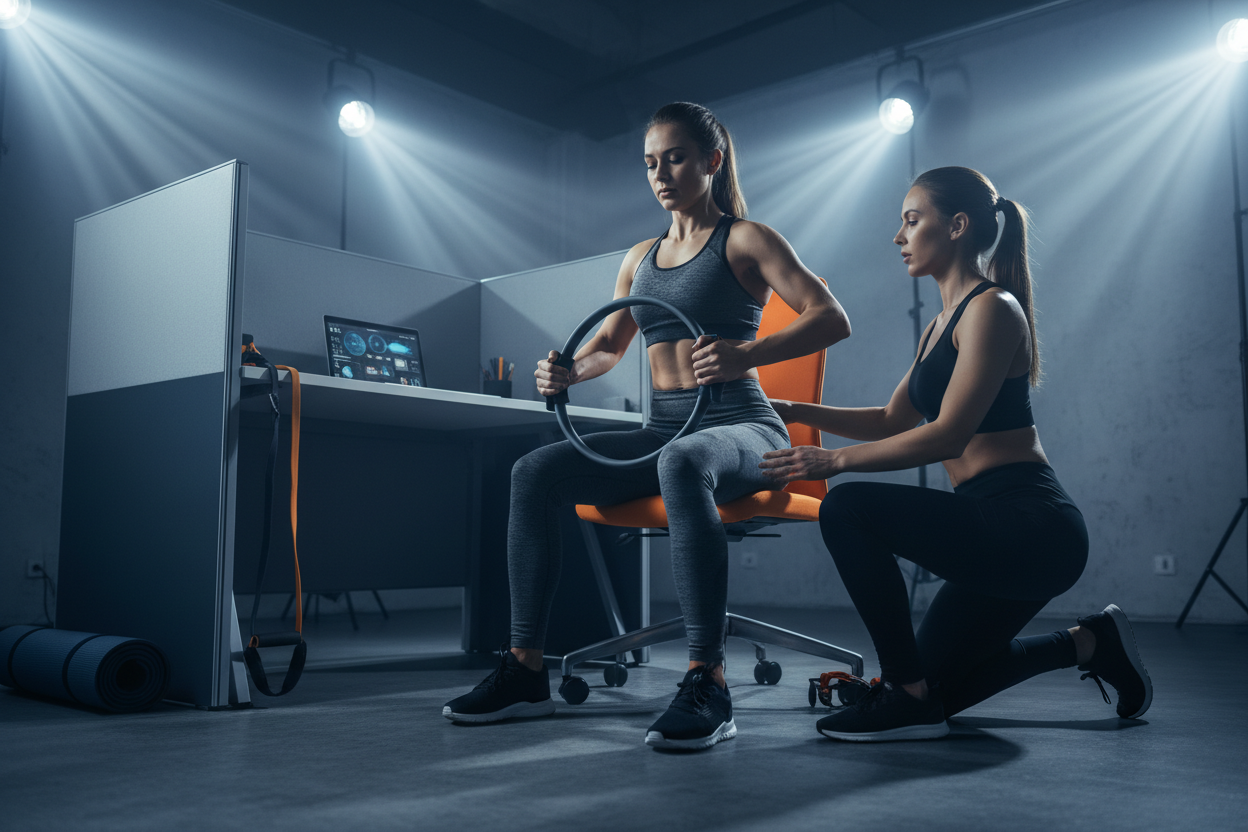
Why Seated Inner Thigh Exercises Are The Secret To Stronger Adductors
You are likely reading this because you are stuck in a chair for the majority of your day, or perhaps mobility issues limit your ability to perform standing lunges. Whatever the reason, your adductors—the muscles running down the inside of your leg—are likely underactive. Most people assume you need a heavy gym machine to target this area, but that is simply not the case. Seated inner thigh exercises provide a surprisingly effective way to wake up these dormant muscles, improve pelvic stability, and reduce knee pain, all without leaving your seat.
Key Takeaways: The Best Seated Adductor Movements
If you are looking for the most effective movements to perform while seated, here is the shortlist of exercises that yield the highest return on investment:
- The Isometric Ball Squeeze: Best for isolation and firing up the adductor magnus.
- Seated Leg Adduction with Sliders: Mimics the gym machine using simple friction.
- Resistance Band Seated Clamshells: Targets the inner thigh and outer glute simultaneously.
- The "Desk Plie" Heel Raise: A subtle move for office environments.
The Anatomy of the "Sit": Why Your Adductors Are Weak
Before we get into the movements, you need to understand the mechanics. When you spend hours performing sitting inner thigh exercises (or rather, just sitting without the exercise part), your hips remain in a flexed position. This tightens the hip flexors but often leaves the adductors—specifically the adductor longus and brevis—in a shortened but inactive state.
Weak adductors don't just mean less muscle definition. They lead to poor knee tracking. If your inner thighs aren't strong enough to pull your leg toward the midline, your quads and IT bands take over, often resulting in that nagging lateral knee pain many office workers experience.
Top 3 Chair Exercises for Inner Thighs
You don't need a gym membership to fix this. You just need a chair and intention. Here is how to execute a proper inner thigh workout sitting down.
1. The Yoga Block Squeeze (The Isometric King)
This is the gold standard for inner thigh exercises sitting down. It uses isometric tension, which is safer for the joints than dynamic movement.
The Setup: Sit on the edge of your chair with your feet flat. Place a yoga block, a small pilates ball, or even a thick book between your knees.
The Execution: Squeeze the object with your knees as hard as you can. Hold this tension for 10 to 15 seconds. Release slowly. Do not hold your breath; exhale as you squeeze.
2. Seated Banded Adduction
If you have a resistance band, you can replicate the cable machine experience. This is a great chair exercise for inner thighs because it adds progressive overload.
The Setup: Anchor a resistance band to a sturdy table leg or heavy desk leg. Loop the other end around your ankle closest to the anchor point.
The Execution: Sit tall. Let the band pull your leg slightly outward (abduction), then use your inner thigh to pull your foot across your body’s midline. Control the tempo. Don't let the band snap your leg back.
3. The Seated "V" Lift
This is deceptively difficult. It targets the hip flexors and the upper adductors.
The Setup: Sit on the edge of the chair, leaning back slightly, holding the armrests for support. Extend your legs straight out in front of you.
The Execution: Open your legs into a "V" shape. Keeping your legs straight, squeeze them together until your feet touch. The leverage of your straight legs makes your inner thighs work much harder than when your knees are bent.
Stealth Mode: Inner Thigh Exercises While Sitting at Desk
Let's be honest: you probably can't strap a resistance band to your desk leg in the middle of a corporate meeting. You need subtlety.
For discrete inner thigh exercises while sitting at desk, use the "Fist Squeeze." It is identical to the yoga block squeeze, but you use your own two fists placed side-by-side between your knees. It requires zero equipment and looks like you are just deep in thought. Perform 5 sets of 20-second holds. The metabolic stress builds up quickly, and no one on the Zoom call will be the wiser.
My Training Log: Real Talk on Seated Adductor Work
I want to be transparent about my experience with these movements. I started incorporating seated adductor work not for aesthetics, but because I developed a "click" in my left hip after driving for 12 hours straight on a road trip.
Here is the unpolished truth: doing the "Book Squeeze" is awkward at first. I tried using a Hydro Flask initially, and I don't recommend it—hard metal against the bony part of the inner knee is painful and causes bruising. I switched to a cheap foam yoga block.
The biggest realization I had was the cramping. The first time I truly committed to a 20-second max-effort squeeze, my adductor magnus cramped so hard I had to stand up and walk it off in the middle of the office. That cramp was a wake-up call showing me how weak that muscle was, despite my ability to squat heavy weight. It’s a humbling isolation movement. If you don't feel a shake in your legs by the 10th second, you aren't squeezing hard enough.
Conclusion
Building stronger legs doesn't always require a barbell. Seated inner thigh exercises are a legitimate tool for rehabilitation, pre-habilitation, and toning. Whether you are doing a full inner thigh workout sitting down at home or sneaking in reps at the office, consistency is the variable that matters most. Start with the isometric squeezes today, and your knees will thank you tomorrow.
Frequently Asked Questions
Can seated exercises actually tone inner thighs?
Yes. While you cannot "spot reduce" fat, you can hypertrophy (build) the muscle. Seated exercises that use high tension, like isometrics or bands, increase muscle density in the adductors, giving the leg a firmer, more toned appearance.
How often should I do these chair exercises?
Because the adductors are postural muscles used to endurance, they recover relatively quickly. You can perform these seated movements 3 to 4 times a week. If you are doing low-impact isometric holds, you can even do them daily.
Will this help with my knee pain?
In many cases, yes. Knee pain is often the result of an imbalance between the outer thigh (vastus lateralis) and the inner thigh (vastus medialis and adductors). Strengthening the inner thigh helps stabilize the kneecap (patella) and ensures it tracks correctly during movement.

