Why Most Elderly Workouts Are Dangerously Easy
I recently watched a 'senior fitness' class at a local community center where a group of capable adults spent forty-five minutes waving colorful foam noodles in the air. It drove me nuts. If you are looking for elderly workouts that actually move the needle on your health, you have to stop treating your body like it is ready to shatter at the slightest breeze.
We have been told for decades that aging means slowing down and avoiding anything heavy. That advice is killing our independence. Real fitness for seniors exercises should not feel like a leisure activity; they should feel like training. Because if you are not challenging your muscles, you are not maintaining them.
Quick Takeaways
- Under-dosing resistance is the biggest mistake in senior exercise workouts.
- Quality flooring is a safety requirement, not an aesthetic choice.
- Four compound movements are all you need for a functional exercise routine for the elderly.
- Intensity should be measured by effort, not just the number on the dumbbell.
The 'Do No Harm' Trap in Senior Fitness
The fitness industry is terrified of a lawsuit. That is why most fitness seniors exercises look like gentle stretching. While 'do no harm' is a great medical philosophy, it is a terrible way to build bone density. Your bones and muscles require stress to stay strong. Without adequate loading, you are just going through the motions while your sarcopenia—age-related muscle loss—continues unchecked.
I have worked with seventy-year-olds who can deadlift more than most college kids. They did not get there by doing arm circles. They got there by understanding that geriatric exercise needs to be progressive. If you do the same ten repetitions with the same two-pound weight for three years, your body has no reason to adapt. You are essentially just practicing being tired.
We need to shift the focus from 'staying active' to 'building capacity.' A proper exercise program for elderly people should focus on the things that keep you out of a nursing home: leg strength, grip strength, and core stability. If your workout senior routine does not make you huff and puff at least a little, it is probably not doing much for your longevity.
Stop Wasting Time on Endless Light Reps
You do not need to spend two hours in the gym to see results. In fact, most people over sixty do better with shorter, higher-intensity sessions. When you focus on high-rep, low-weight movements, you are mostly training endurance. But seniors do not usually lack endurance; they lack power. Power is what helps you catch yourself if you trip on a curb.
By increasing the resistance, you can cut your gym time in half. A good exercise routine workout focuses on quality over quantity. If you can do twenty reps of an exercise without breaking a sweat, the weight is too light. You are better off doing eight reps that actually feel difficult. This triggers the hormonal response needed to maintain muscle mass without the systemic fatigue of a marathon session.
I tell my clients that fitness for senior health is about efficiency. We want the maximum physiological bang for our buck. This means moving away from the 'pink dumbbell' mentality and toward weights that actually require focus and effort. It is more effective, and frankly, it is a lot less boring than counting to fifty while waving your arms around.
Setting Up a Slip-Free Landing Pad
Before you even think about buying a set of dumbbells, look at your floor. Most home injuries during seniors exercising happen because of poor footing. A plush carpet is great for a living room, but it is a nightmare for balance. You need a dedicated space where your feet feel glued to the ground.
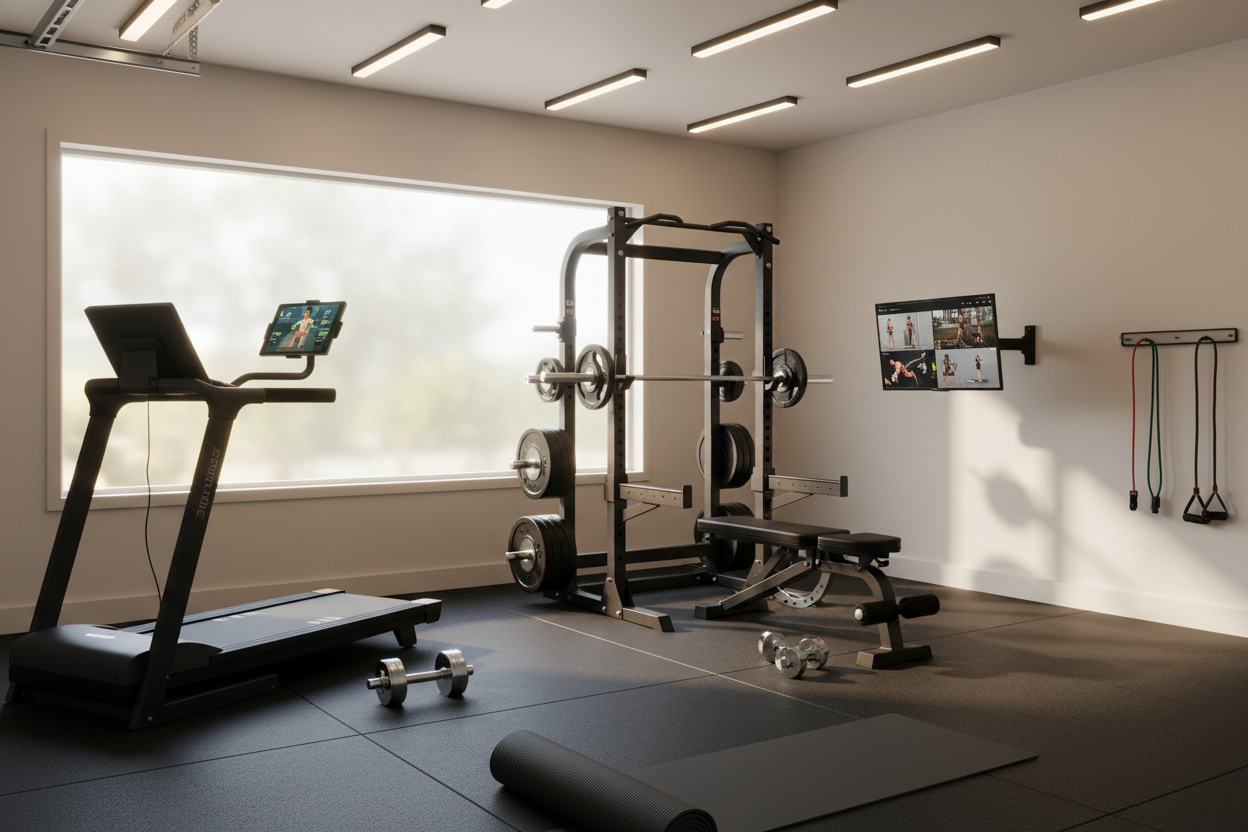
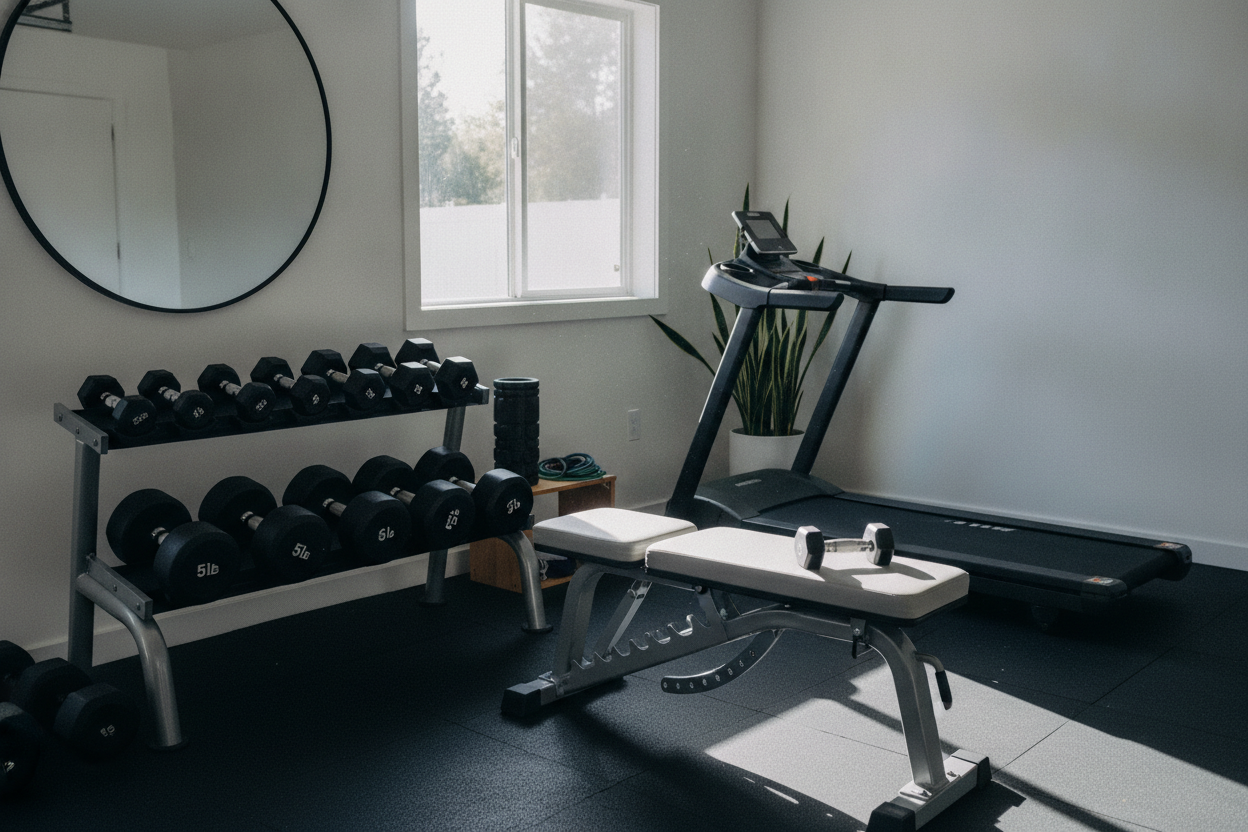
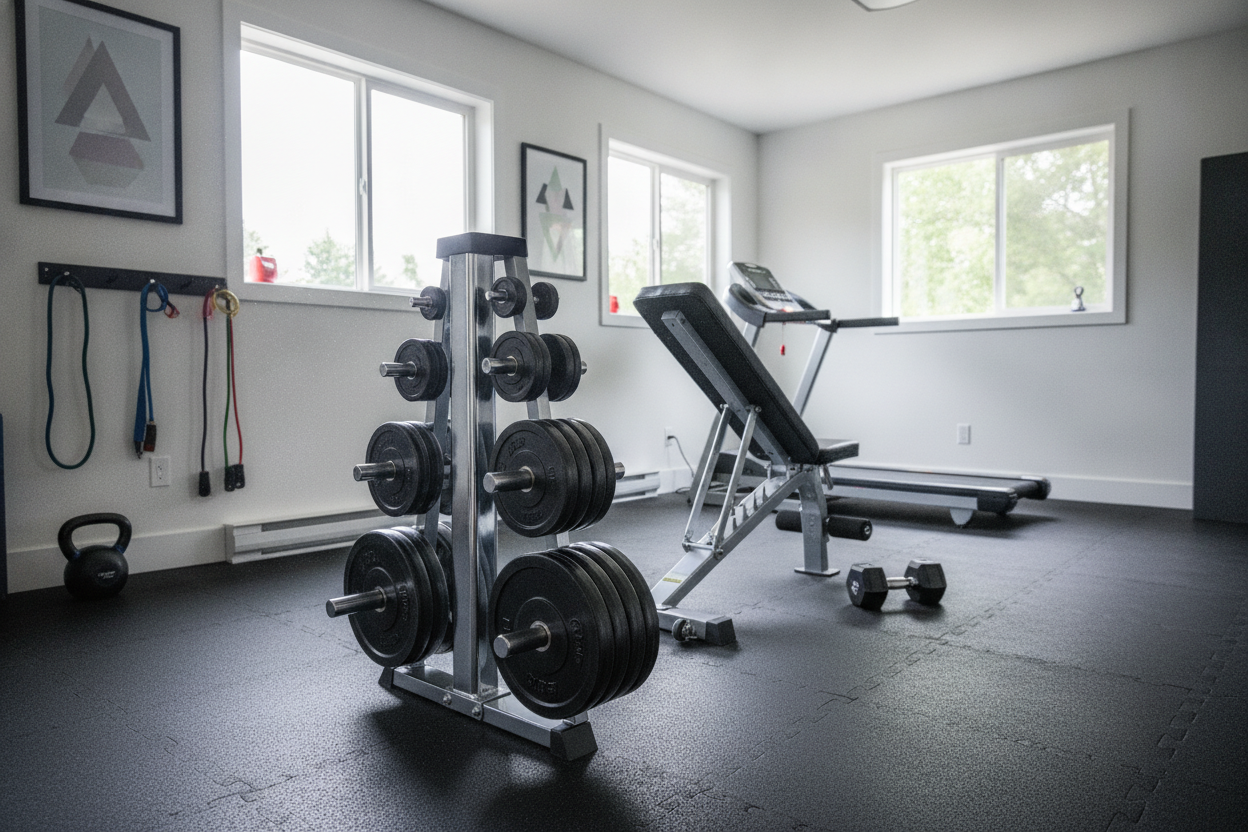
Setting up a large exercise mat for home gym use is the foundational first step for creating a safe training area. You want something that provides enough cushion to protect your joints if you are doing floor work, but enough density that it does not feel 'squishy' when you are standing. A squishy surface is a recipe for a rolled ankle.
Avoid those cheap, thin yoga mats that bunch up or slide across the hardwood. I always recommend a heavy-duty gym flooring for home workout setup. A 6x8ft mat with a non-slip bottom gives you plenty of room to move without worrying about the edges curling up. When you feel stable, you train harder. It is that simple. Confidence in your footing is the difference between a tentative workout and a productive one.
The 4 Non-Negotiable Movements for Aging Bodies
You do not need a room full of gadgets. A solid senior workout program should revolve around four basic human patterns: the Squat, the Hinge, the Push, and the Pull. These are the movements that translate directly to real life, like getting out of a chair or carrying groceries.
For the squat, start with a chair behind you for safety. For the hinge, think about pushing your hips back to close a car door with your butt. For pushing and pulling, you can use resistance bands or dumbbells. If you find free weights intimidating or have joint issues that make them feel unstable, looking into at home exercise machines can be a smart move. Machines provide a fixed path of motion, which can be helpful for those starting an exercise program at 65 who want to build a baseline of strength without worrying about balance.
The goal is to hit these four patterns twice a week. You do not need fancy senior gym exercises; you just need consistency. Whether you are doing a senior citizen workout program at a local YMCA or an elderly workout routine in your garage, the mechanics remain the same. Master the form, then slowly add weight. That is how you stay independent into your eighties and nineties.
How to Know if You're Actually Pushing Hard Enough
This is where most senior fitness routine advice fails. They tell you to 'listen to your body,' but if your body is used to being sedentary, it is going to tell you to stop the moment things get uncomfortable. We use a scale called RPE, or Rate of Perceived Exertion. On a scale of 1 to 10, your senior fitness workout should land somewhere around a 7 or 8.
A '7' means you are working hard, your breathing is heavy, but you could still squeeze out two or three more reps if you absolutely had to. If you are finishing your sets feeling like you could do another thirty reps, you are 'under-dosing.' This is the hidden danger of many elderly physical activity programs—they are so easy they provide no benefit, yet they give a false sense of security.
Training the elderly fitness doesn't mean being reckless. It means being intentional. If you have a history of heart issues or joint replacements, obviously consult your doc. But for the average older adult, the risk of being weak is far greater than the risk of lifting a challenging weight. Don't be afraid to break a sweat. That sweat is a sign that your body is actually getting the message to stay strong.
Personal Experience: The Day I Stopped Babying My Uncle
A few years ago, I started helping my Uncle Jim with a workout for seniors over 70. At first, I was terrified he would break. I had him doing seated leg extensions and light band work. After three weeks, he looked at me and said, 'This is boring, and I still can't get the mulch bags out of my truck.'
I realized I was the problem. I was treating him like a patient, not an athlete. We ditched the bands and started doing goblet squats with a 20-pound kettlebell. We did standing rows. His posture improved in a month. His balance stabilized. The mistake I made was assuming age equals fragility. Jim didn't need a 'senior' version of exercise; he just needed a scaled version of real strength training. Now, he's the one telling his friends that 'movement is medicine' is only true if the dose is high enough.
FAQ
Is it safe for a senior citizen to lift weights?
Yes, and it is arguably the safest thing you can do for long-term health. The key is starting with proper form and a weight that is challenging but manageable. Strength is the best defense against falls and fractures.
What if I have arthritis or joint pain?
Motion is lotion. While you should avoid movements that cause sharp, stabbing pain, 'good' soreness and the dull ache of arthritis often improve with strength training. Building muscle around a joint takes the pressure off the joint itself.
How many days a week should I do a senior workout routine?
Two to three full-body sessions per week is the sweet spot. This allows for plenty of recovery time, which becomes more important as we age, while still providing enough stimulus to build muscle and bone density.