Why Just One Metal Bar Is the Only Gym Equipment You Actually Need
Walk into any modern health club and you are immediately assaulted by a visual cacophony of flashing screens, hydraulic pistons, and complex cable systems. It is easy to get paralyzed by the sheer volume of options. You might wonder if you need to isolate your rear delts on machine number four or if the elliptical is better for fat loss than the recumbent bike. But if you cut through the noise and look at what the strongest, most capable athletes are doing, you will usually find them in the simplest corner of the room. They are lifting a weights bar.
The answer to building a resilient, powerful physique isn't found in the newest fitness tech. It lies in gravity and iron. Training with free weights remains the most effective method for stimulating muscle growth and increasing bone density because it forces your body to function as a complete unit rather than a collection of disjointed parts. When you strip away the cables and the seatbelts, you are left with the raw mechanics of human movement.
My Transition from Machines to Iron
I spent my first two years in the gym terrified of the free weight section. It felt like a club I wasn't invited to, populated by people who already knew exactly what they were doing. I stuck to the leg press and the chest press machine because they felt safe. The movement path was fixed; I just had to push. The problem was that after two years, I looked exactly the same as when I started.
My progress stalled because I wasn't challenging my body's stability or coordination. The day I finally decided to pick up a standard weight bar was humbling. I tried to bench press what I usually did on the machine, and the bar wavered uncontrollably. I nearly dropped it. That shake was my central nervous system realizing it had no idea how to stabilize a load. That moment changed my entire philosophy. I realized that moving weights along a fixed track had given me a false sense of strength. Real strength requires controlling the object in three-dimensional space.
Understanding Your Tools
Before you start loading up plates, you need to understand the focal point of your training. The barbell, or weights bar, is a deceptive piece of engineering. While it looks like a simple rod of steel, the quality and type matter significantly. In most commercial gyms, you will encounter the Olympic barbell. These are seven feet long and weigh 45 pounds (or 20 kilograms). The defining feature is the rotating sleeves on the ends. This rotation is crucial because it allows the plates to spin independently of the bar, reducing the torque on your wrists during movements like the clean or the curl.
Home gym enthusiasts often start with a "standard" weight bar, which is usually one inch in diameter and lighter than its Olympic counterpart. While these are fine for beginners, they lack the rotating sleeves and tensile strength required for heavy lifting. If you are serious about long-term fitness, getting familiar with the feel of an Olympic bar is a necessary step. The knurling—that rough, cross-hatched pattern on the metal—is there to help your grip. Learning where to place your hands on these markings ensures your form remains consistent from session to session.
The Philosophy of Progressive Overload
The magic of this equipment lies in the math. It is infinitely scalable. You can add weights in increments as small as a fraction of a pound. This facilitates progressive overload, the fundamental principle of physiology that dictates muscle growth. You stress the body, it recovers, and it adapts to handle that stress better next time. With machines, the jump between weight stacks is often too large, leading to plateaus. With a bar and plates, you can micro-load your progress.
This linear progression is incredibly motivating. Seeing the numbers go up in your logbook provides tangible proof that your effort is yielding results. You aren't just sweating; you are building a measurable capacity to do work. There is a primal satisfaction in loading a heavy weights bar and moving it against gravity that a digital display on a treadmill simply cannot replicate.
Compound Movements: The Big Four
You don't need a thousand different exercises. You need a handful of movements that deliver the highest return on investment. These are known as compound lifts because they utilize multiple joints and muscle groups simultaneously.
The Squat
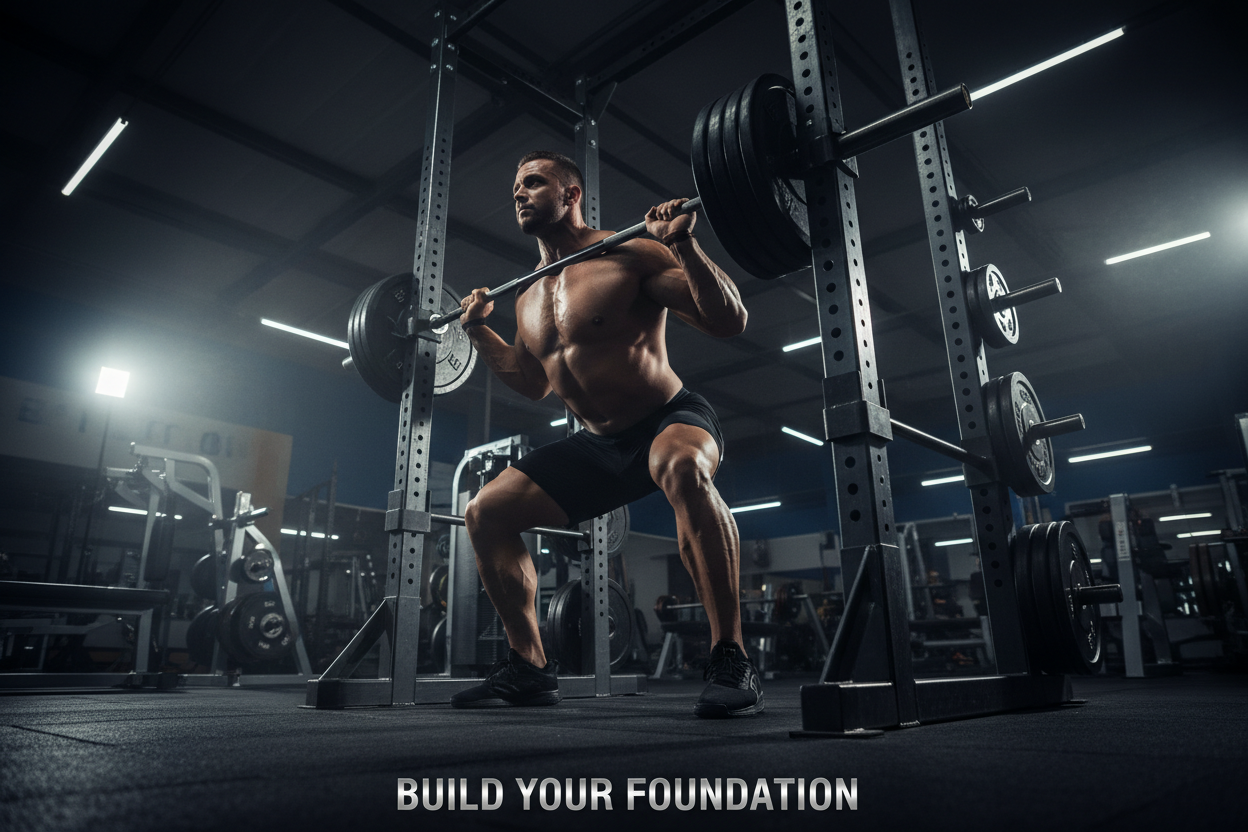
Often called the king of exercises, placing the bar on your back and squatting down recruits almost every muscle in your lower body and core. It teaches you to carry a load structurally. It is demanding, uncomfortable, and incredibly effective.
The Deadlift
There is nothing more functional than picking a heavy object up off the floor. The deadlift strengthens the posterior chain—the hamstrings, glutes, and back. It is the ultimate test of raw strength. You simply grab the weight bar and stand up.
The Bench Press
This is the standard for upper body pushing strength. It develops the chest, shoulders, and triceps. Unlike a chest press machine, the bench press forces you to balance the load laterally, engaging the stabilizer muscles in your shoulders.
The Overhead Press
Lifting a weight over your head requires tremendous core stability. If your midsection is weak, you will crumble under the bar. This movement builds broad shoulders and a robust core without a single sit-up.
Safety and Respecting the Iron
Free weights demand respect. The freedom of movement that makes them effective is also what introduces risk if you are careless. Ego is the most dangerous thing you can bring into the weight room. Technique must always supersede the amount of weights on the bar. If your back rounds during a deadlift or your knees cave in during a squat, the weight is too heavy.
Using safety equipment is part of being a smart lifter. Always use collars to secure the plates so they don't slide off mid-set. If you are lifting alone at home or in a quiet gym, learn how to fail safely. For a squat, this means using safety pins in the rack that will catch the weights bar if you can't stand back up. For bench pressing, it means not collaring the weights so you can dump them if necessary, or better yet, never benching to absolute failure without a spotter.
Fitness doesn't have to be complicated. The industry thrives on selling you shortcuts and secrets, but the reality is mundane. Consistency, good food, and a heavy bar are the only ingredients required. Once you master the basics of the weight bar, you unlock a level of physical capability that serves you for the rest of your life.
Frequently Asked Questions
How much does a standard gym bar weigh?
An Olympic barbell, which is the standard in most commercial gyms and CrossFit boxes, weighs 45 pounds (approx. 20.4 kg). Smaller "standard" bars often found in beginner home sets usually weigh between 15 and 25 pounds, depending on the length and material.
Do I need to wear gloves when lifting weights?
While gloves can prevent calluses, most experienced lifters prefer lifting with bare hands or using chalk. Direct contact with the knurling on the bar provides a more secure grip and better feedback, which is essential for safety during heavy lifts.
Can I get a full-body workout with just a bar and plates?
Absolutely. By utilizing compound movements like squats, deadlifts, overhead presses, and rows, you can hit every major muscle group in the body. This approach is often more efficient and effective than using a room full of isolation machines.