Why 'Grinding It Out' Ruins Exercise for Middle-Aged Man
I remember the exact Tuesday my 'young man' ego died. I was standing in my garage, staring at a 315-lb barbell, feeling a familiar, dull throb in my lower back and a sharp pinch in my left shoulder. I had been following the same high-volume powerlifting program for a decade, convinced that if I just 'pushed through,' the gains would return. Instead, I was just getting slower, stiffer, and more irritable. Finding the right exercise for middle-aged man longevity isn't about matching your 25-year-old self; it's about training smarter so you don't end up on a physical therapist's table twice a week.
- Stop the two-hour sessions; 45 to 60 minutes is the sweet spot for recovery.
- Stability is your best friend—swap some barbell work for machines or cables.
- High-density flooring is a non-negotiable for joint health.
- Mobility work is no longer a 'warm-up'—it is the foundation of the workout.
The Myth of the Two-Hour Garage Gym Grind
We grew up on a diet of 'no pain, no gain' and 'sleep when you're dead.' That mentality is a fast track to systemic fatigue when you're pushing forty or fifty. Your Central Nervous System (CNS) simply doesn't bounce back like it used to. When you're designing a middle aged man workout, you have to prioritize the minimum effective dose. This means doing just enough work to trigger muscle growth and bone density improvements without digging a recovery hole you can't climb out of by your next session.
I used to think a workout didn't count unless I was crawling out of the gym. Now, I look at my HRV (Heart Rate Variability) and realized that those 'grind' sessions were actually tanking my testosterone and making me weaker. Shorter, high-intensity sessions with fewer sets but better form will beat a two-hour slog every single time. It's about quality over quantity, especially when your joints are starting to show their age.
Swapping Free Weight Dogma for Efficiency
There is a weird stigma in the home gym community that if you aren't back-squatting or deadlifting from the floor, you aren't 'really' training. That is total nonsense for the aging lifter. A workout for middle aged man goals should focus on muscle tension, not just moving a heavy object from point A to point B. I swapped my heavy back squats for Bulgarian split squats and belt squats, and my knees have never felt better.
If you're training alone in a garage, the risk-to-reward ratio of a maximal effort bench press or squat changes as you age. Using the top home exercise machines—like a high-quality functional trainer or a dedicated leg press—allows you to take a muscle to failure without the fear of a barbell crushing your chest. It’s about isolating the muscle and sparing the spine.
Protecting Your Joints Starts From the Ground Up
I spent years lifting on bare concrete or those cheap, 1/2-inch puzzle mats you find at big-box retailers. It was a massive mistake. Concrete has zero give, and every time you land a jump or even just stand for an hour of overhead presses, that force travels straight into your ankles, knees, and hips. You wouldn't run a marathon in dress shoes, so why lift on a surface that offers no shock absorption?
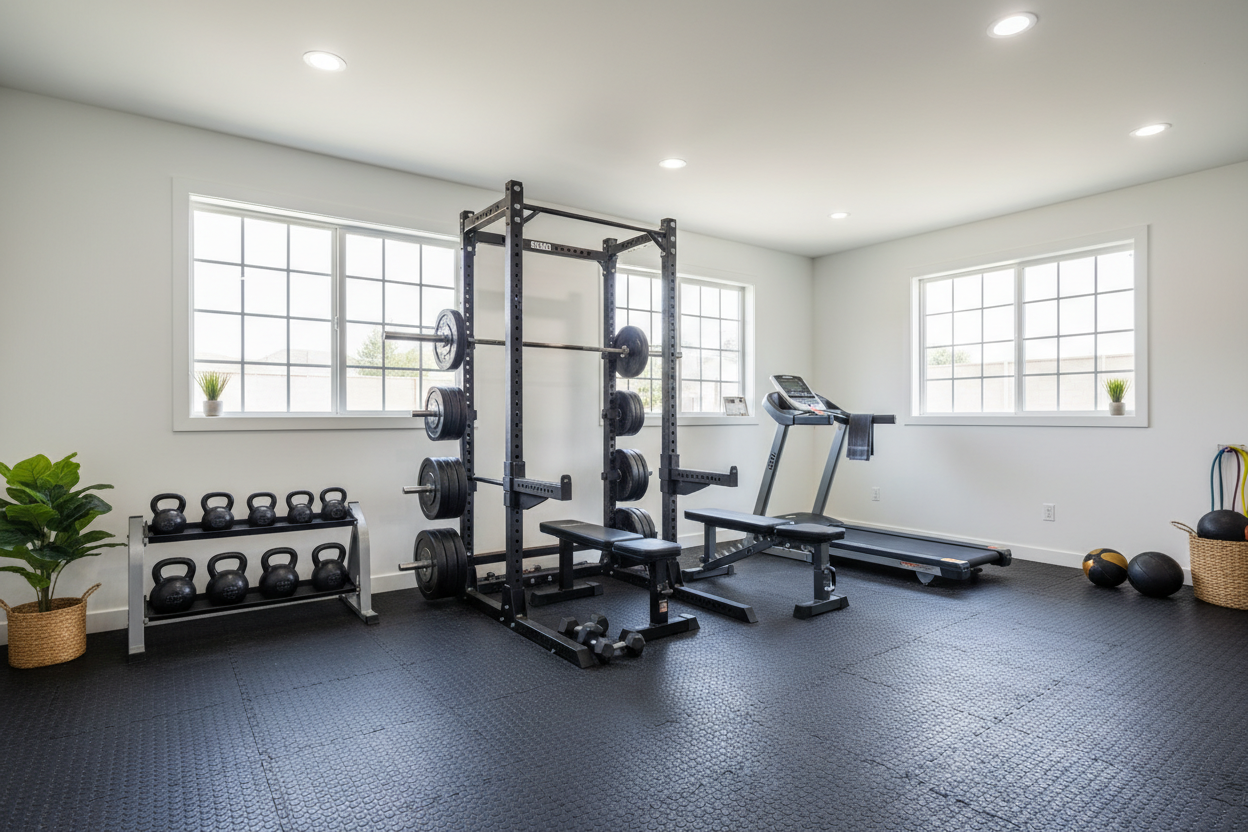
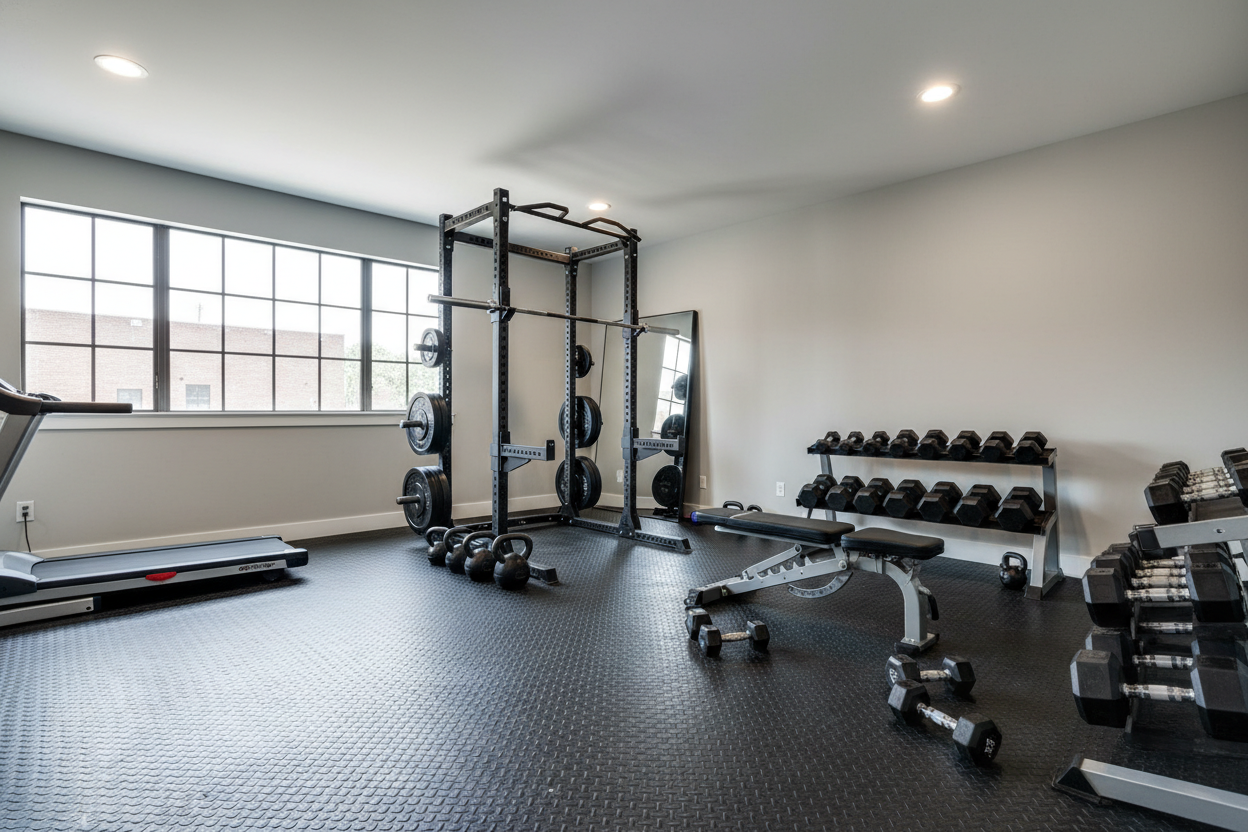
Upgrading to a large protective exercise mat is probably the single best 'equipment' upgrade I've made for my longevity. A dense, 7mm or 8mm rubber surface provides enough stability for heavy lifts while offering just enough cushion to save your joints during high-impact movements. If you're over 40 and your feet hurt after a workout, your floor is likely the culprit.
Structuring the Minimum Effective Middle Aged Man Workout
The best workout for middle aged men is the one you can actually finish without needing a nap afterward. I recommend a 3-day-a-week full-body split. This allows for 48 hours of recovery between sessions, which is where the actual muscle building happens. Focus on one 'big' compound movement per day—like a trap bar deadlift or an overhead press—followed by three or four accessory movements that focus on stability and unilateral strength.
You don't need a complex 6-day PPL (Push/Pull/Legs) routine that requires you to live in your gym. You can browse our workout hub to find templates that fit into a busy schedule, but the key is consistency over intensity. If you hit your targets 90% of the time without getting injured, you're going to look better at 50 than most guys did at 30.
The 10-Minute Mobility Tax You Now Have to Pay
In my 20s, my warm-up was two arm circles and a set with the empty bar. If I tried that now, I’d probably tear a pec just reaching for the rack. Mobility is the 'tax' we have to pay to keep lifting. You need a dedicated space for dynamic stretching and floor-based movements like 90/90 hip switches and thoracic rotations.
I keep a standard 6x4ft yoga mat unrolled in the corner of my gym specifically for this. If the mat is there, I'll use it. If I have to go find it, I'll skip the warm-up. Making mobility convenient is the only way to ensure it actually happens. Your shoulders and hips will thank you for those ten minutes of 'boring' work before you touch the weights.
My Personal Experience: The Ego Check
Two years ago, I tried to 'prove' I still had it by jumping into a heavy squat session without a proper warm-up. I felt a 'zip' in my lower back that kept me from tying my own shoes for a week. It was embarrassing and unnecessary. That injury forced me to rethink everything. Now, I prioritize tempo, control, and how I feel on a scale of 1-10. If I'm a 4, I don't try to train like a 10. That shift in mindset has kept me injury-free for 24 months and counting.
Frequently Asked Questions
How many days a week should a middle-aged man work out?
Three to four days of resistance training is usually the sweet spot. This allows for enough stimulus to maintain and build muscle while giving your joints and nervous system plenty of time to recover.
Is cardio more important than weights after 40?
It's not an either/or situation. You need resistance training to prevent sarcopenia (muscle loss) and cardio for heart health. A mix of 70% strength and 30% steady-state cardio is a solid target.
Can I still do heavy deadlifts?
Yes, but consider the tool. A trap bar (hex bar) is generally much safer for the middle-aged lower back than a traditional straight barbell because it keeps the center of gravity inside your frame.