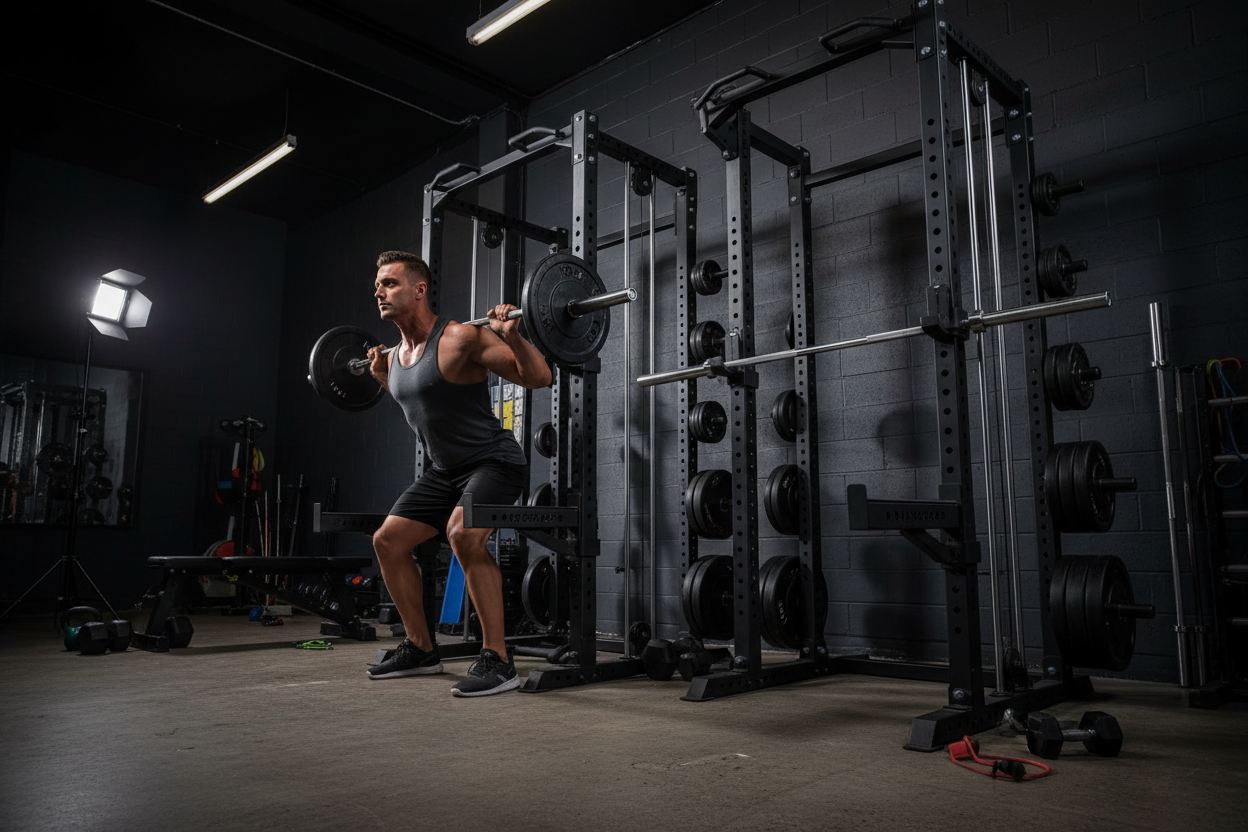
Why a Power Cage With Smith Machine Is the Only Gym You Need
Building a home gym is essentially a game of spatial Tetris. You want the raw strength potential of a squat rack, but you also miss the safety and hypertrophy benefits of commercial gym machines. If you have limited square footage, choosing between the two feels like a losing battle. This is exactly why the power cage with smith machine has become the gold standard for garage gym owners.
It is not just about saving space; it is about training longevity. By combining the stabilization demands of free weights with the fixed path of a machine, you unlock a style of training that maximizes muscle growth while minimizing injury risk. Let’s break down why this hybrid unit is the smartest investment for your training environment.
Key Takeaways
- Hybrid Functionality: Combines a traditional power rack for compound movements with a Smith machine for isolation and safety.
- Solo Training Safety: The Smith component allows for self-spotting on heavy lifts without needing a training partner.
- Space Efficiency: A smith machine power cage consolidates two massive footprints into a single unit, usually taking up less than 20 square feet.
- Versatility: Allows for seamless transitions between heavy squats (rack) and high-volume hypertrophy work (Smith) in the same session.
The Science of the Hybrid: Why You Need Both
There is a longstanding debate in the fitness community: free weights versus machines. The truth is, optimal programming requires both. A standard smith machine power rack solves this by giving you access to two distinct training stimuli.
The Power Rack Component
The cage section is for your primary movers. When you squat or bench press with a free barbell inside the cage, you are engaging stabilizer muscles. Your nervous system works overtime to balance the load.
This is non-negotiable for building functional strength and athletic power. If you ignore this and only use machines, you risk developing "show muscle" without the structural integrity to support it.
The Smith Machine Advantage
Conversely, the power rack with smith machine allows you to remove stabilization from the equation. Why would you want to do that? Hypertrophy.
When you don't have to balance the bar, you can drive closer to mechanical failure safely. It is excellent for movements like split squats, calf raises, or seated overhead presses where stability often fails before the target muscle does. Having a cage smith setup means you can destroy your quads on the Smith machine immediately after heavy barbell squats.
Analyzing the Mechanics: What Matters?
Not all equipment is created equal. When shopping for a smith cage machine, the difference between a frustrating workout and a great one usually comes down to one component: Linear Bearings.
Cheaper units use nylon bushings that slide over metal rods. Over time, these create friction/drag. You want a unit that utilizes linear ball bearings. This ensures the bar glides vertically without resistance, mimicking the feel of a commercial gym.
Furthermore, look at the gauge of the steel. A robust smith power rack should be constructed from at least 12-gauge steel (lower numbers are thicker). If the cage wobbles when you re-rack 315 lbs, it’s not safe.
Common Mistakes When Buying
The biggest error I see lifters make is ignoring the internal depth of the cage. Some hybrid units are very shallow to save space.
If the cage is too shallow, you will feel claustrophobic while squatting. You might even hit the uprights or the Smith bar (when it's docked) during your barbell movements. Ensure the rack depth allows you enough room to walk the weight out comfortably.
My Personal Experience with power cage with smith machine
I want to be real about the transition to these units because specs don't tell the whole story. The first time I used a budget combo rack, the thing that drove me crazy wasn't the weight capacity—it was the knurling and the "stick."
I remember loading up for a heavy shrug set on the Smith component. As I dragged the bar up, I could feel a distinct, gritty friction on the guide rods because I hadn't lubricated them in a month. It completely threw off my mind-muscle connection. Unlike a free barbell which just requires chalk, these machines need silicone spray maintenance or they get jerky.
Another detail people forget is the "clank." When I am training at 5:00 AM and I fail a rep on the Smith machine, hooking that bar back into the safety slots creates a sharp, metal-on-metal clack that echoes through the whole house. It’s distinctively louder than dropping a barbell on rubber bumper plates. If you have sleeping kids upstairs, you learn to control your eccentric phase very quickly, which, ironically, led to better gains for me.
Conclusion
Investing in a high-quality unit is about future-proofing your fitness journey. It eliminates the excuse of "I don't have a spotter" and allows for high-intensity training in a safe environment. Whether you call it a smith cage machine or a hybrid rack, the utility it provides per square foot is unmatched.
Frequently Asked Questions
Can you squat normally in a power cage with smith machine?
Yes. The primary function of the power cage aspect is to allow for free-weight barbell squats. You simply move the Smith bar to its highest storage position (or out of the way), place your J-hooks on the uprights, and squat with a standard Olympic barbell just as you would in a commercial gym rack.
Is a Smith machine safer than a power rack?
It depends on the context. The Smith machine is safer for solo training to failure because you can lock the bar with a simple wrist turn. However, a power rack with properly set safety spotter arms is equally safe for catching a failed rep. The best setup utilizes both safety mechanisms depending on the lift.
Does the Smith machine bar count as weight?
Yes, but it is lighter than a standard barbell. While a standard Olympic bar weighs 45 lbs (20kg), a Smith machine bar usually has a starting resistance of 15 to 25 lbs due to the counter-balance system. You should always check the manufacturer's manual to know the exact starting weight for progressive overload tracking.