What Easy Exercise Equipment Actually Looks Like (No Gimmicks)
I have spent the last decade scouring Craigslist, testing prototypes, and turning my garage into a temple of iron. I have also wasted thousands of dollars on gear that promised to make fitness 'effortless.' We have all seen the 2 AM commercials for vibrating plates or folding ab-crunchers that look more like torture devices than tools. Most people searching for easy exercise equipment are not looking to avoid hard work; they are looking to avoid the massive headache of complex setups and fragile parts.
Quick Takeaways
- Friction is the enemy of consistency. If it takes ten minutes to set up, you will not do it.
- Simple gear is harder to break. Fewer moving parts mean a longer lifespan.
- Real 'easy' gear is accessible gear—tools you can use the moment you walk into the room.
- Avoid anything that requires a Wi-Fi connection or a monthly subscription to function.
The Infomercial Trap: Why Most Low-Effort Gear is Junk
The fitness industry loves to sell the dream of the 'quick fix.' They market simple exercise equipment that supposedly does the work for you. You have seen the belts that shock your abs while you eat pizza or the chairs that promise a core workout while you watch TV. It is all garbage. These products play on a psychological vulnerability: the desire to achieve a result without the associated struggle. When you buy a gimmick, you are buying a temporary hit of dopamine, not a path to health.
I have owned those $40 'as-seen-on-TV' gadgets. They usually share three traits: they are made of cheap plastic, they have a weight capacity that would make a toddler nervous, and they end up as clothes hangers within three weeks. The irony is that these 'low-effort' machines are actually high-effort in the worst way. They are clunky, they squeak, and they feel so precarious that you never actually push yourself. You want gear that stays out of your way, not gear that makes you wonder if a bolt is about to shear off and send you to the ER.
The real trap is thinking that 'easy' means 'effortless.' True simple gym equipment should make the transition from sitting on your couch to moving your body as seamless as possible. It should not promise to melt fat while you sleep. It should promise to be ready the second you are.
Frictionless Fitness: Redefining What Makes Gear Actually Easy
In my experience, the best workout is the one you actually finish. Friction is anything that stands between you and your first rep. This includes clearing a space on the floor, untangling cables, or waiting for a tablet to update its firmware. If you want a simple workout equipment for home setup, you need to prioritize 'readiness.' This is why I always tell people to start with their flooring. If you have to roll out a thin, curling yoga mat every time you want to move, you have already added a barrier.
Instead, I recommend dedicated space. Laying down a heavy-duty 6x8ft exercise mat in a corner of your room changes the psychology of the space. It is no longer just a corner; it is a gym. That mat is always there, flat, grippy, and ready. You do not have to 'set up' for a workout; you just step onto the mat. That is what real easy equipment looks like. It is about reducing the number of decisions you have to make before you start sweating.
Think about your gear like a kitchen appliance. If the blender is buried in the back of a high cabinet, you will never make a smoothie. If it is on the counter, you will use it every day. Your simple workout equipment should be the 'countertop' version of fitness gear. It should be durable enough to live out in the open and simple enough that a five-year-old could figure out how to use it.
3 Pieces of Simple Workout Equipment for Home That Never Fail
If I had to strip my gym down to three items that provide the highest return on investment with the lowest barrier to entry, here is what I would keep. First, a single, heavy kettlebell. A 16kg or 24kg bell is a complete gym in one hunk of iron. You can swing it, press it, or squat it. There are no pins to adjust and no cables to grease. It just sits there, judging you, until you pick it up.
Second, a suspension trainer. These are essentially two high-strength nylon straps with handles. You can anchor them to a door or a ceiling beam. They weigh about two pounds and can handle a 350-lb lifter with ease. You use your own body weight for resistance, meaning you can change the difficulty just by moving your feet. It is the definition of simple workout equipment for home because it adapts to you instantly.
Third, a doorway pull-up bar. Not the cheap ones that ruin your molding, but a solid, bolt-in version if your home allows it. Having a bar you can hang from every time you walk through a door is the ultimate 'easy' habit. Pair these tools with a simple exercise routine for home gym and you will see more progress than the guy with the $5,000 vibrating treadmill. These tools are effective because they are honest. They do not hide behind fancy displays; they just provide a way to move against resistance.
Stop Overcomplicating Your Simple Gym Equipment Setup
We are currently living through a 'smart' fitness bubble. Everything has a screen, a heartbeat sensor, and a mandatory $39/month subscription. I have tested these machines, and while the tech is cool, it is the opposite of 'easy.' I once spent twenty minutes trying to troubleshoot a Bluetooth connection on a pair of 'smart' dumbbells. By the time I got them synced, my motivation was dead. I could have finished an entire workout with a pair of rusty iron plates in that time.
When you are looking for home gym equipment deals, ignore the flashy tech. Look for high-quality basics: solid steel, dense rubber, and thick nylon. You want gear that will be just as functional in twenty years as it is today. A cast-iron plate does not need a software update. A steel rack does not care if your Wi-Fi is down. Avoid anything with more than two moving parts if you want to keep your stress levels low.
The more complex the machine, the more points of failure it has. If the proprietary cable on your high-tech rower snaps, you are stuck waiting three weeks for a replacement part from a company that might not exist in two years. If you buy a simple rower with a chain drive, you can fix it with a trip to the hardware store. Buy for durability, not for novelty.
The Five-Minute Rule for Buying New Gear
Before you pull the trigger on any new piece of equipment, apply the five-minute rule. If it takes more than five minutes to get from 'thinking about working out' to 'actually working out,' the equipment is a failure. This includes assembly time, adjustment time between sets, and the time it takes to clear a space to use it. This is why simple exercise equipment wins every time. It respects your time.
If you find that your budget or space is too tight for even the basics, remember that home workout routines no equipment are a perfectly valid starting point. Your body is the simplest piece of gear you own. Push-ups, lunges, and planks require zero setup and zero storage space. Once you have mastered moving your own mass, then you can look into adding external resistance.
The goal is to build a lifestyle, not a museum of unused gear. If a piece of equipment makes you feel intimidated or frustrated before you even touch it, it does not belong in your home. Stick to the basics, keep your space clear, and focus on the work. That is the only real 'shortcut' there is.
Personal Experience: The 'All-in-One' Disaster
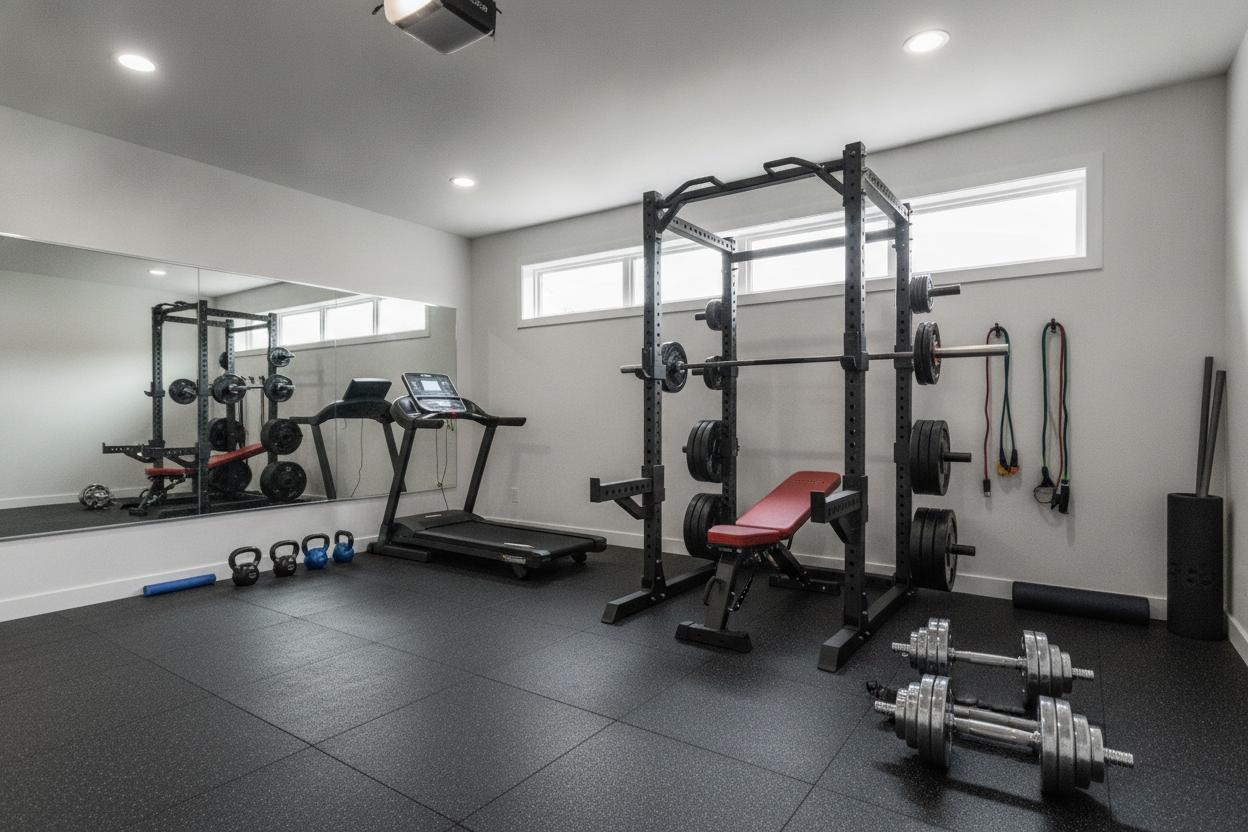
A few years ago, I fell for a 'compact' home gym system that used power rods for resistance. It promised 50 exercises in one tiny footprint. It took me six hours to assemble. The 'rods' felt like pulling on giant rubber bands, and the resistance was never consistent. Changing from a chest press to a leg extension required moving four different cables and three pins. I used it for a week, realized I hated the 'friction' of changing exercises, and sold it for a $300 loss. Now, I use a rack, a bar, and plates. It takes up more space, but I actually use it every single day because I don't have to solve a puzzle to do a set of squats.
FAQ
Is simple exercise equipment enough to build muscle?
Absolutely. Your muscles do not know if you are lifting a $3,000 computerized cable machine or a heavy sandbag. They only react to tension. If you provide enough resistance and stay consistent, you will grow.
What is the most versatile piece of simple gym equipment?
The kettlebell. It covers strength, cardio, and mobility. You can store it under your bed, and it will literally last for three generations of your family.
Does 'easy' equipment mean it's only for beginners?
No. Some of the strongest people I know train in garages with nothing but a barbell and a pull-up bar. Simple gear allows for higher intensity because you aren't distracted by settings or screens.