What Are Free Squats? Why Your Home Gym Needs Them
If you have ever hit a plateau on leg day or felt restricted by bulky, expensive gym machines, you are not alone. Building foundational lower-body strength at home requires stripping things back to the basics. That brings us to the ultimate question: what are free squats, and why are they considered the absolute gold standard for strength training?
In this guide, we will break down exactly what this movement entails, the equipment you need to perform it safely in your garage or basement gym, and how mastering it can completely transform your lower body.
Key Takeaways
- A free squat is performed using free weights (like barbells or dumbbells) or bodyweight, without the fixed path of a machine.
- It engages your core and stabilizer muscles significantly more than a leg press or Smith machine.
- You only need a basic power rack, a barbell, and weight plates to start lifting heavy at home.
- Proper form requires a neutral spine, driving through the mid-foot, and achieving adequate depth.
The Anatomy of the Movement
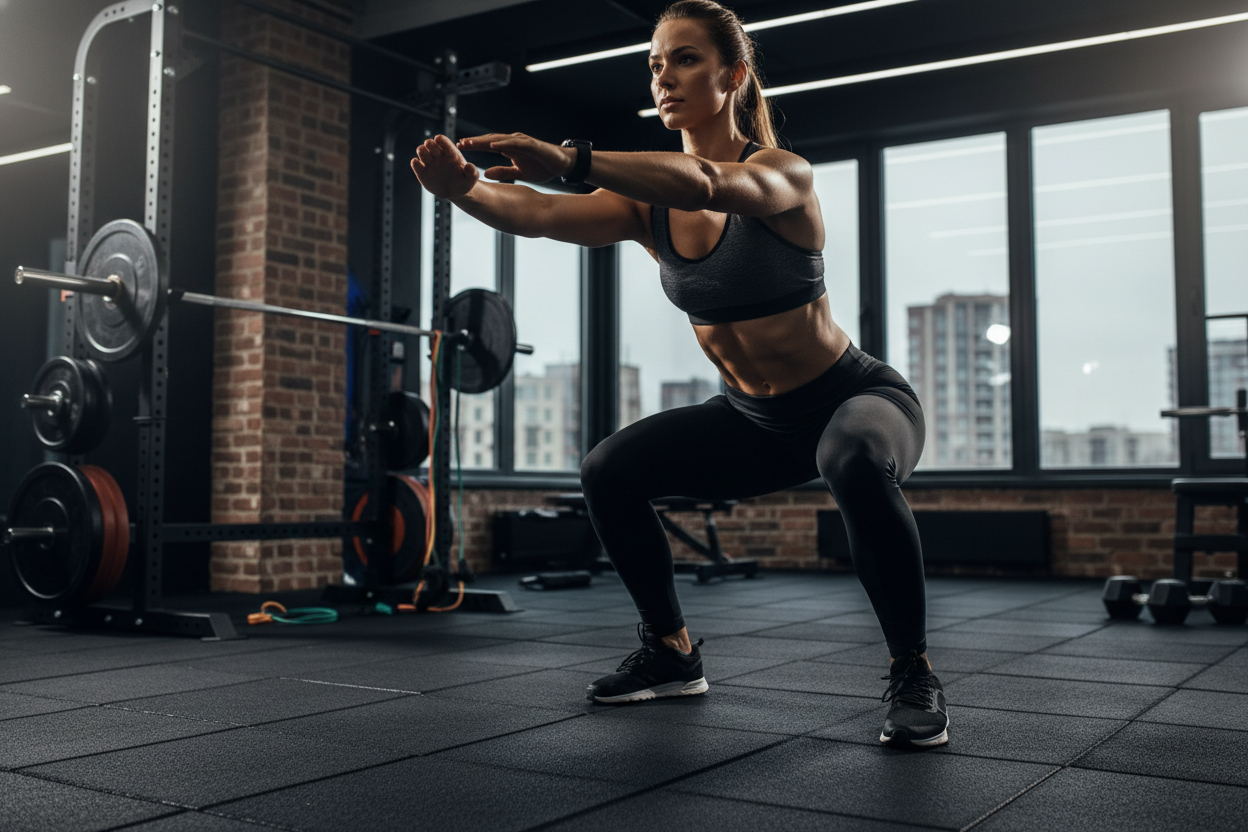
To truly understand what is a free squat, you have to look at the mechanics. Unlike a Smith machine squat, which locks the bar into a rigid vertical track, a free squat forces your body to balance and control the load through three-dimensional space.
Muscles Targeted
Because you are managing the weight independently, free squats recruit a massive amount of muscle. Your quadriceps, hamstrings, and glutes do the heavy lifting, but your spinal erectors, abdominals, and obliques work overtime to keep you upright. It is a full-body movement disguised as a leg exercise.
Barbell vs. Bodyweight
A free squat can range from a simple bodyweight air squat to a heavy barbell back squat. For home gym owners, transitioning from bodyweight to a loaded barbell is the fastest route to progressive overload and serious muscle growth.
Setting Up for Free Squats at Home
One of the biggest advantages of free squats is their efficiency. You do not need a massive commercial footprint to get commercial-grade results.
Essential Gear
To safely perform heavy free squats, you need three things: a sturdy power rack or half rack, a reliable 20kg Olympic barbell, and bumper or iron plates. Investing in a rack with adjustable safety spotter arms is non-negotiable if you train alone in your garage or basement.
Space Requirements
A standard power rack requires about a 4-foot by 4-foot footprint. However, you need to factor in the 7-foot length of an Olympic barbell. We recommend a minimum clearance of 10 feet in width to comfortably load and unload plates without punching a hole in your drywall.
From Our Gym: Honest Take
When I first built out my garage gym, I debated getting a leg press machine. Space was tight, and I worried about safely bailing a heavy barbell alone. But I opted for a heavy-duty half rack and committed to barbell free squats.
The difference in core stabilization was immediate. My chalked grip held solid on an aggressive knurled bar, and the freedom of movement fixed the knee pain I used to get from fixed-track machines. One caveat: at 6-foot-2, I quickly realized I needed a rack with at least 80 inches of internal height to unrack the bar comfortably without hitting the crossmember. Always measure your ceiling and your own wingspan before buying a rack.
Frequently Asked Questions
Are free squats safe for beginners?
Yes, provided you start with just your bodyweight or an empty barbell. Mastering the hip hinge and depth before adding heavy plates is crucial to preventing injury.
How much space do I need for a free squat setup?
You need a minimum area of 10 feet by 6 feet. This accommodates a standard power rack, a 7-foot Olympic barbell, and enough room to safely load weight plates on the sleeves.
Can I build big legs with just free squats?
Absolutely. Barbell back squats and front squats provide enough mechanical tension and progressive overload to build significant lower body mass without ever needing an isolation machine.