Building 3D Delts: The Definitive Guide to the Best 5 Exercises for Shoulder
Most lifters treat shoulder training as an afterthought or, worse, an ego contest. They load up the bar, arch their backs excessively, and wonder why their joints ache while their deltoids remain flat. If you want that coveted "boulder shoulder" look, you need to stop lifting randomly and start respecting biomechanics.
The anatomy of the deltoid is complex. It requires a mix of heavy compound movements for mechanical tension and precise isolation work for metabolic stress. To build a complete physique without wrecking your rotator cuffs, you need to focus on the best 5 exercises for shoulder development.
Quick Summary: The Core Rotation
If you are looking for the most effective movements to stimulate hypertrophy across all three deltoid heads (anterior, medial, and posterior), here is the shortlist based on electromyography (EMG) data and mechanical advantage:
- Standing Barbell Overhead Press: The primary mass builder for the anterior delts and overall strength.
- Dumbbell Lateral Raises (Scapular Plane): The non-negotiable movement for width and the "capped" look.
- Face Pulls: The critical movement for rear delt development and rotator cuff health.
- Seated Dumbbell Press: Allows for greater isolation and range of motion than the barbell version.
- Reverse Pec Deck (Rear Delt Fly): Isolates the posterior chain without allowing the traps to take over.
The Foundation: Vertical Pushing
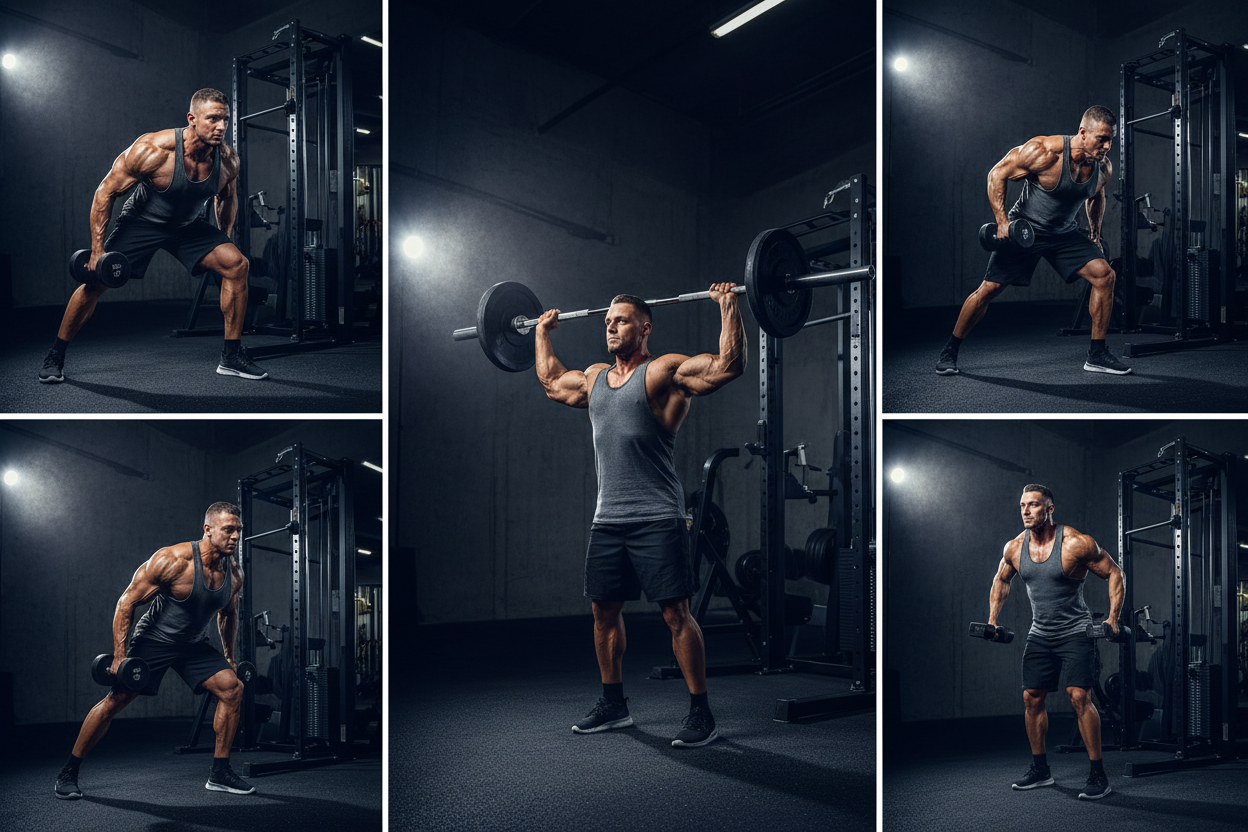
1. Standing Barbell Overhead Press (OHP)
This is the gold standard. No other movement allows you to load the anterior deltoid with as much weight. However, it is also the most butchered lift in the gym.
The Science: The OHP is a kinetic chain movement. It requires stability from your glutes and core. Unlike seated variations, standing forces the stabilizer muscles to engage, leading to a higher systemic hormonal response.
Coach’s Tip: Stop flaring your elbows out to 90 degrees. Tuck them slightly in front of the bar. When you press, imagine pushing your head through the window created by your arms at the top, rather than just pushing the bar back.
2. Seated Dumbbell Press
While the barbell is great for raw strength, dumbbells are superior for symmetry and range of motion. The best 5 shoulder exercises always include a unilateral component to fix muscle imbalances.
Why it works: Dumbbells allow your wrists to rotate naturally. This reduces the shearing force on the shoulder joint. You can also bring the weights down lower than a barbell, increasing the stretch on the muscle fibers, which is a key driver of hypertrophy.
The Width: Medial Head Isolation
3. Dumbbell Lateral Raises (In the Scapular Plane)
You cannot build wide shoulders just by pressing. You need lateral raises. But if you are raising the weights directly out to your sides (T-pose), you are likely grinding your supraspinatus tendon.
The Adjustment: Move your arms about 30 degrees forward (the scapular plane). Think about pouring water out of a pitcher gently, but lead with the elbow, not the wrist. If your traps are burning more than your shoulders, the weight is too heavy. Drop the ego.
The Rear: Posterior Chain & Health
4. Face Pulls
This is the most underrated exercise in this list. Most people have overdeveloped front delts from bench pressing and underdeveloped rear delts. This imbalance leads to a hunched posture and injury.
Execution: Set the cable at eye level. Use a rope attachment. Pull the rope towards your forehead while externally rotating your hands (thumbs pointing back behind you). This hits the rear delts and the external rotators simultaneously.
5. Reverse Pec Deck
Free weight rear delt flys are difficult because the resistance curve drops off at the bottom of the movement. The machine version keeps constant tension on the muscle throughout the entire range of motion.
The Nuance: Keep your palms facing each other (neutral grip). Do not let your shoulders shrug up towards your ears. The moment you shrug, your upper traps steal the tension from the rear delts.
My Training Log: Real Talk
I want to be honest about my experience with the best 5 exercises for shoulder growth. When I first started coaching, I was obsessed with the Standing OHP. I chased a bodyweight press for years.
I got the strength, but my shoulders didn't look "3D." They just looked thick from the front. It wasn't until I humbled myself on the Lateral Raises that the shape changed.
I specifically remember the frustration of dropping from 35lb dumbbells down to 15lbs. It felt embarrassing. But with the 35s, I was using momentum and feeling a sharp pinch in my neck (traps taking over). When I switched to the 15s and utilized the "scapular plane" angle, I felt a burning sensation right in the center of the side delt cap that made it difficult to even lift my arm to wash my hair post-workout. That specific, deep burn—devoid of joint pain—is the only indicator of a successful shoulder session for me now.
Conclusion
Building impressive shoulders isn't about inventing new exercises; it's about executing the proven ones with surgical precision. By sticking to these five movements and focusing on progressive overload and proper angling, you ensure longevity and mass.
Don't let the simplicity fool you. Master the form, control the eccentric (lowering) phase, and the results will follow.
Frequently Asked Questions
Can I train shoulders every day?
No. The shoulder joint is delicate and is involved in almost every other upper body movement (bench press, pull-ups, rows). Training them directly every day will lead to overuse injuries. A frequency of 2 times per week is optimal for most natural lifters.
Why does my shoulder click when I do lateral raises?
Clicking usually indicates impingement, often caused by internal rotation (thumbs down) or lifting directly to the side. Try moving your arms 30 degrees forward into the "scapular plane" and keeping your thumbs slightly higher than your pinkies. If pain persists, see a physio.
Are upright rows safe?
For many people, upright rows cause shoulder impingement due to the internal rotation required at the top of the movement. While they can be effective, Face Pulls and Lateral Raises are generally safer alternatives for the majority of the population looking to hit similar muscle groups.