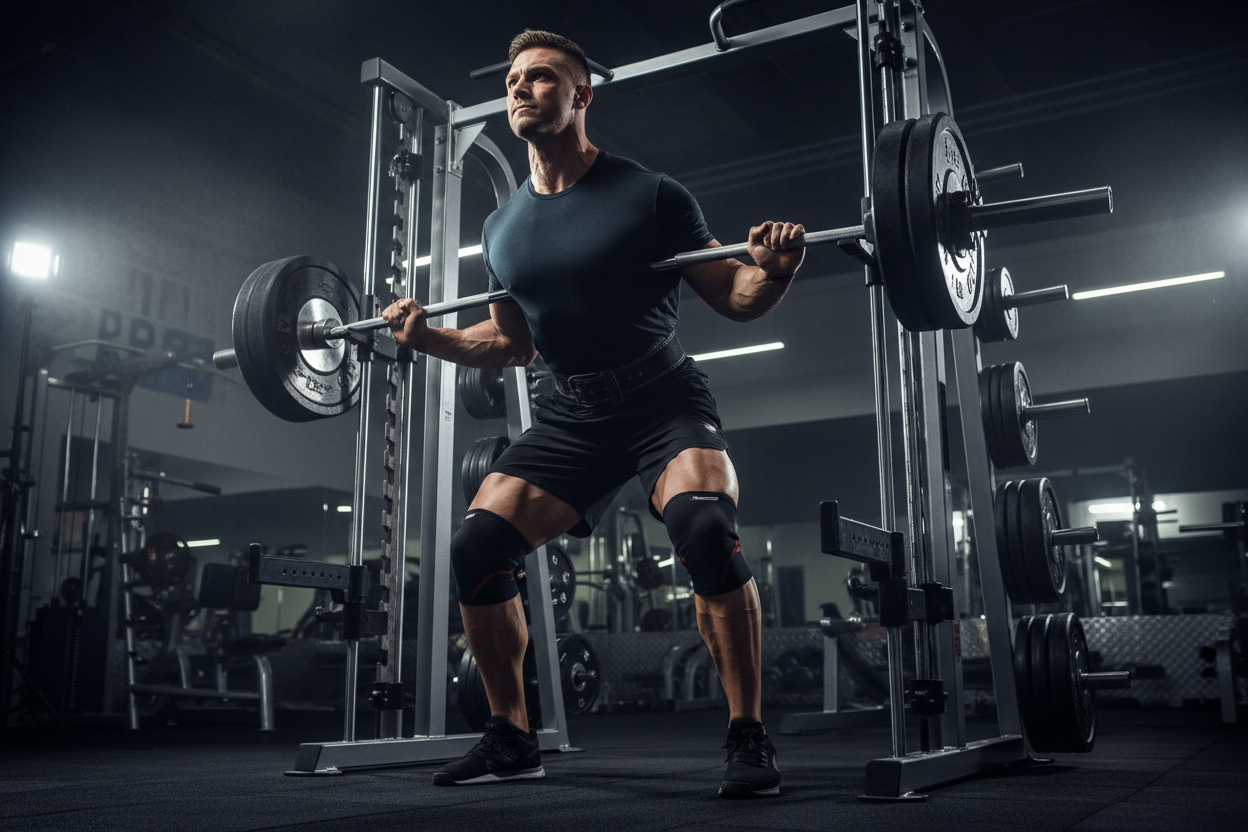
Weight for Legs: How to Build Massive Power Safely
You want stronger, more defined legs, but bodyweight squats aren't cutting it anymore. Adding external load is the only way to force adaptation and growth. However, simply strapping on random weight for legs without a plan is a recipe for joint pain rather than muscle gain.
If you are looking to truly transform your lower body, you need to understand the difference between therapeutic resistance (like ankle weights) and hypertrophy-focused loading (like dumbbells and barbells). This guide breaks down the mechanics, the gear, and the strategy.
Key Takeaways
- Distinction Matters: Ankle weights are best for isolation and hip mobility, while free weights (dumbbells/barbells) are essential for mass and compound strength.
- Progressive Overload: You must track your weights for leg exercise and increase load or volume weekly to see changes.
- Compound First: Always prioritize multi-joint movements (squats, lunges) before isolation movements.
- Safety Check: Knee alignment and core stability are more critical than the amount of weight on the bar.
The Hierarchy of Leg Training Weights
Not all resistance is created equal. When athletes talk about weights legs workouts, they usually refer to two distinct categories. Understanding where each fits into your routine is crucial for avoiding plateaus.
1. Wearable Resistance (Ankle Weights)
Ankle weights are often misunderstood. They are rarely heavy enough to build massive quadriceps. Instead, their value lies in leverage. Because the weight is placed at the distal end of the lever (your ankle), a mere 5lbs feels significantly heavier to your hip flexors and glutes.
Use these for open-chain exercises like leg lifts, donkey kicks, or hamstring curls. They are exceptional for fine-tuning stability but poor for raw strength.
2. Free Weights (Dumbbells, Kettlebells, Barbells)
To stimulate Type II muscle fibers—the ones responsible for size and explosive power—you need heavier loads. Using weights for leg exercise like dumbbells or kettlebells allows for compound movements. This engages the nervous system and recruits more motor units, triggering the hormonal response necessary for growth.
Mastering the Lower Body Workout with Weight
Effectiveness comes down to biomechanics. You can move weight from point A to point B, or you can use weight to create tension in a specific muscle. Here is how to execute the latter.
The Goblet Squat
This is the ultimate teacher. By holding a weight at chest height, you force your thoracic spine to extend and your core to engage. This acts as a counter-balance, allowing you to sit deeper into the squat than you could with a barbell on your back.
The Science: The anterior load shifts your center of gravity, allowing for greater knee flexion without compromising the lower back. This targets the quads heavily.
The Weighted Lunge
Unilateral (single-leg) training is non-negotiable. Leg training weights are most effective here because they expose imbalances. If your left glute is weaker than your right, a heavy lunge will reveal it immediately.
The Science: Lunges destabilize the pelvis. Your glute medius has to fire aggressively to keep your knee from collapsing inward. This builds functional strength that translates to running and jumping.
Common Mistakes with Weighted Leg Exercises
Most people fail not because they lack effort, but because they lack tension.
Bouncing out of the hole: When you drop down fast and bounce back up, you are using the stretch-shortening cycle (elastic energy) of your tendons, not muscle power. Control the eccentric (lowering) phase. Take three seconds to go down. Pause. Then explode up.
Ego Lifting: Using weight exercises legs routines that are too heavy shortens your range of motion. A half-rep squat with 200lbs builds less muscle than a full-depth squat with 135lbs. Full range of motion stretches the muscle fibers under load, which is a primary driver of hypertrophy.
My Training Log: Real Talk
Let’s be honest about the gear for a second. I remember the first time I committed to a "wearable weight" cycle for my hip flexors. I bought a cheap pair of velcro ankle weights online. The product photos looked pristine.
The reality? About 15 minutes into a session, once the sweat started, those things became a nightmare. The velcro started slipping, and the rough nylon binding began chafing right against my Achilles tendon. I had to stop mid-set to readjust them constantly, which killed my flow.
Furthermore, when I switched to heavy dumbbell lunges, I realized my grip was failing before my legs did. I'd be holding 60lb dumbbells, and my forearms would be screaming while my quads were barely warmed up. I learned the hard way that if you want to push your lower body workout with weight seriously, you absolutely need to invest in straps or chalk. Don't let your hands be the bottleneck for your leg growth.
Conclusion
Adding weight for legs is the bridge between average fitness and athletic power. Whether you are using ankle weights for rehab and mobility or heavy iron for mass, the principle remains the same: control the weight, do not let the weight control you. Start with a load you can manage with perfect form for 10 reps, and earn the right to go heavier.
Frequently Asked Questions
Can I use ankle weights for walking to build leg muscle?
Generally, no. While it burns slightly more calories, ankle weights alter your gait mechanics and can increase stress on the knees and hips. It is better to keep resistance training separate from cardio.
How heavy should my weights be for leg exercises?
Select a weight that allows you to complete your target rep range (e.g., 8-12 reps) with 1 or 2 reps left "in the tank." If you can easily do more, increase the load. If your form breaks down, decrease it.
Are free weights better than machines for legs?
Free weights are generally superior for overall strength and stabilizer muscle recruitment. However, machines are excellent for isolating specific muscles safely when you are fatigued near the end of a workout.