Unlock Total Body Fitness With The Ultimate Erg Machine Workout
Walk into any gym, and you’ll see the treadmills packed while the rowing machines sit empty. That is a massive opportunity you are missing. The erg machine workout is arguably the most efficient tool for cardiovascular health and muscular endurance available today. It isn't just for competitive crew teams; it is the great equalizer of fitness.
However, most people avoid the "erg" (short for ergometer) because they don't understand the mechanics, or worse, they hop on and pull with all their might using only their arms. This leads to back pain and zero results. Let's fix your form and structure a plan that actually works.
Key Takeaways: Mastering the Indoor Rower
- Sequence matters: The stroke is 60% legs, 30% body swing, and only 10% arms. Remember: Legs, Body, Arms.
- Check the damper: Setting the lever to 10 doesn't mean a better workout; it usually leads to poor form. A setting of 3-5 mimics water best.
- Variety is key: Mix long "steady state" sessions with high-intensity interval training (HIIT) for maximum fat loss.
- Metric focus: Watch your "split time" (time per 500m) rather than just total distance to gauge intensity.
Why the Rowing Machine is the King of the Gym
Many people treat indoor rowing fitness as a backup plan when the elliptical is taken. This is a mistake. An indoor rowing workout engages approximately 86% of the muscles in your body. Unlike running, which is high-impact, or cycling, which is mostly lower body, rowing connects the chain from your fingertips to your toes.
Whether you are looking for a quick rowing workout to spike your heart rate or a long session for endurance, the rower delivers. It creates a unique metabolic demand that burns calories long after you step off the seat. This is why you see it heavily utilized in CrossFit and functional fitness regimens.
Perfecting Your Form: The "Catch, Drive, Finish, Recovery"
Before we look at specific routines, we have to address the technique. A good rowing workout is impossible without proper biomechanics. If you don't get this right, you aren't training; you're just straining.
1. The Catch
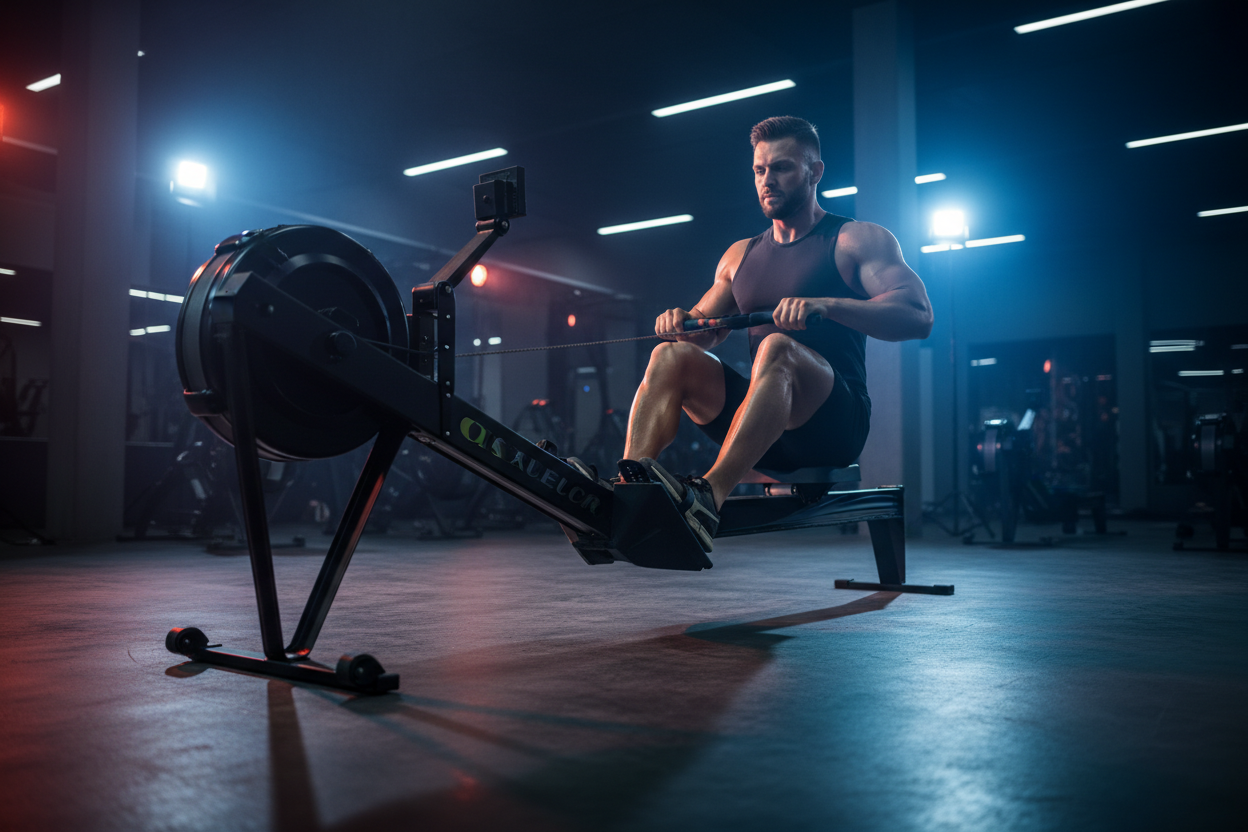
This is your starting position. Your shins should be vertical, arms extended straight, and shoulders relaxed. You are coiled like a spring, ready to explode.
2. The Drive
This is where the power happens. Drive specifically through your heels. Do not pull the handle yet. The sequence is critical: extend your legs first. Once the legs are nearly straight, swing your torso back. Finally, pull the handle to your sternum.
3. The Finish
Legs are flat, core is engaged (leaning back slightly at an 11 o'clock angle), and the handle is touching your lower chest. Elbows should be tucked in, not flared out like a chicken.
4. The Recovery
This is the reverse. Extend your arms away from your body, swing the torso forward, and then bend the knees to slide back to the catch. Arms, Body, Legs.
The Routines: From Beginner to Beast
Now that you understand the movement, let's look at three distinct indoor rowing exercise workouts tailored to different goals.
The "Steady State" Foundation
This is a daily rowing workout staple. The goal here is consistency, not speed. You want to maintain a stroke rate (strokes per minute or s/m) between 18 and 22.
- Warm-up: 5 minutes light rowing.
- Work: 20 minutes at a consistent split time (maintain a conversation pace).
- Cooldown: 5 minutes light rowing.
This builds your aerobic base and is an excellent rowing machine workout for seniors or those recovering from injury due to the low impact nature.
The "500m Repeats" (HIIT)
If you want a rowing machine best workout for fat loss, this is it. It hurts, but it works.
- Warm-up: 10 minutes (include some power bursts).
- The Set: Row 500 meters as fast as possible.
- Rest: 1 minute of complete rest.
- Repeat: 4 to 6 times.
- Goal: Keep all intervals within 5 seconds of each other.
The "Pyramid" Endurance Builder
This keeps your mind engaged so you don't get bored. It’s a great rowing gym workout for building mental toughness.
- Row 1 minute hard, 1 minute easy.
- Row 2 minutes hard, 2 minutes easy.
- Row 3 minutes hard, 3 minutes easy.
- Row 2 minutes hard, 2 minutes easy.
- Row 1 minute hard, 1 minute easy.
Common Mistakes That Kill Progress
When working out with a rowing machine, check your "drag factor." Most beginners sit down and jam the damper lever on the side of the fan cage all the way up to 10. They think higher numbers mean a harder workout. It doesn't.
Setting it to 10 is like trying to row a boat through mud. It places unnecessary stress on your lower back. For a realistic water feel, keep the damper between 3 and 5. This allows for a quicker catch and better rhythm, which is essential for a good rower workout.
Another issue is the "rainbow" stroke. This happens when you lift the handle over your knees on the recovery because you bent your knees too early. Remember: arms away before the knees bend.
My Training Log: Real Talk
I want to be honest about my personal experience with the erg machine workout. The first time I attempted a 2,000-meter time trial, I thought I was fit. I was a runner; I lifted weights. I figured, "It's just sitting down, how hard can it be?"
I went out way too hot. By the 800-meter mark, my lungs felt like they were coated in sandpaper—that specific dry, metallic taste often called the "erg cough." My grip started slipping because I hadn't chalked up, and the sweat was pooling in the handle grooves. But the worst part wasn't the lungs; it was the forearm pump. I couldn't even unclench my fingers to drink water afterward.
That session humbled me. It taught me that on the rower, efficiency beats brute strength every time. I learned to relax my grip on the recovery and drive with my heels, not my biceps. If you finish a session and your lower back hurts, you're doing it wrong. If your quads are on fire and you can barely stand? You nailed it.
Conclusion
Integrating a rowing routine into your schedule changes the game. It provides a full-body blast that saves time and spares your joints. Whether you are doing at home rowing workouts or hitting the gym, the principles remain the same. Focus on the sequence, control your breathing, and respect the machine. The erg doesn't lie; the work you put in is exactly what you get out.
Frequently Asked Questions
Is a rowing machine workout good for belly fat?
Yes, absolutely. Because rowing recruits so many muscle groups (legs, back, core, arms), it burns a significant amount of calories per hour compared to stationary cycling. Combined with a proper diet, high-intensity indoor rowing workouts are highly effective for fat loss.
Can I do a rowing workout every day?
You can, but intensity matters. You can perform a low-intensity, steady-state rowing routine daily for cardiovascular health. However, if you are doing high-intensity sprints or heavy resistance intervals, you should take rest days to allow your muscles to recover, similar to weight training.
What is a good damper setting for beginners?
Ignore the numbers 1-10 on the lever and look at the "Drag Factor" in the monitor settings if possible. Generally, a damper setting of 3 to 5 is ideal for most people. This mimics the resistance of water in a sleek boat. Setting it to 10 increases the drag significantly, which can lead to fatigue and poor form before you get a good cardiovascular workout.