Unlock Shoulder Stability: The Ultimate Scapula Strengthening Guide
If you have ever felt a sharp pinch during an overhead press or a nagging ache behind your shoulder blade while sitting at your desk, the issue likely isn't your shoulder joint itself. It is the foundation: your scapula.
Most rehabilitation protocols focus heavily on the rotator cuff, but without a stable scapula (shoulder blade), the rotator cuff has no solid platform to operate from. Finding a comprehensive scapula strengthening exercises pdf or guide is often the turning point for athletes and office workers alike who are struggling with chronic instability.
This guide cuts through the noise of generic fitness advice. We are going to break down exactly how to stabilize the shoulder girdle, fix winging, and build a bulletproof upper body.
Key Takeaways: Quick Summary
- Stability Before Strength: You cannot strengthen a muscle you cannot activate. Start with isometrics before adding load.
- The Serratus Anterior is King: This muscle is the primary fix for "winged scapula" and is essential for overhead motion.
- Lower Traps Over Upper Traps: Most people are upper-trap dominant. Effective scapular stabilization requires learning to depress and retract the blades without shrugging.
- Consistency Trumps Intensity: These small stabilizer muscles respond better to daily, low-load volume than heavy, infrequent lifting.
The Science of Scapular Dyskinesis
Before jumping into the movements, you need to understand the mechanism. Scapular dyskinesis refers to the abnormal movement of the shoulder blade. Instead of gliding smoothly against the ribcage, the scapula may wing out or tilt forward.
This creates a mechanical disadvantage for your shoulder. When you look for shoulder stabilisation exercises pdfs, you are essentially looking for ways to restore "scapulohumeral rhythm." This is the coordinated movement between the humerus (arm bone) and the scapula. If this rhythm is off, impingement is almost guaranteed.
Phase 1: Activation and Isometrics
If you are dealing with pain, dynamic movement might be too aggressive. We start with scapular isometrics pdf style protocols. These build the mind-muscle connection without joint wear.
The Wall Press Isometric
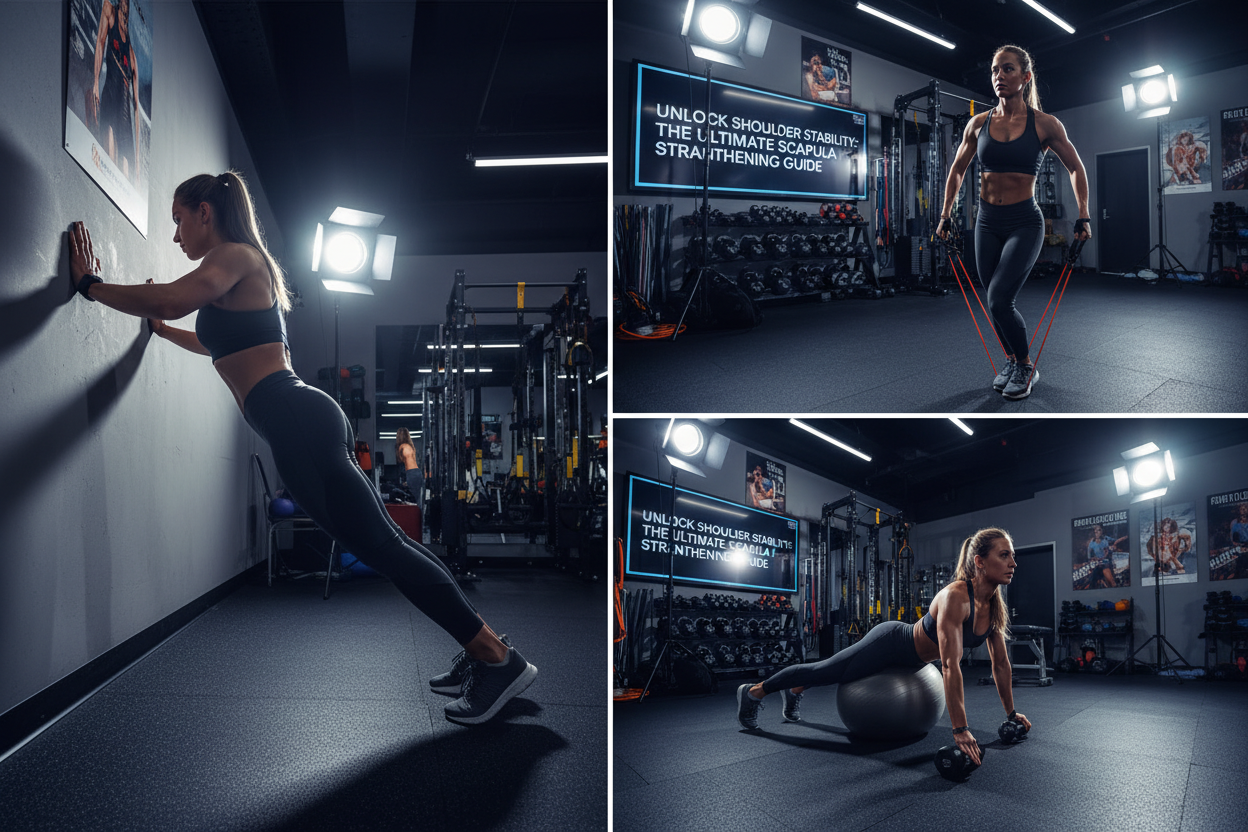
Stand facing a wall with your fist against it at shoulder height. Push gently into the wall without moving your body. Focus on feeling the tension underneath your armpit (the serratus anterior). This is a foundational periscapular exercise.
Scapular Retraction Holds
Stand tall. Squeeze your shoulder blades together as if you are trying to hold a pencil between them. Do not shrug your shoulders up toward your ears. Hold for 10 seconds. This targets the rhomboids and middle trapezius, crucial for correcting posture.
Phase 2: Dynamic Control and Mobility
Once you can engage the muscle, we move to scapular mobility exercises pdf patterns. The goal here is controlled movement through a full range of motion.
Scapular Push-Ups (The Winging Fix)
This is the gold standard for winged scapula exercises. Get into a plank position (or on your knees). Keep your elbows locked straight. Lower your chest toward the floor by pinching your shoulder blades together. Then, push the floor away as hard as you can, rounding your upper back slightly at the top. That extra push at the top is what activates the serratus anterior.
Prone Y-W-T Raises
Lie face down on the floor. These are classic shoulder instability exercises.
- Y-Raise: Arms overhead at a 45-degree angle (thumbs up). Lift specifically using the lower traps.
- T-Raise: Arms out to the side. Squeeze the blades together.
- W-Raise: Elbows bent, squeezing the rotator cuff and scapula.
Perform these slowly. If you feel your upper neck tensing, you are compensating. Reset and try again.
Phase 3: Integration and Strength
This phase is what you would typically find in an advanced shoulder stabilization exercises pdf. This is about keeping the scapula stable while the arm moves under load.
Banded Pull-Aparts
Hold a resistance band with palms facing up (supinated). This external rotation opens the shoulder joint. Pull the band apart until it touches your chest. The focus is on scapular retraction and depression. Do not let the ribs flare out.
The Wall Slide
Stand with your back against a wall. Press your lower back into the wall. Put your arms up in a "field goal" position, elbows and wrists touching the wall. Slide your arms up as high as you can without your lower back arching or your arms popping off the wall. This is a humbling check on your true scapular mobility.
My Training Log: Real Talk
I want to share a specific experience from my own rehab journey that you won't find in a medical textbook. When I first started addressing my own shoulder impingement, I printed out a generic scapular exercises pdf and went to the gym.
I tried the Prone Y-Raises I mentioned above. I grabbed 5lb plates, thinking, "I bench press 225lbs, this is nothing." I was wrong. I couldn't lift my arms more than an inch off the ground without my upper traps trying to hike up to my ears.
The most distinct sensation wasn't a muscle pump; it was a nervous system shake. My arms were literally quivering with just the weight of my hands. It felt like a wobble in the signal between my brain and my lower traps. That grit—the frustration of struggling with zero weight—was the moment I realized my "strength" was all compensation. If you feel that shake, don't add weight. Embrace the wobble. That is your nervous system finally learning how to stabilize.
Conclusion
Building a bulletproof shoulder isn't about how much weight you can overhead press; it's about how well your scapula can support that press. Whether you are looking for scapular dyskinesis exercises or general shoulder stability, the secret is precision.
Don't rush through these movements. Treat every rep as a skill practice. Download a plan, stick to the mechanics, and your shoulders will thank you for years to come.
Frequently Asked Questions
How often should I perform scapula strengthening exercises?
Unlike heavy compound lifting, postural muscles like the lower trapezius and serratus anterior respond well to high frequency. You can perform these exercises 3 to 4 times a week, or even daily at lower intensities as part of a warm-up.
Can these exercises fix a winged scapula?
Yes, in many cases, winging is caused by a weak serratus anterior. Exercises like the Scapular Push-Up (Push-Up Plus) are specifically designed to target this weakness and plaster the shoulder blade back against the ribcage.
Do I need equipment for a shoulder stabilization routine?
Most shoulder stability exercises pdf guides rely on body weight and gravity. However, a light resistance band is a highly effective, low-cost tool that can significantly enhance activation exercises like pull-aparts and external rotations.