Unlock Elite Hip Mobility With the Adductor Stretch Machine
Tight hips are the silent killer of athletic performance. Whether you are a martial artist chasing a high kick, a powerlifter trying to hit depth, or just an office worker with chronic lower back pain, the inner thighs are likely the culprit. Enter the adductor stretch machine.
This device, often seen in dojos or tucked away in the functional fitness area of your gym, promises what floor stretching often fails to deliver: true, measurable progress in your splits. But is it a magic bullet or a recipe for a groin strain? Let's break down the mechanics, the safety protocols, and how to actually use this tool to change your physiology.
Key Takeaways: Quick Summary
- Mechanism: The machine uses leverage (usually a wheel or crank) to bypass the body's natural defense mechanism (the stretch reflex), allowing for a deeper range of motion than gravity alone.
- Best Use Case: Ideal for static stretching after a workout when muscles are warm, not as a cold warmup.
- Duration: Aim for holds of 60 to 90 seconds to allow the fascia to actually lengthen.
- Safety Rule: If you feel sharp pain in the joint capsule or knee ligaments, stop immediately. The sensation should be a dull tension in the muscle belly.
Why Manual Stretching Often Fails
Most people struggle with the classic butterfly stretch or seated straddle because their muscles are actively working to hold the position. When your nervous system senses you are in a vulnerable position, it triggers the myotatic reflex, causing the muscles to contract rather than relax.
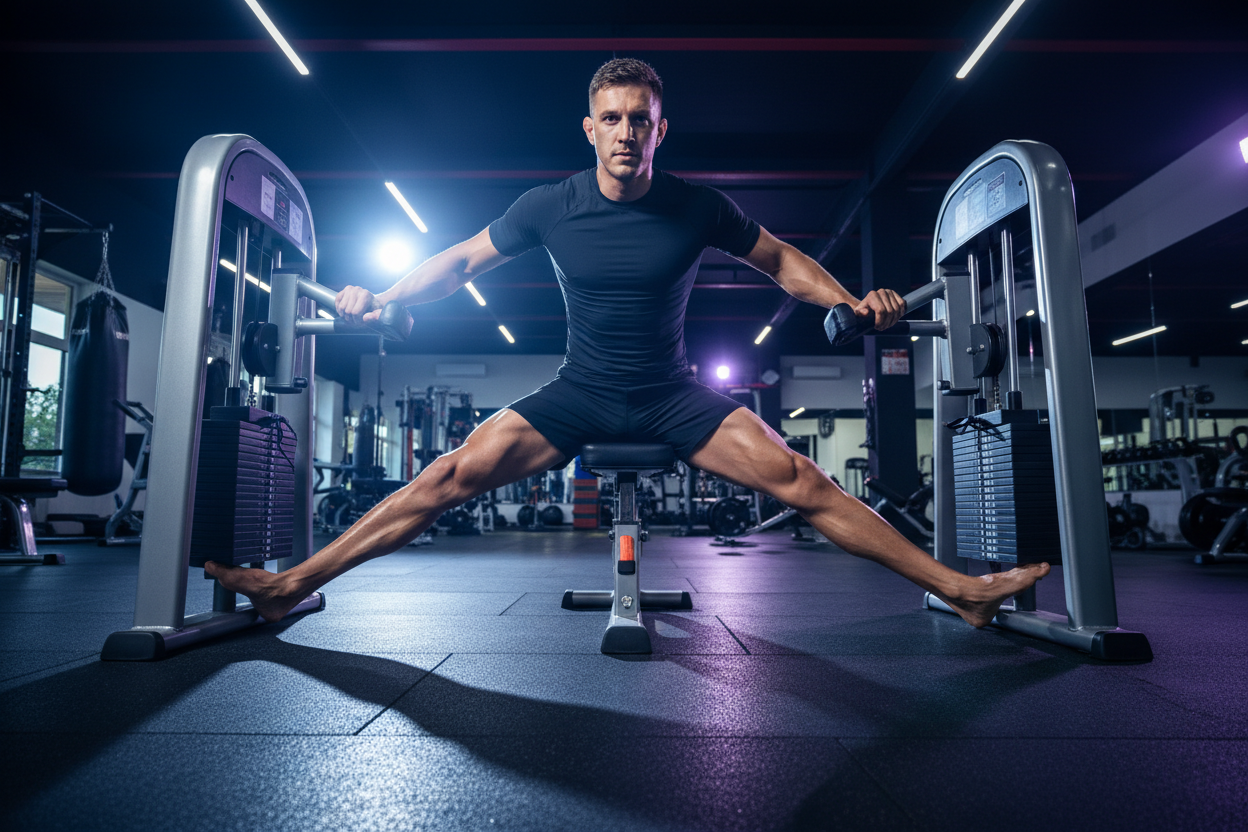
The adductor stretch machine solves this through passive leverage. By locking your legs into position and using a mechanical crank or gear system to widen the angle, you remove the need for muscular exertion. You can focus entirely on breathing and relaxing the nervous system, which is the only way to convince your brain that this extreme range of motion is safe.
Proper Technique: How to Use the Machine
1. The Setup Phase
Adjust the backrest so your spine remains neutral. Slouching defeats the purpose by tilting your pelvis posteriorly, which shortens the adductor magnus. Your sit bones should be firmly planted against the back of the seat. Secure your ankles in the pads; ensure the padding is thick enough to prevent bruising on the shin bone.
2. The Approach
Begin cranking the wheel or pulling the lever slowly. Do not jerk the machine. Move to the point of "mild discomfort." This is where you feel a stretch, but your face doesn't scrunch up in pain. Hold here for 30 seconds.
3. The PNF Method
To maximize results, integrate Proprioceptive Neuromuscular Facilitation (PNF). Once you are at your limit:
- Gently squeeze your legs inward against the pads (about 20% effort) for 10 seconds.
- Relax the muscles completely.
- Immediately turn the crank slightly further. You will find you have gained a few degrees of range instantly.
Common Mistakes That Lead to Injury
Cold Stretching
Never hop on an adductor stretch machine the moment you walk into the gym. Cold fascia is like beef jerky—it tears. Warm fascia is like taffy—it stretches. Use this machine only after 10 minutes of dynamic movement or at the end of your weight training session.
Ignoring the Knees
If your adductors are extremely tight, the tension often bypasses the muscle and torques the medial collateral ligament (MCL) of the knee. If you feel pain on the inside of your knee rather than your inner thigh, you are damaging the joint. Bend your knees slightly or reduce the width until the tension shifts back to the groin.
My Training Log: Real Talk
I bought a mid-range, wheel-crank adductor machine for my home gym about three years ago because my squat width was suffering. Here is the unpolished truth about living with one.
The first thing you notice isn't the stretch; it's the ankle pain. On cheaper machines, the rollers are often too hard. I actually had to wrap mine in an extra towel because the pressure on my outer shin bone became unbearable before my adductors even felt a deep stretch.
There is also a very specific psychological panic that sets in when you use the gear-driven models. Unlike floor stretching, where you can just roll out if it hurts, you are mechanically locked in. I remember one session where I pushed the crank one "click" too far. The ratchet locked, and for a split second, I couldn't release the tension wheel. I wasn't injured, but that moment of being trapped in a painful split taught me to respect the machine. Now, I keep one hand on the release lever at all times. It works, but it demands respect.
Conclusion
The adductor stretch machine is a potent tool for bypassing the stretch reflex and achieving the splits, provided you treat it with caution. It is not a torture device to be cranked to the max; it is a tool for teaching your nervous system to relax at end-range. Warm up, pad your ankles, and breathe through the tension.
Frequently Asked Questions
How often should I use the adductor stretch machine?
Consistency beats intensity. Using the machine 3 to 4 times a week for 10 minutes is far superior to one aggressive 30-minute session that leaves you limping. Your muscles need recovery time from intense stretching just like they do from lifting.
Can this machine help with high kicks?
Yes. High kicks require dynamic flexibility, but static flexibility sets the baseline potential. By increasing your passive range of motion with the machine, you create the "room" necessary to throw higher kicks without straining a muscle.
Is it better than the butterfly stretch?
For pure range of motion, yes. The machine provides leverage and stability that allows for a deeper stretch than gravity alone can provide in a butterfly stretch. However, the butterfly stretch is still excellent for maintenance and warm-ups.