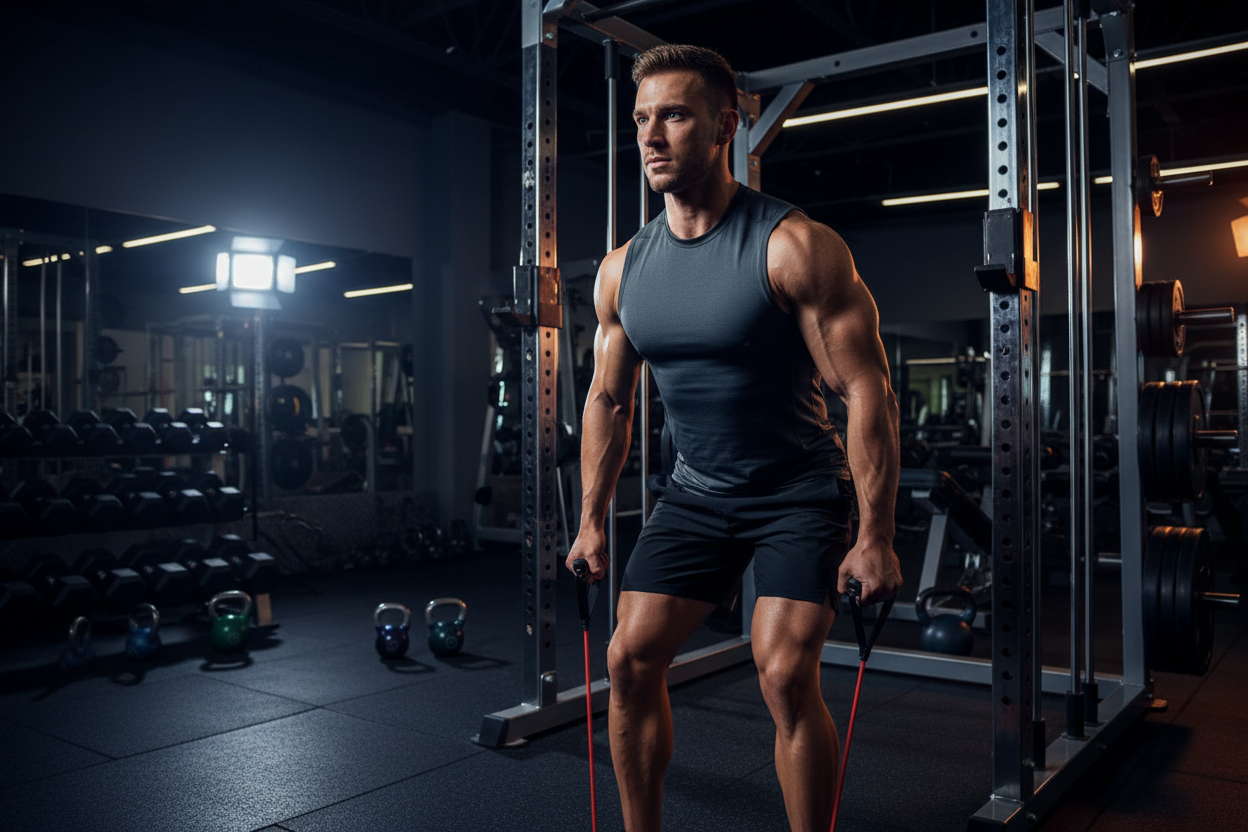
Unlock Bulletproof Shoulders With Rotator Cuff Strength
You can have the strongest pecs in the gym and massive deltoids, yet still struggle to put on a jacket without a wince. This is the paradox of the shoulder joint. It is the most mobile joint in the body, but that mobility comes at a steep price: instability. If you ignore rotator cuff strength, you are building a mansion on a foundation of sand.
Most lifters treat the rotator cuff as an afterthought—a few half-hearted band pulls before a heavy bench session. But true shoulder health isn't just about warming up; it's about structural integrity. Without it, your power output hits a glass ceiling, and your risk of injury skyrockets.
Key Takeaways: Quick Summary
- Function over Size: The rotator cuff's primary job is dynamic stability, keeping the humerus centered in the socket during movement.
- High Reps, Low Load: Rotator cuff stabilization exercises respond best to higher volume and controlled tempo, not max effort loading.
- Timing Matters: Perform activation work before heavy lifting, but save exhaustion/strengthening work for the end of the session.
- Integration: Essential movements include Face Pulls, Bottom-Up Kettlebell Presses, and Isometrics.
The Science of Dynamic Stability
Think of the shoulder joint like a golf ball sitting on a tee. The big muscles (pecs, lats, delts) are responsible for moving the ball. The rotator cuff is the gravity that keeps the ball on the tee while it spins.
This mechanism is known as rotator cuff stabilization. When you press a heavy weight overhead, your deltoid pulls the arm bone upward. Without the cuff muscles firing to pull it back down and in, the bone crashes into the acromion process. This is the mechanism of impingement. Strength in these small muscles isn't about moving weight; it's about fine-tuning the axis of rotation so your prime movers can work without grinding your joints to dust.
Essential Rotator Cuff Stabilization Exercises
Forget the standard internal/external rotations with a dumbbell tucked against your side. While better than nothing, they don't mimic how the shoulder functions in real life. We need to train the cuff to stabilize while the arm is moving or under load.
1. The Bottom-Up Kettlebell Press
This is the ultimate truth-teller. By holding a kettlebell upside down (handle in palm, bell facing the ceiling), you force the cuff to work overtime to balance the unstable load. If your stabilizers are weak, the bell flops over immediately. It forces perfect alignment and recruits the cuff reflexively.
2. Face Pulls with External Rotation
Most people do face pulls wrong. They pull to the chin. Instead, pull the rope towards your eyes and actively rotate your hands back as if you are hitting a "double bicep" pose. This targets the rear delts and the external rotators simultaneously, counteracting the hunched posture from too much bench pressing.
3. Banded W's (No Money Drill)
Tuck your elbows into your ribs with a light resistance band in your hands, palms up. Rotate your hands out while keeping elbows pinned. This isolates the infraspinatus and teres minor, which are crucial rotator cuff stabilizer exercises for preventing the shoulders from rolling forward.
Programming Your Shoulder Health
The biggest mistake athletes make is treating these exercises like power movements. The rotator cuff is comprised of small endurance muscles. They do not need to be maxed out.
If you perform these exercises to failure before your heavy compound lifts, you destabilize the joint right before you need it most. Use light activation (1-2 sets, not to failure) as a warm-up. Save the fatigue-inducing strengthening work (3-4 sets of 15-20 reps) for after your main workout is done.
My Personal Experience with Rotator Cuff Strength
I learned this lesson the hard way about five years ago. I was chasing a 315lb bench press and ignored the nagging ache in the front of my right shoulder. I thought it was just "good pain." One Tuesday, un-racking just 225lbs, my arm simply gave out. It didn't snap, but the neural shut-down was instant.
My rehab involved the Bottom-Up Kettlebell Press I mentioned earlier. I remember the humiliation of grabbing a 6kg (13lb) kettlebell. I looked around the gym to make sure no one was watching. As I tried to press that tiny weight, my hand shook so violently that the handle rattled against my wedding ring. It wasn't that my muscles were tired; it was that my brain couldn't find the stability to push. That specific, uncontrollable wobble was the wake-up call. It took three months of using those "pink dumbbell" weights before the shaking stopped and I could bench pain-free again.
Conclusion
Building a massive upper body without addressing the underlying stabilizers is a ticking time bomb. By incorporating dedicated rotator cuff stabilization exercises into your routine, you aren't just preventing injury. You are unlocking the brakes on your prime movers, allowing you to press heavier and harder in the long run.
Frequently Asked Questions
How often should I train my rotator cuff?
Because these muscles are endurance-based and recover relatively quickly, you can train them 2-4 times per week. However, vary the intensity. Do not do heavy stabilization work the day before a max-effort pressing session.
Should I use heavy weights for rotator cuff exercises?
Generally, no. Heavy weights usually cause the larger muscles (deltoids and lats) to take over, defeating the purpose. Stick to lighter weights where you can feel a distinct "burn" deep in the shoulder socket rather than surface muscle fatigue.
Can rotator cuff exercises fix clicking shoulders?
Often, yes. Clicking usually indicates that the humerus is not tracking smoothly in the socket. Strengthening the stabilizers helps center the bone, which can reduce or eliminate the clicking sound, provided there is no structural tear.