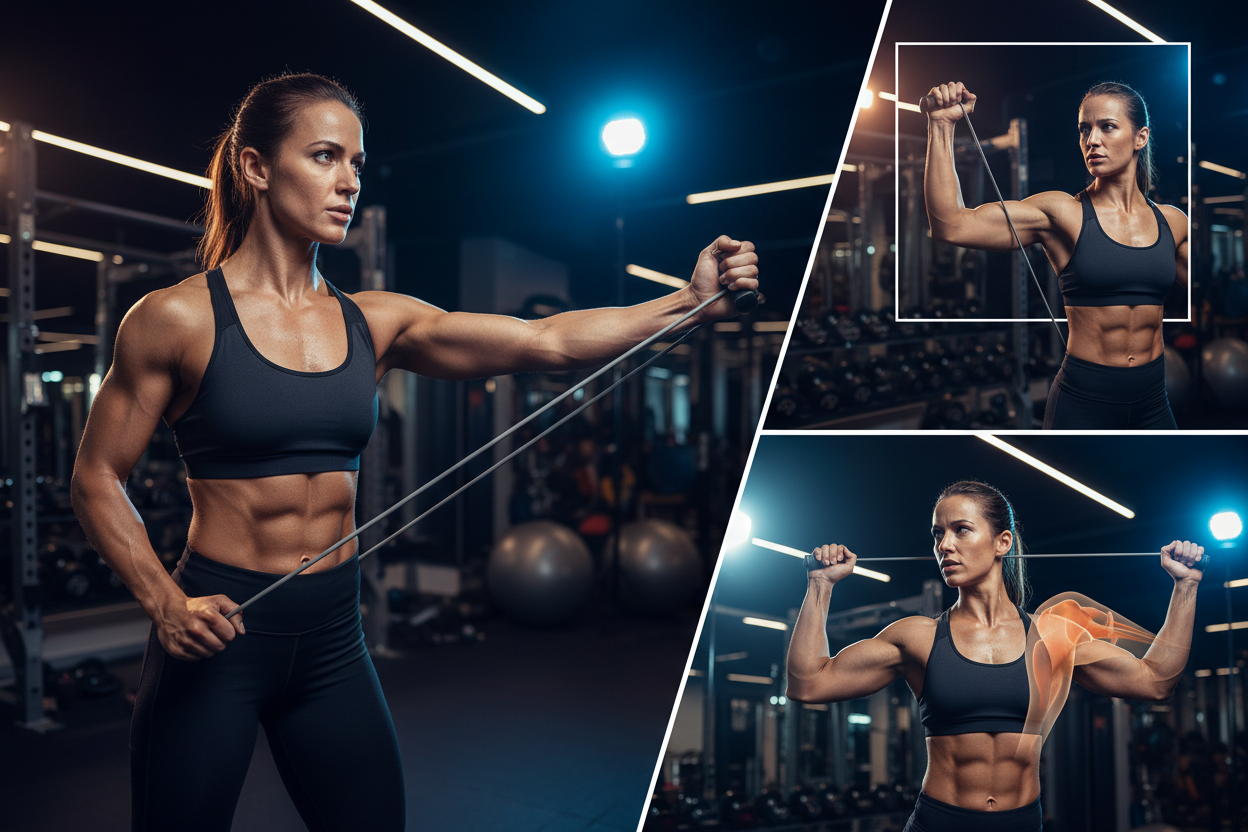
Unlock Bulletproof Shoulders Through Periscapular Strengthening
If your bench press has stalled, your overhead press feels shaky, or you simply have that nagging ache between your shoulder blades after a long day at the desk, the issue usually isn't your deltoids. The culprit is often a weak foundation.
Most lifters obsess over the mirror muscles but neglect the engine room behind them. I'm talking about periscapular strengthening. Without a stable scapula (shoulder blade), your arm is essentially trying to fire a cannon from a canoe. It doesn't work, and eventually, the canoe tips over.
Key Takeaways: The Essentials
- The Foundation: The scapula is a floating bone connected only by the collarbone and muscles; stability is 100% muscular.
- Target Muscles: Focus shifts from the upper traps to the lower traps, rhomboids, and serratus anterior.
- The Goal: Achieve proper scapulohumeral rhythm (the coordinated movement of the humerus and scapula).
- Key Movements: Scapular push-ups, Y-T-W raises, and wall slides are the gold standard for activation.
Why Your Shoulder Blade Stability Matters
Think of your scapula as the seal that connects your arm to your torso. When you move your arm, the scapula must rotate and glide seamlessly along the ribcage. This is called scapulohumeral rhythm.
When you ignore periscapular muscles exercises, that rhythm breaks down. The scapula starts to 'wing' (stick out) or tilt forward. This reduces the space in the shoulder joint, leading to impingement. You cannot build a massive overhead press on a shaky structure. Strengthening these muscles locks the shoulder blade against the rib cage, providing a concrete platform to push from.
Effective Periscapular Strengthening Exercises
The biggest mistake athletes make here is going too heavy. These are small, endurance-based stabilizers, not power movers. If you grab the 50lb dumbbells, your big prime movers (lats and upper traps) will take over, defeating the purpose.
1. The Serratus Push-Up Plus
This is the king of periscapular stabilization. It targets the serratus anterior, the muscle responsible for keeping the shoulder blade glued to the ribs.
Get into a plank position. Keeping your elbows locked straight, let your chest sink toward the floor so your shoulder blades pinch together. Then, push the floor away as hard as you can, spreading your shoulder blades apart and rounding your upper back slightly. That extra push at the top is the 'plus'—that’s where the magic happens.
2. Prone Y-T-W Raises
This circuit hits the lower traps and rhomboids, correcting the forward-slumped posture we all suffer from.
Lie face down on the floor or a bench. With thumbs pointing up, raise your arms in a 'Y' shape (lower traps), then a 'T' shape (rhomboids), and finally a 'W' shape (external rotators). The focus isn't on height; it's on the squeeze. If you feel this in your neck (upper traps), you are doing it wrong. Reset and depress your shoulders down away from your ears.
3. Scapular Wall Slides
This serves as both a mobility drill and a strengthener. Stand with your back against a wall. Try to keep your head, upper back, and—crucially—your forearms and wrists touching the wall. Slide your arms up into a 'V' and back down into a 'W'.
It looks easy, but if you have tight pecs or weak external rotators, keeping your wrists on the wall will feel like a battle.
My Training Log: Real Talk
I want to be honest about what periscapular strengthening actually feels like because it’s a massive ego check. Years ago, I was rehabbing a nasty rotator cuff strain. My physical therapist handed me a pair of 2.5lb pink dumbbells and told me to do prone Y-raises.
I laughed. I was benching over 300lbs at the time. But by the eighth rep, my arms were shaking uncontrollably. The burn wasn't deep in the muscle belly like a bicep curl; it was this sharp, localized fatigue right at the bottom tip of my shoulder blade. It was humbling.
The hardest part wasn't the weight; it was the mental focus required to not shrug. Every time I got tired, my shoulders wanted to creep up toward my ears. I had to mentally fight to keep them depressed. That specific 'shaking' feeling while holding a tiny weight is exactly what you are chasing. If you aren't shaking, you're probably using momentum or the wrong muscles.
Conclusion
Building a massive chest or broad shoulders is fun, but periscapular exercises are the insurance policy that allows you to keep training them. You don't need to dedicate an entire hour to this. simply add 5-10 minutes of these movements as a warm-up or a finisher on your upper body days. Your posture will improve, your pain will decrease, and your main lifts will go up.
Frequently Asked Questions
How often should I perform periscapular exercises?
Because these are postural muscles designed for endurance, they respond well to high frequency. You can perform them 3 to 4 times a week. However, keep the volume moderate—2 to 3 sets of 12-15 reps is usually sufficient.
Can I use heavy weights for periscapular strengthening?
Generally, no. The moment the load becomes too heavy, larger muscle groups like the lats and upper trapezius take over to protect the joint. Keep the weight light (often just bodyweight or light bands) and focus on the quality of the contraction.
What is the difference between rotator cuff and periscapular exercises?
While they often overlap, the rotator cuff muscles (supraspinatus, infraspinatus, teres minor, subscapularis) focus on rotating and centering the arm bone in the socket. Periscapular muscles focus on moving and stabilizing the shoulder blade itself against the ribcage. You need both for a healthy shoulder.