Triangle Pose (Trikonasana): How to Do It and Variations
Quick answer: To do triangle pose (Utthita Trikonasana, or extended triangle pose), stand with your feet wide apart, about 3–4 feet, along the long edge of your mat. Turn your right foot out to point to the short edge and your left toes slightly in. Raise your arms parallel to the floor, palms facing down. Keeping both legs straight (not locked), reach your torso forward over the right leg, then hinge at the hip joint and lower your right hand to your shin, ankle, a yoga block or the floor. Extend the left arm straight up so both arms form one straight line, and turn your chest open to the side. Hold for 5–8 breaths, then repeat on the other side. Triangle pose stretches the hamstrings, inner thighs and side body, opens the hips and chest, and builds leg strength.
Key takeaways
- Hinge from the hip, don't just bend sideways at the waist.
- Keep both sides of the waist long.
- Bottom hand can rest high: a block or the shin is better than collapsing to reach the floor.
- Micro-bend the front knee so it doesn't hyperextend.
- A wide mat fits the stance without your feet sliding off the edges.
Muscles stretched and worked
| Area | Effect |
|---|---|
| Hamstrings and calves (front leg) | Stretched |
| Inner thighs and groin | Stretched; opens hips |
| Side body and rib cage | Lengthened (lateral bend) |
| Chest and shoulders | Chest opening as the top arm reaches up |
| Quads, glutes and core | Engaged to hold the pose |
Benefits
- Hamstring and hip flexibility in one pose.
- Leg strength from holding straight, active legs.
- Side-body stretch and spine mobility.
- Balance and stability.
- A foundation pose found in nearly all yoga styles.
How to do triangle pose step by step
- Starting position: begin in mountain pose at the top of your mat, then step your left foot back so your feet are wide, about one leg length apart. Face the long edge.
- Feet: turn the right foot out 90 degrees toward the short edge. Turn the left toes in about 15 degrees. Line up the right heel with the arch of the back foot.
- Arms: raise your arms to shoulder level, parallel to the floor, palms facing down.
- Reach: shift your hips back to the left and reach your torso forward over the right leg, keeping the waist long.
- Hinge: tip the right hand down to the shin, ankle, a block or the floor outside the right foot. Press firmly into the outer edge of the back foot.
- Top arm: extend the left arm vertically so the arms remain parallel in one straight line. Turn the chest open toward the long edge.
- Gaze: look at the top hand, straight ahead, or down if your neck is sensitive.
- Hold 5–8 breaths. Inhale to rise, turn the feet, and repeat the same steps on the other side.
Triangle pose variations
| Variation | How | Why |
|---|---|---|
| Triangle with a yoga block | Bottom hand on a block | Keeps the spine long; great for tight hamstrings |
| Wall triangle | Back body near a wall | Feedback on alignment |
| Revolved triangle pose | Hips square; opposite hand down; spinal twist | Rotation and balance; harder |
| Bound triangle pose | Top arm wraps behind the back to bind | Deeper shoulder opening |
| Big toe triangle | Bottom fingers hold the big toe | Deeper stretch for flexible practitioners |
Triangle vs extended side angle
Both are wide-stance poses. In triangle, the front leg is straight and the bottom arm reaches down. In extended side angle, the front knee is bent to 90 degrees (like warrior 2) and the forearm rests on the thigh or the hand on the floor, with the top arm reaching over the ear. Many sequences flow between them.
Common mistakes
| Mistake | Fix |
|---|---|
| Collapsing the bottom side of the waist | Reach forward first, then hinge; bring the hand higher |
| Locking the front knee | Keep a micro-bend; lift the kneecap with the thigh |
| Chest turning toward the floor | Bottom hand higher; rotate the top shoulder back |
| Weight in the bottom hand | Legs do the work; the hand rests lightly |
| Stance too narrow or too wide | About one leg length apart |
Where triangle fits in a yoga sequence
| Pose | Time |
|---|---|
| Sun salutation | 3 rounds |
| Warrior 2 | 5 breaths per side |
| Extended side angle | 5 breaths per side |
| Triangle pose | 5–8 breaths per side |
| Wide-leg forward bend | 5 breaths |
| Tree pose | 5 breaths per side |
Who should be careful
- Low blood pressure or dizziness: look down rather than up, and come up slowly.
- Neck problems: keep the gaze forward or down.
- Hamstring or hip injury: use a block and a shorter stance.
- Balance issues: practice with your back near a wall.
Practicing triangle pose at home
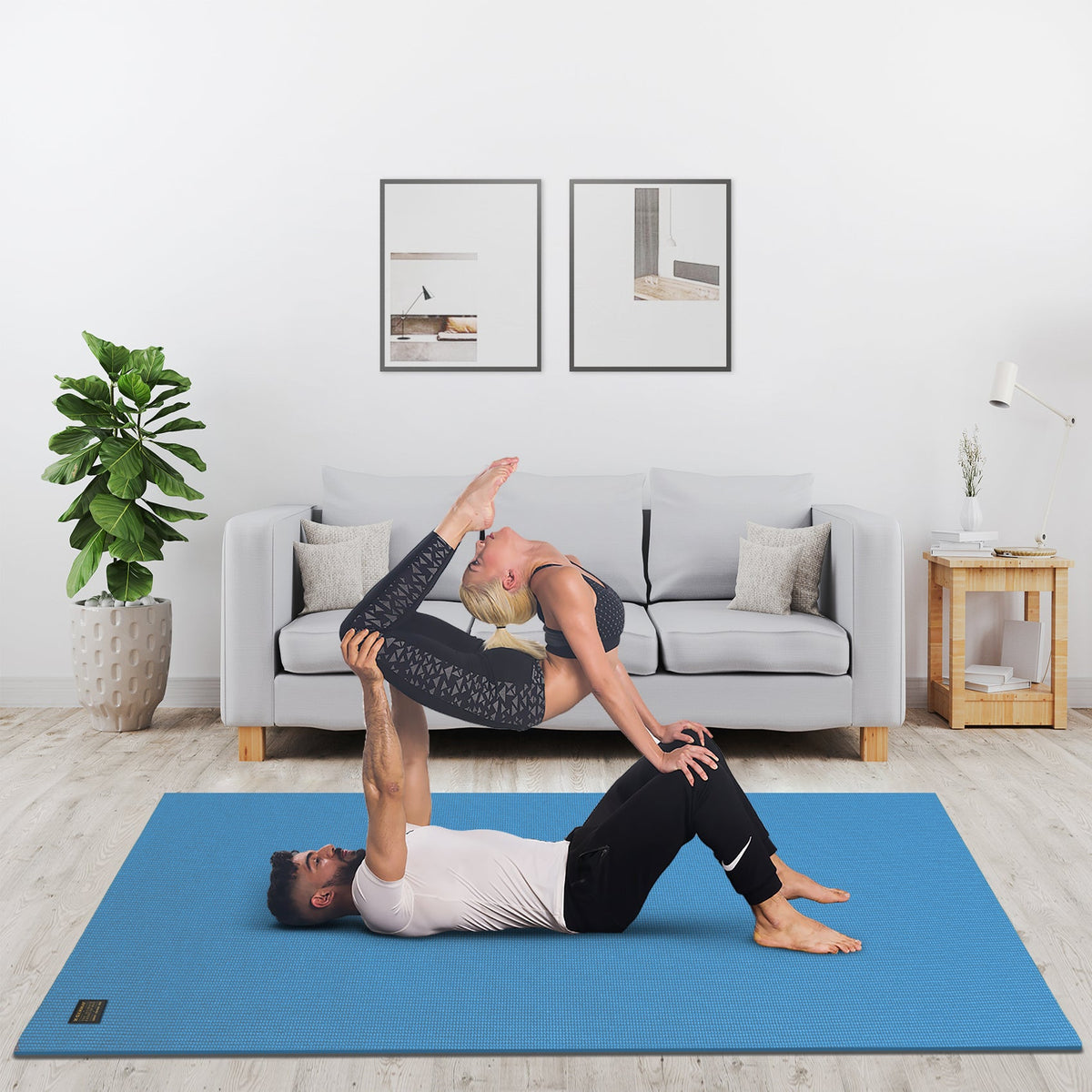
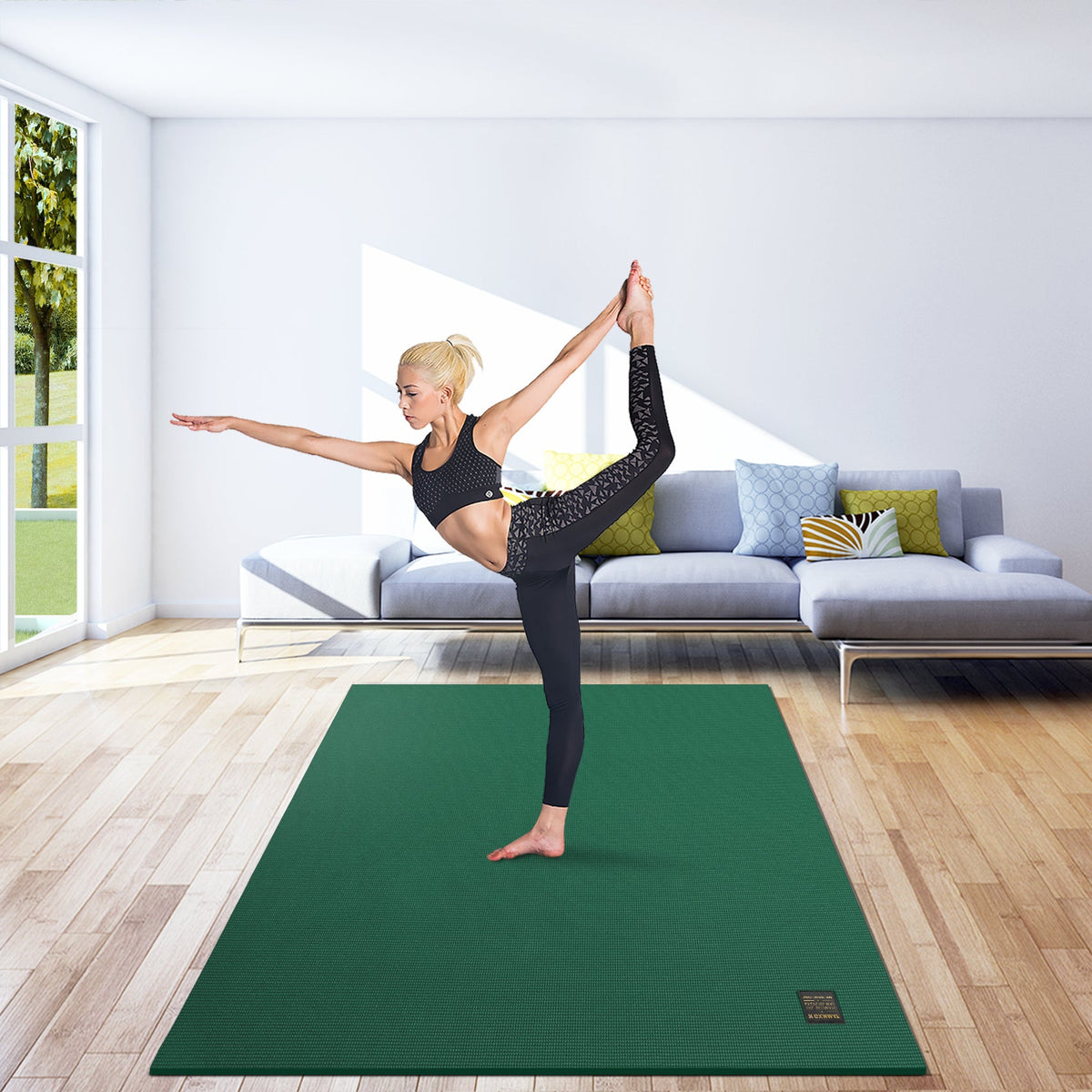
Triangle's wide stance runs along the long edge of the mat, and the back foot needs grip to press into. Standard yoga mats are only about 2 feet wide, so in wide-leg poses many people end up with a foot half on the floor. GXMMAT large yoga mats start at 4 feet wide and 6 feet long, with a non-slip surface, so the whole stance fits comfortably. Compare thickness in the yoga mat thickness guide.
FAQ
What is triangle pose good for?
Stretching the hamstrings, inner thighs and side body, opening the hips and chest, and building leg strength and balance.
Should my hand touch the floor in triangle pose?
Only if you can keep both sides of your waist long. Resting the hand on the shin or a yoga block is just as correct.
What's the Sanskrit name for triangle pose?
Utthita Trikonasana, which means extended triangle pose.
How far apart should my feet be in triangle?
About one leg length, roughly 3–4 feet for most adults.
What is revolved triangle pose?
A twisting variation: the hips face forward, the opposite hand goes down by the front foot, and the chest rotates open. It's more challenging.
Written by Yuvien Royer for GXMMAT. This article is general fitness information, not medical advice.