Total Gym Leg Exercises: Setup and Workout Guide
Training the lower body at home often presents a practical dilemma: bulky barbells require heavy weight plates and massive racks, while basic bodyweight squats can quickly become too easy to stimulate ongoing progress. Incorporating total gym leg exercises into your weekly routine provides an adaptable middle ground. By adjusting the incline of an unstable glideboard, you can challenge the thighs, hips, calves, and hamstrings without loading heavy iron directly onto your spine.
Whether your goal is to build strength, maintain muscular endurance, or establish a joint-friendly lower body routine, understanding how to handle resistance training on an incline board is essential. Pairing proper glideboard technique with stable room placement allows you to get the most out of every repetition while protecting your home floors.
Why Total Gym Leg Exercises Deliver Effective Lower Body Training
Incline glideboard systems work by using a percentage of your body weight as resistance against gravity. Raising the rails increases the workload, while lowering them allows for a lighter resistance curve suitable for controlled recovery or high-volume sets. This makes incline training versatile for lifters of varying fitness levels who want a dependable beginner workout guide for Total Gym setups.
Unlike free weights that apply continuous downward axial pressure on the spine, glideboard leg exercises support the back and torso. As you lie back against the padded surface, your core and abs remain engaged for stabilization, but your spinal column remains supported throughout the range of motion. For lifters working through joint discomfort or seeking a lower-impact alternative to standard back squats, the glideboard offers a consistent, guided track for smooth muscle recruitment across the quadriceps, hamstrings, and calves.
Essential Total Gym Leg Exercises: Leg Press and Squat Variations
The squat stand attachment serves as the foundation for the most productive glideboard lower body movements. By adjusting your foot positioning and stance width, you can emphasize different muscle groups across the thighs and hips.
Two-Leg Glideboard Squat and Leg Press
Lie back on the glideboard with your head supported and your spine resting flat against the pad. Place both feet flat on the squat stand, roughly shoulder-width apart, with your toes pointed slightly outward. This represents your starting position.
Lower the glideboard by bending your knees until your thighs form a parallel angle with the foot platform. Keep your heels firmly planted—avoid shifting your weight onto your toes. From the bottom of the movement, push through the midfoot and heels to slide the glideboard back to the top. Keep a soft bend at the knee joint at peak extension rather than locking out the joints aggressively.
Single-Leg Press
Unilateral work balances out strength discrepancies between limbs. From the same supine starting position, center one foot on the squat stand and lift the opposite leg off the board, holding it in a comfortable bent position. Slowly descend under control, allowing the working knee to track directly in line with your second toe. Push firmly through the platform to return to the starting position before switching to the opposite leg.
Wide-Stance Sumo Squat
Position your feet near the outer edges of the squat stand with toes angled outward around forty-five degrees. As you descend, keep your knees pushed wide over your ankles. This variation places greater demand on the inner thighs (adductors) and glutes while reducing the forward travel of the knees.
Glideboard Calf Raises
Position the balls of your feet on the lower edge of the squat stand with your heels hanging free. Extend your knees so your legs are straight but not locked. Lower your heels below the platform level to feel a stretch across the calves and achilles tendon, then push upward onto your tiptoes to achieve a full contraction. Maintain a steady, deliberate tempo to avoid bouncing off the platform.
Glideboard Leg Curl and Posterior Chain Leg Exercises
A balanced lower body routine requires deliberate hamstring and posterior chain development alongside quad-dominant squats. The glideboard accommodates effective pulling and curling patterns using the pulley and cable attachments.
Lying Leg Curl
Attach the foot harness or ankle cuffs to the lower pulley system. Lie face down on the glideboard with your chest and hips flat against the padding. Fasten the cables to your ankles. From this starting position, curl your heels upward toward your glutes, feeling the hamstrings contract as the board slides up the rails. Slowly lower your feet back down, resisting the pull of the cables during the return phase.
Kneeling Hip Extensions
Kneel on the glideboard facing the tower, holding the handles or securing the foot cuffs. Drive one foot backward and upward while keeping your abs braced to prevent overextending your lower back. This movement isolates the glutes and upper hamstrings through hip extension.
Structuring an Effective Home Gym Leg Workout
You can achieve balanced muscular development by organizing your training day around clear movement patterns: a primary squat, a unilateral press, a hamstring curl, and an ankle extension movement. When you want to combine incline work with traditional resistance training, you can blend glideboard sets with floor-based movements outlined in our guide to barbell leg exercises or free-weight staples.
Sample Total Gym Leg Day Routine
- Two-Leg Glideboard Squat: 3 to 4 sets of 12 to 15 reps (focus on controlled eccentric tempo)
- Single-Leg Press: 3 sets of 10 to 12 reps per leg
- Lying Glideboard Leg Curl: 3 sets of 10 to 12 reps
- Glideboard Calf Raise: 3 sets of 15 to 20 reps
- Complementary Floor Finisher: 2 sets of walking lunges or a light romanian deadlift with dumbbells across your gym space
If you prefer standing movements to finish your workout, integrating a light goblet squat, front squat, or good mornings using dumbbells helps bridge the gap between machine stabilization and free-standing balance.
Total Gym Floor Setup: Base Stability and Mat Protection
Lower body exercises generate substantial lateral and longitudinal forces through the machine frame. During heavy leg presses or explosive squats, the base rails can shift across hard surfaces, causing scratching on hardwood or slipping on tile.
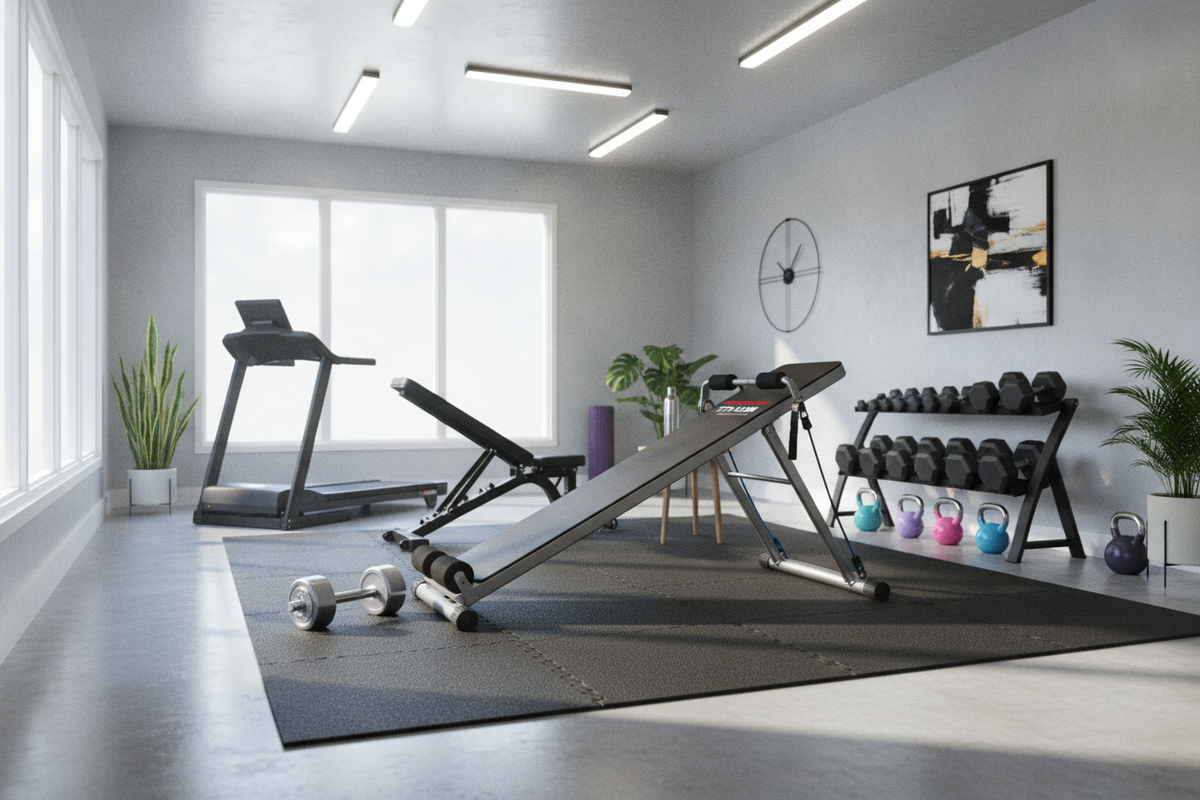
To create a safe workout zone, ensure your training area provides ample clearance around the machine. A fully extended incline unit requires generous floor length plus additional clearance on either side for safe mounting and dismounting. Placing a dense, non-slip mat underneath the entire footprint—such as a dedicated large home gym flooring mat—solves several common training issues:
- Frame Stability: High-density textured rubber keeps the steel feet planted during vigorous squats and single-leg drives.
- Subfloor Protection: Heavy frame contact points can dent laminate or crack ceramic tiles over time under repetitive pressure.
- Noise Dampening: A protective underlay absorbs the mechanical rumble of glideboard rollers moving along the rails.
- Dedicated Multi-Use Space: A wide mat gives you room beside the machine to perform walking lunges, deadlifts, and stretches without stepping onto bare concrete or slippery flooring.
Frequently Asked Questions About Total Gym Leg Workouts
Is 4 exercises enough for a leg day?
Yes. A focused four-exercise routine that hits knee flexion (squats), unilateral balance (single-leg presses), knee extension/hip pull (leg curls), and calf plantarflexion provides comprehensive coverage for the entire lower body. Quality of effort and controlled tempo matter far more than piling on excessive movements.
What is the 3-3-3 rule for gym training?
The 3-3-3 rule is a flexible planning concept often used by home lifters to simplify program design. It typically refers to choosing 3 exercises per workout, performing 3 sets per exercise, and targeting 3 workout sessions per week. Applied to leg day, this could mean alternating between a squat variation, a hamstring curl, and a hip extension three days each week.
How much room do you need for a Total Gym?
An incline trainer generally requires an open floor rectangle roughly eight to ten feet in length and three to four feet in width to allow full glideboard travel and unhindered movement. For additional program planning tips and layout ideas, visit our fitness and workout hub.